
Product Usage: This product is intended solely for use as a research chemical. It is designated exclusively for in vitro research and laboratory testing. All information provided on this site is for educational purposes only. It is strictly prohibited to administer this product to humans or animals. Only licensed and qualified professionals should handle it. This product is not classified as a drug, food, or cosmetic and must not be misrepresented or used as such. This product is for research use only. Not for human consumption.
CJC1295 Without DAC
CJC-1295 (no DAC), also known as Modified GRF (1-29), is a shortened synthetic analogue of growth hormone-releasing hormone (GHRH). Originally developed in the 1980s, this peptide has been extensively studied for its potential to enhance natural growth hormone secretion without altering the body’s hormonal rhythm.
Research suggests that modGRF may support muscle growth and recovery, accelerate wound healing, and enhance bone strength. It has also been associated with increased fat metabolism, improved energy balance, and potential benefits in regulating blood glucose levels. Additionally, CJC-1295 (no DAC) may contribute to immune system support by influencing growth hormone-related pathways.
Overall, modGRF’s profile makes it a promising compound for studying metabolic health, tissue regeneration, and age-related decline.
Price range: $55.00 through $75.00
All Products
- DESCRIPTION
- STORAGE
Modified GRF (1-29) Peptide (CJC-1295 Without DAC)
Modified GRF (1-29), also known as CJC-1295 without DAC, is a synthetic 29–amino acid fragment based on growth hormone–releasing factor (GHRF). It has been engineered with specific substitutions to improve stability and receptor interaction in experimental systems. In laboratory settings, Mod GRF (1-29) is used to explore growth hormone (GH) axis biology, including how pulsatile GH release and downstream IGF-1 signaling are regulated in cell and animal models.
Modified GRF (1-29) Structure
Sequence:
Tyr-D-Ala-Asp-Ala-Ile-Phe-Thr-Gln-Ser-Tyr-Arg-Lys-Val-Leu-Ala-Gln-Leu-Ser-Ala-Arg-Lys-Leu-Leu-Gln-Asp-Ile-Leu-Ser-Arg-NH2
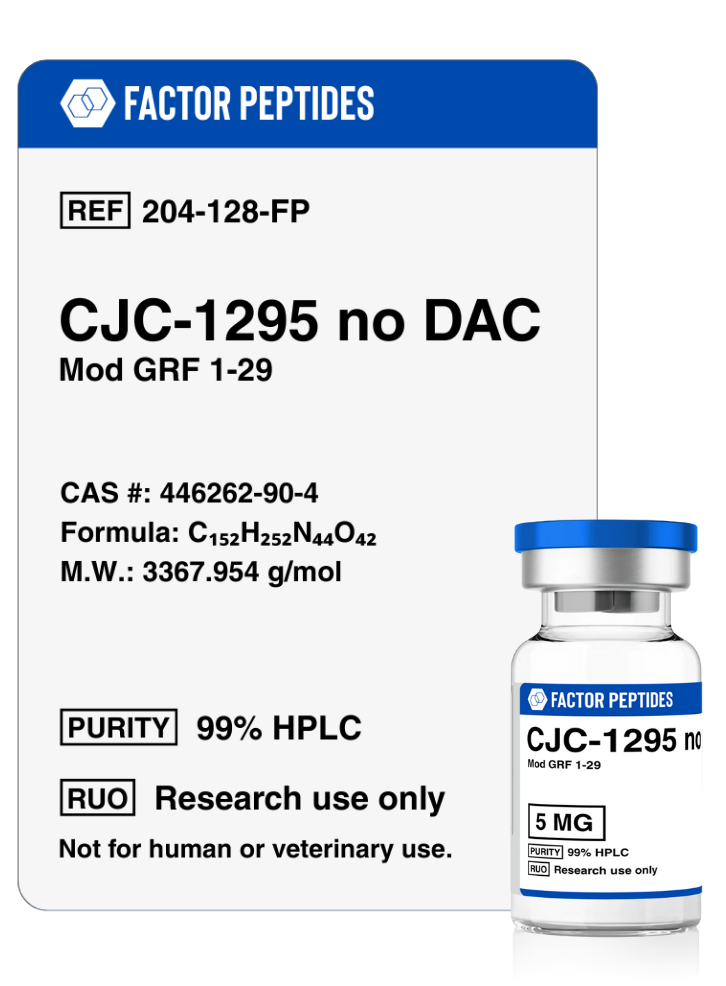
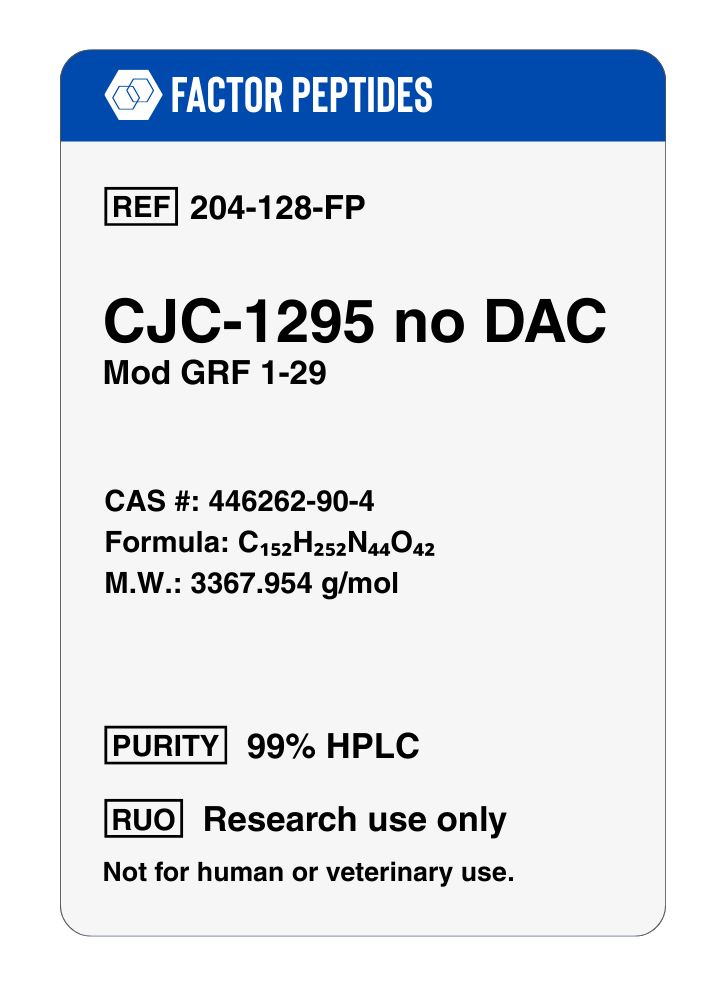
Molecular formula: C152H252N44O42
Molar mass: 3368.7 g/mol
Synonyms: Mod GRF (1-29), CJC-1295 no DAC
By focusing on the first 29 amino acids of native GHRF and incorporating stabilizing substitutions, Modified GRF (1-29) is designed to be more resistant to enzymatic breakdown in vitro, making it a useful research tool for controlled experiments on GH release dynamics and receptor pharmacology.
Research Use Only
ALL ARTICLES AND PRODUCT INFORMATION PROVIDED ON THIS WEBSITE ARE FOR INFORMATONAL AND EDUCATIONAL PURPOSES ONLY.
The products offered on this website are supplied exclusively for in-vitro studies (Latin: “in glass”), carried out outside of living organisms. These materials are not medicines or drugs and have not been evaluated or approved by the FDA to prevent, treat, or cure any disease, condition, or ailment. Any form of administration or bodily introduction into humans or animals is strictly prohibited by law.
Factor Peptides Storage Guidelines:
These peptides arrive in a dried, stabilized form produced by a process called lyophilization, or freeze drying. In this state, they are generally suitable for transport and short-term storage at typical room temperatures for several months.
Once the dry powder is mixed with bacteriostatic water and turned into a liquid solution, the storage requirements change. The reconstituted solution should be kept in a refrigerator to help maintain its properties, and is usually considered suitable for use for about 30 days under chilled conditions.
Lyophilization involves freezing the material and then exposing it to low pressure so that ice in the sample passes directly from solid to vapor, rather than melting. This leaves behind a light, porous, white solid that is more stable than the original liquid. In this form, the product can often be kept at room temperature until it is time to add diluent.
After delivery, it is good practice to protect the vials from heat and strong light. If the product will be used in the near future, storing the lyophilized powder or reconstituted solution in a refrigerator at temperatures below about 4°C (39°F) is typically appropriate. The dry form often remains intact at room temperature for a number of weeks, so this may also be acceptable when immediate refrigeration is not available and the intended use is relatively soon.
For storage over longer periods, such as many months or years, much colder conditions are preferred. Placing the vials in a deep freezer, around -80°C (-112°F), is commonly used to help preserve the structure and activity of peptides for extended time frames.