
Product Usage: This product is intended solely for use as a research chemical. It is designated exclusively for in vitro research and laboratory testing. All information provided on this site is for educational purposes only. It is strictly prohibited to administer this product to humans or animals. Only licensed and qualified professionals should handle it. This product is not classified as a drug, food, or cosmetic and must not be misrepresented or used as such. This product is for research use only. Not for human consumption.
GHRP6
GHRP-6 is a lab-created compound that activates receptors involved in the release of growth hormone and mimics certain actions of ghrelin. In experimental settings, it has been associated with increased food intake, supportive effects on heart muscle cells, influences on how scars develop, and changes in sexual drive. Research in animal models also suggests that this orally active molecule may benefit learning and recall and could play a role in protecting the nervous system from some of the degenerative changes seen in conditions similar to Parkinson’s disease.
Price range: $40.00 through $55.00
Cellular Age Support Peptides
Cellular Growth Research Peptides
Metabolic Activation Peptides
Metabolic Research Peptides
Popular Peptides
Reproductive System Research Peptides
Tissue Integrity Research Peptides
Uncategorized
- DESCRIPTION
- STORAGE
Overview of GHRP-6
GHRP-6 is a synthetic growth hormone releasing peptide that activates receptors in the pituitary and ghrelin system, prompting the body to release its own growth hormone. In laboratory settings it has been associated with support for cardiac muscle, learning and memory processes, tissue repair and scar quality, sexual drive, and dopamine-related neurons often studied in Parkinson’s research. It can be given by oral or sublingual routes and shows a relatively focused interaction profile with its target receptors.
GHRP-6 Structure
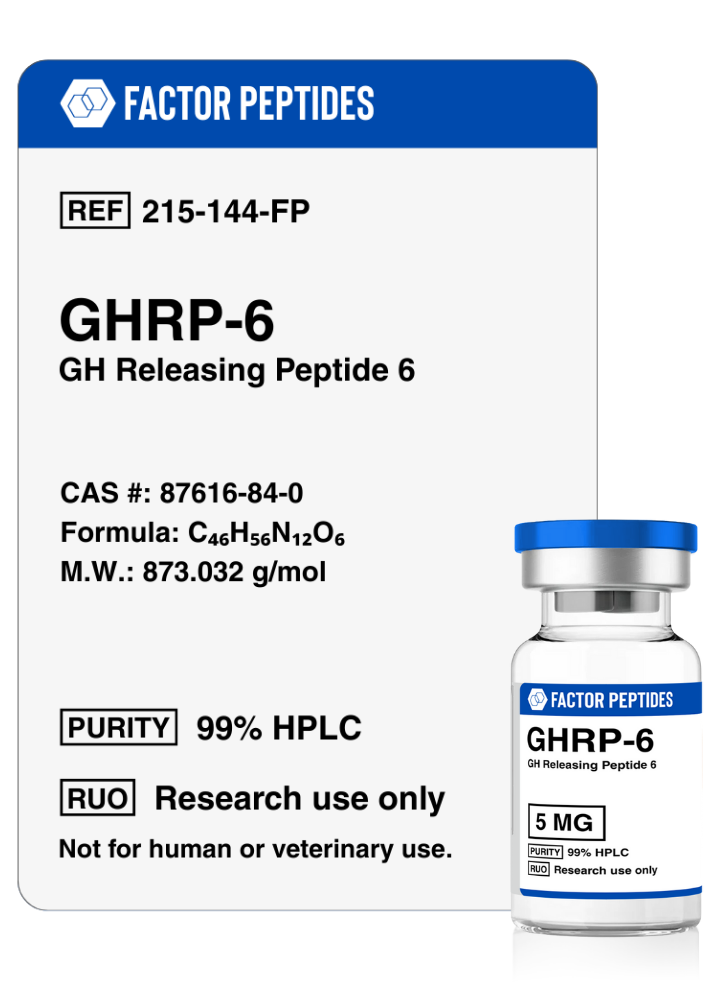
Sequence: His-D-Trp-Ala-Trp-D-Phe-Lys
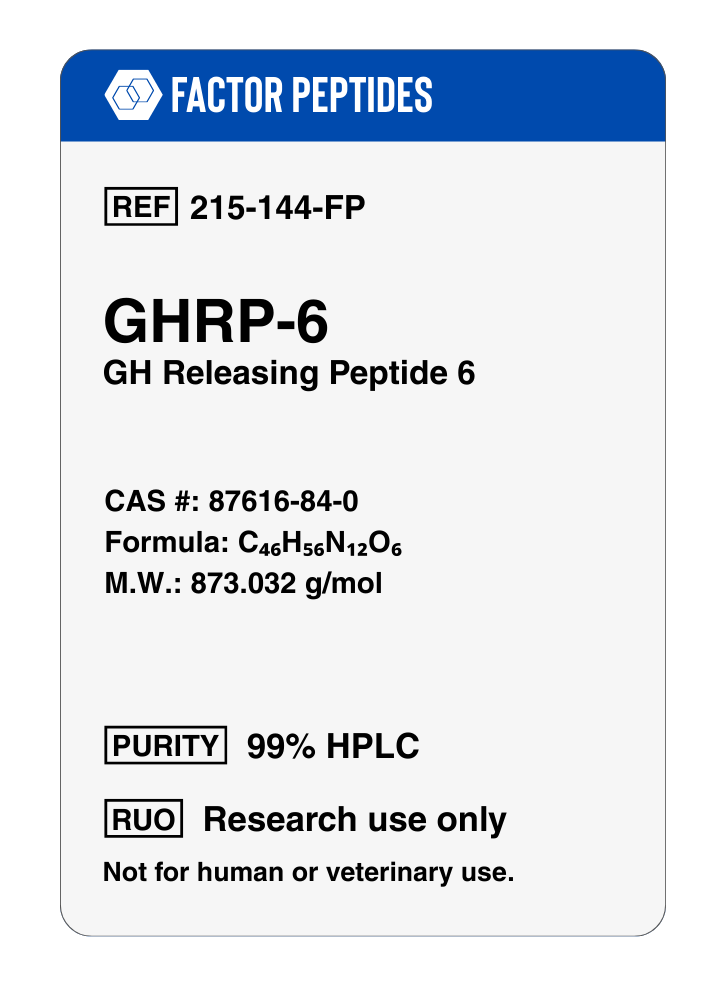
Molecular Formula: C46H56N12O6
Molecular Weight: 873.032 g/mol
PubChem CID: 9919153
CAS Number: 87616-84-0
GHRP-6 Research Highlights
1. Memory and Learning
Work in animal models suggests that activating ghrelin-related pathways with GHRP-6 can enhance how new information is encoded and stabilized in the brain. When signaling through these receptors is intact, short-term memories are more likely to be consolidated into long-term storage, and performance in tasks that require spatial navigation and learning tends to improve. These findings fit with the idea that some of the cognitive benefits attributed to physical exercise may be mediated not just by blood flow, but also by growth hormone secretagogues such as GHRP-6.
2. Protection of Brain Tissue
Experimental stroke models have been used to explore whether GHRP-6 can help the brain cope with reduced blood supply. Results show that the peptide can limit cell loss during acute ischemic events and, when given within a certain time frame, can partially rescue cognitive performance after injury. Its actions appear to involve dampening programmed cell death and moderating inflammatory responses in nervous tissue, thereby preserving neurons that might otherwise be lost.
3. Support for Dopaminergic Neurons
Studies examining regions of the brain affected in Parkinson-like conditions have identified ghrelin receptors on dopamine-producing cells in the substantia nigra. Reduced receptor expression in this area has been linked to motor disturbances resembling Parkinson’s symptoms. Because GHRP-6 is an agonist at these receptors, it is being evaluated as a tool to see whether stimulating this pathway can improve survival of these neurons and slow the development of Parkinsonian features in experimental systems.
4. Wound Healing and Scar Quality
GHRP-6 has been shown to enhance the survival of cells involved in tissue repair and to interact with receptors such as CD36 that are important for new blood vessel formation. In animal wound models, this combination of anti-apoptotic and pro-angiogenic actions speeds closure of skin injuries, encourages more orderly deposition of collagen and other matrix proteins, and leads to smoother, less prominent scars. The peptide has also reduced the formation of thick, raised scars, suggesting a role in moderating abnormal healing responses.
5. Cardiac Protection
In heart attack models, administration of GHRP-6 has reduced the extent of tissue damage by limiting the toxic impact of reactive oxygen species on heart muscle cells. By curbing oxidant-induced injury in areas that are vulnerable but not yet irreversibly damaged, the peptide has the potential to preserve more functional myocardium. This line of research aims to inform development of treatments that could be given after an ischemic event to improve long-term cardiac outcomes.
6. Sexual Behavior, Motivation, and Mood
Ghrelin-sensitive circuits in the brain participate in reward and motivational processes, including sexual behavior. Experiments in male animals indicate that stimulation of central ghrelin receptors with GHRP-6 can increase sexual motivation and modulate how reward-related behaviors are expressed. In parallel, work in stress models suggests that agonists at these receptors may exert antidepressant-like effects, supporting hippocampal function and reducing signs of low mood. These observations have prompted interest in GHRP-6 as a research tool for exploring new approaches to disorders of desire, appetite, stress, and affect.
In preclinical studies, GHRP-6 has shown minimal to moderate reported side effects, limited usefulness by oral route, and strong effectiveness when administered subcutaneously in animals. Dosing used in these models is specific to experimental conditions and does not translate directly to people. At present, GHRP-6 is intended solely for controlled scientific and educational research and is not approved for human consumption or unsupervised use.
Factor Peptides Storage Guidelines:
These peptides arrive in a dried, stabilized form produced by a process called lyophilization, or freeze drying. In this state, they are generally suitable for transport and short-term storage at typical room temperatures for several months.
Once the dry powder is mixed with bacteriostatic water and turned into a liquid solution, the storage requirements change. The reconstituted solution should be kept in a refrigerator to help maintain its properties, and is usually considered suitable for use for about 30 days under chilled conditions.
Lyophilization involves freezing the material and then exposing it to low pressure so that ice in the sample passes directly from solid to vapor, rather than melting. This leaves behind a light, porous, white solid that is more stable than the original liquid. In this form, the product can often be kept at room temperature until it is time to add diluent.
After delivery, it is good practice to protect the vials from heat and strong light. If the product will be used in the near future, storing the lyophilized powder or reconstituted solution in a refrigerator at temperatures below about 4°C (39°F) is typically appropriate. The dry form often remains intact at room temperature for a number of weeks, so this may also be acceptable when immediate refrigeration is not available and the intended use is relatively soon.
For storage over longer periods, such as many months or years, much colder conditions are preferred. Placing the vials in a deep freezer, around -80°C (-112°F), is commonly used to help preserve the structure and activity of peptides for extended time frames.