
Product Usage: This product is intended solely for use as a research chemical. It is designated exclusively for in vitro research and laboratory testing. All information provided on this site is for educational purposes only. It is strictly prohibited to administer this product to humans or animals. Only licensed and qualified professionals should handle it. This product is not classified as a drug, food, or cosmetic and must not be misrepresented or used as such. This product is for research use only. Not for human consumption.
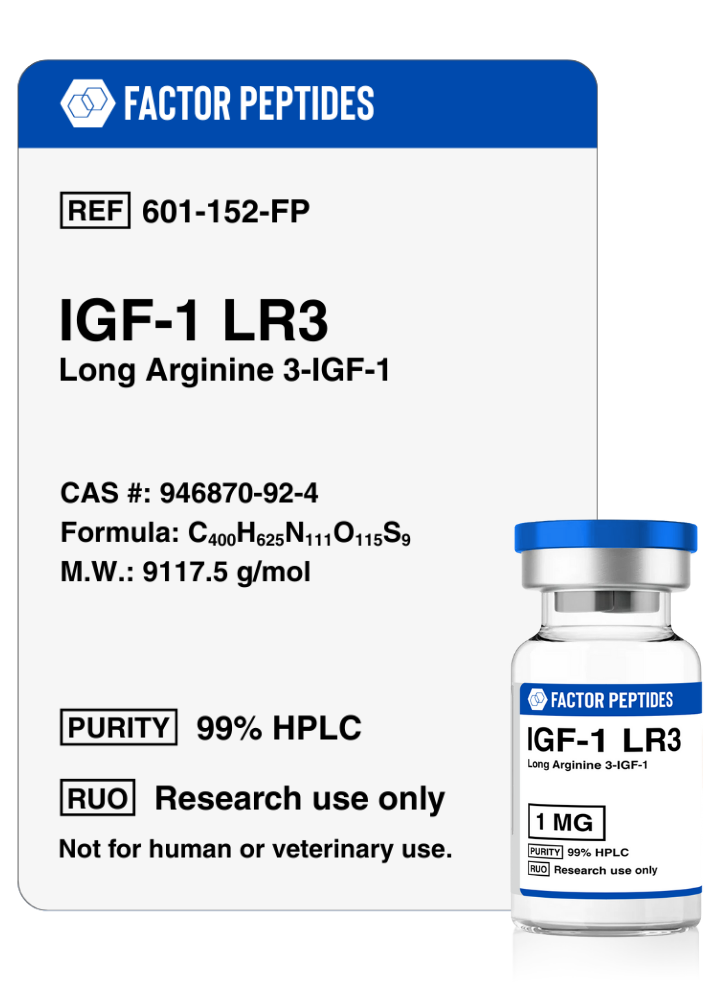
IGF-1 LR3 1 mg
IGF-1 LR3 is a laboratory-engineered version of insulin-like growth factor-1 that has been altered so it interacts less efficiently with the usual binding proteins that limit IGF-1 activity. Because of this reduced binding, it stays active in the body far longer than the standard form, giving it an extended half-life and more prolonged biological effects. In research settings, IGF-1 LR3 has been linked to increased cell growth and division, support for muscle repair and enlargement through the modulation of myostatin, and a greater use of fat as an energy source. Emerging studies also indicate that it may have a role in supporting milk production in nursing mothers.
$85.00
All Products
- DESCRIPTION
- STORAGE
What is IGF1-LR3?
IGF1-LR3 is an extended and re-engineered form of insulin-like growth factor-1 that has been altered to stay active in the body far longer than the naturally occurring hormone. It belongs to the IGF family of peptides that coordinate growth, cell replication, and communication between tissues. Compared with standard IGF-1, this version binds weakly to the usual carrier proteins in the blood, so it is cleared much more slowly and can signal cells for an extended period. The longer activity is achieved by adding a stretch of extra amino acids to the N-terminal end of the original molecule and by replacing the third amino acid with arginine, which together produce a substantially prolonged half-life.
IGF1-LR3 Structure
Sequence: MFPAMPLSSL FVNGPRTLCG AELVDALQFV CGDRGFYFNK PTGYGSSSRR APQTGIVDEC CFRSCDLRRL EMYCAPLKPA KSA
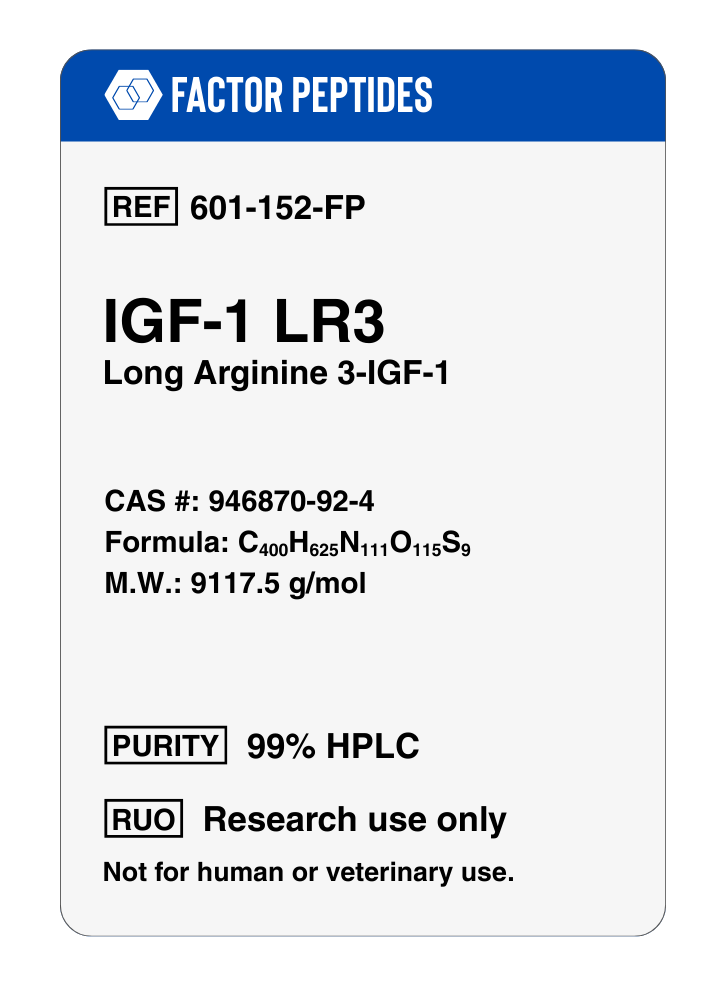
Molecular Formula: C400H625N111O115S9
Molecular Weight: 9117.5 g/mol
CAS Number: 946870-92-4
IGF1-LR3 Research
Role in Cellular Growth
IGF1-LR3 is a strong promoter of both cell multiplication and maturation, acting on many tissues including skeletal muscle, bone, liver, skin, lung, kidney, blood cells, and the nervous system. It can be viewed as a coordination signal that encourages young cells to divide and then progress toward their fully specialized roles. Because this variant remains in circulation much longer than unmodified IGF-1, the same nominal amount of peptide produces a much greater overall period of receptor activation. In experimental models, its activity is associated mainly with an increase in cell number within a tissue (hyperplasia) rather than simple enlargement of existing cells, which is particularly relevant for research on muscle and connective tissue development.
Influence on Glucose and Fat Use
IGF1-LR3 interacts with both IGF receptors and insulin receptors, which gives it a pronounced effect on how cells handle blood sugar and stored fats. By encouraging glucose transport from the bloodstream into muscle, liver, and nerve cells, it lowers circulating glucose levels and shifts the body toward using internal energy reserves. As blood sugar falls, fat cells and the liver respond by releasing stored fuels through the breakdown of glycogen and triglycerides, leading to greater energy expenditure and a reduction in fat stores under experimental conditions.
Because it improves cellular uptake of glucose, IGF1-LR3 can reduce the amount of insulin required to maintain a given level of blood sugar in research models. This insulin-sparing effect has prompted interest in how IGF-related pathways might be leveraged to better understand insulin resistance and the progression of metabolic disorders.
Interaction with Myostatin
Myostatin is a regulatory protein that limits muscle growth and helps ensure that repair and enlargement do not proceed unchecked. While this control is important for balance, excessive myostatin activity contributes to muscle wasting in a number of settings. IGF1-LR3 has been shown in animal and cell studies to counter some of myostatin’s actions, supporting muscle cell survival and reducing programmed cell death in stressed or diseased muscle tissue.
In models of severe muscle loss, IGF1-LR3 activates key muscle regulatory factors such as MyoD, which are normally turned on by resistance exercise or tissue damage. Through this pathway, the peptide supports the formation of new muscle fibers and protects existing ones, making it a valuable research tool for exploring strategies to preserve muscle mass during immobilization or in inherited muscle disorders.
IGF1-LR3 in Aging Studies
Because IGF signaling is deeply involved in tissue repair, maintenance, and adaptation, IGF1-LR3 has become a focus of research into healthy aging and functional decline. Studies in large and small animal models are examining whether carefully controlled IGF1-LR3 exposure can help maintain organ function, preserve muscle, and support cognitive performance as organisms grow older. Findings from this work build on earlier evidence that balanced growth hormone and IGF pathways can influence both lifespan and the quality of life during later years, particularly by moderating the accumulation of cellular damage.
Connections to Glucocorticoid Use
Glucocorticoid medications are widely used to control inflammation and immune activity, yet long-term treatment often causes muscle loss, fat gain, and weakened bones. IGF1-LR3 is being investigated as a way to offset some of these catabolic effects in experimental systems. By promoting protein synthesis and survival in muscle and bone cells, it may help dampen tissue breakdown associated with prolonged glucocorticoid exposure and support better structural integrity while anti-inflammatory therapy is ongoing.
In animal studies, IGF1-LR3 has shown minimal to moderate reported adverse effects, poor effectiveness when given orally, and strong activity following subcutaneous administration. Research protocols use species- and context-specific dosing that cannot be directly converted to human use. At present, IGF1-LR3 is intended solely for controlled laboratory and educational investigations and is not approved for human consumption or unsupervised application.
Factor Peptides Storage Guidelines:
These peptides arrive in a dried, stabilized form produced by a process called lyophilization, or freeze drying. In this state, they are generally suitable for transport and short-term storage at typical room temperatures for several months.
Once the dry powder is mixed with bacteriostatic water and turned into a liquid solution, the storage requirements change. The reconstituted solution should be kept in a refrigerator to help maintain its properties, and is usually considered suitable for use for about 30 days under chilled conditions.
Lyophilization involves freezing the material and then exposing it to low pressure so that ice in the sample passes directly from solid to vapor, rather than melting. This leaves behind a light, porous, white solid that is more stable than the original liquid. In this form, the product can often be kept at room temperature until it is time to add diluent.
After delivery, it is good practice to protect the vials from heat and strong light. If the product will be used in the near future, storing the lyophilized powder or reconstituted solution in a refrigerator at temperatures below about 4°C (39°F) is typically appropriate. The dry form often remains intact at room temperature for a number of weeks, so this may also be acceptable when immediate refrigeration is not available and the intended use is relatively soon.
For storage over longer periods, such as many months or years, much colder conditions are preferred. Placing the vials in a deep freezer, around -80°C (-112°F), is commonly used to help preserve the structure and activity of peptides for extended time frames.