
Product Usage: This product is intended solely for use as a research chemical. It is designated exclusively for in vitro research and laboratory testing. All information provided on this site is for educational purposes only. It is strictly prohibited to administer this product to humans or animals. Only licensed and qualified professionals should handle it. This product is not classified as a drug, food, or cosmetic and must not be misrepresented or used as such. This product is for research use only. Not for human consumption.
LL37 5 mg
LL-37 is a multifunctional peptide belonging to the cathelicidin family, recognized for its potent antimicrobial properties. It exhibits broad-spectrum activity against bacteria, viruses, and fungi, making it a key player in innate immune defense.
In addition to its pathogen-fighting abilities, LL-37 has demonstrated significant anti-inflammatory effects and plays a role in modulating the immune response. Research has shown that LL-37 may also support angiogenesis—the formation of new blood vessels—under certain physiological conditions. Furthermore, studies suggest potential anti-cancer properties, with LL-37 displaying the ability to inhibit tumor growth in specific cancer models. These combined effects make LL-37 a valuable peptide in ongoing research targeting infections, inflammation, wound healing, and cancer biology.
$90.00
Cellular Age Support Peptides
Cellular Growth Research Peptides
Metabolic Activation Peptides
Metabolic Research Peptides
Popular Peptides
Reproductive System Research Peptides
Tissue Integrity Research Peptides
Uncategorized
- DESCRIPTION
- STORAGE
What Is LL-37 (CAP-18)?
LL-37 is the only known human cathelicidin and a member of a large family of antimicrobial peptides (AMPs). These peptides are primarily produced by macrophages and polymorphonuclear leukocytes where they contribute to first line defense against pathogens. Beyond direct antimicrobial activity, LL-37 has been implicated in autoimmune disease, cancer biology, wound repair, and tissue homeostasis.
LL-37 participates in innate immune responses and in shaping downstream inflammatory signaling. Its actions are context dependent and can vary according to the cellular environment and the activation state of local immune cells, making it a key focus in research on immune regulation and chronic inflammatory conditions.
LL-37 Structure
-
Sequence:
Leu Leu Gly Asp Phe Phe Arg Lys Ser Lys Glu Lys Ile Gly Lys Glu Phe Lys Arg Ile Val Gln Arg Ile Lys Asp
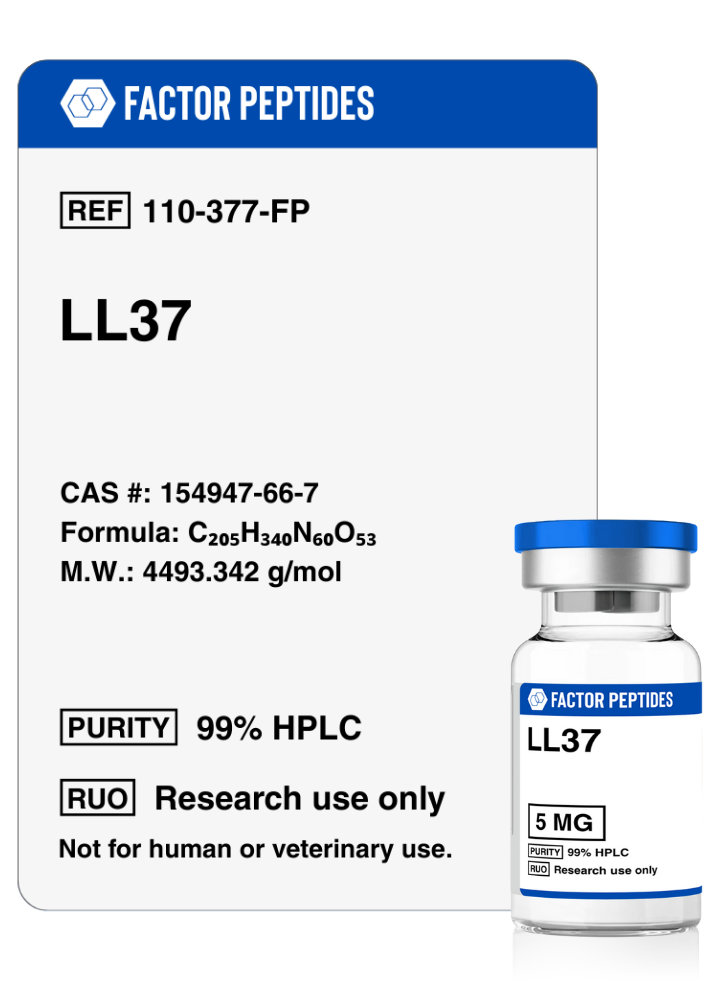
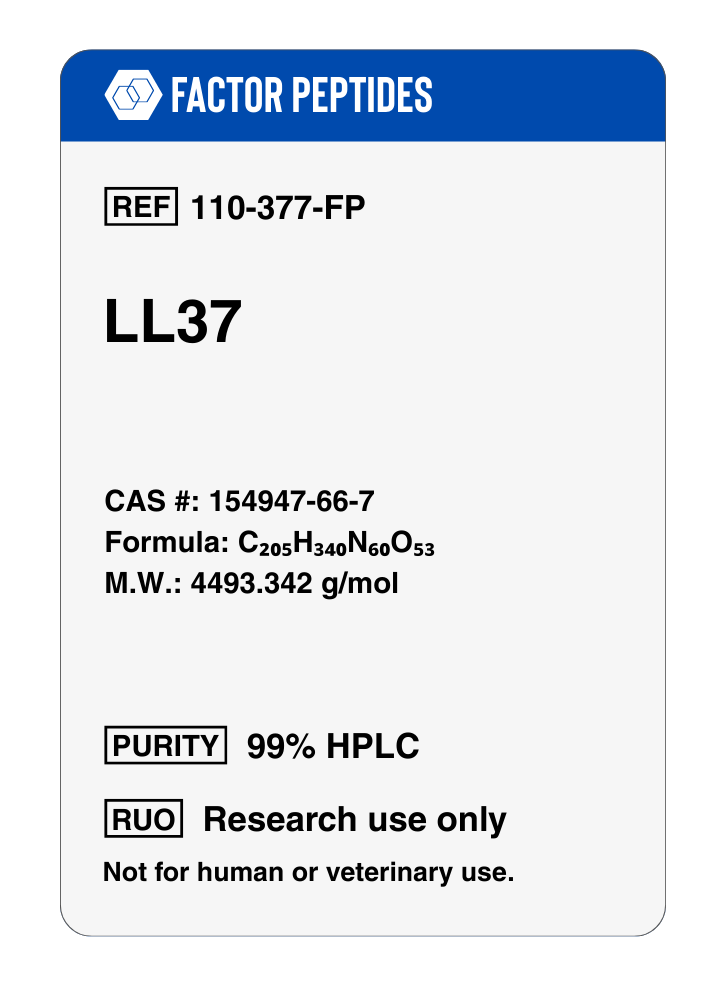
Phe Leu Arg Asn Leu Val Pro Arg Thr Glu Ser - Molecular Formula: C205H340N60O53
- Molecular Weight: 4493.342 g/mol
- PubChem CID: 16198951
- CAS Number: 154947 66 7
- Synonyms: CAP 18, cathelicidin, antibacterial peptide LL 37
Structure
Source: PubChem
Immune and Inflammatory Modulation
LL-37 is involved in a number of inflammatory and autoimmune conditions including psoriasis, lupus, rheumatoid arthritis, and therosclerosis. Depending on the local milieu and activation status of immune cells, LL-37 can exert both pro and anti inflammatory effects. Reported actions include:
- Decreasing keratinocyte apoptosis
- Increasing IFN alpha production
- Altering chemotaxis of neutrophils and eosinophils
- Down regulating signaling through toll like receptor 4 (TLR4)
- Increasing IL 18 production
- Decreasing atherosclerotic plaque burden in experimental models
In vitro data indicate that the inflammatory environment shapes how immune cells respond to LL-37. For example, T cells may increase inflammatory actions when not activated, but reduce inflammatory output once activated in the presence of LL-37. These bidirectional effects suggest that LL-37 helps maintain immune homeostasis and prevents overshooting inflammatory responses.
Earlier work proposed that LL-37 might drive autoimmune inflammation. More recent interpretations suggest that elevated LL-37 levels in autoimmune disease may instead reflect a compensatory response that limits more severe inflammation rather than causing it.
LL-37 as an Antimicrobial Peptide
As part of the innate immune system, LL-37 is rapidly induced during infection. In healthy skin, basal levels of LL-37 are low, but rise quickly following pathogen exposure. LL-37 often works together with other AMPs such as human beta defensin 2 to control microbial growth in barrier tissues.
LL-37 shows strong activity against gram negative bacteria by binding to bacterial lipopolysaccharide (LPS), a critical component of the outer membrane. Disruption of LPS compromises membrane integrity and is lethal to many gram negative organisms. There is active interest in exploring LL-37 as an exogenous antimicrobial for severe bacterial infections.
LL-37 also exhibits activity against gram positive bacteria. In vitro studies indicate that it enhances the activity of lysozyme, an enzyme that targets gram positive organisms such as Staphylococcus aureus. These combined properties position LL-37 as a broad spectrum antimicrobial and a valuable research tool in host pathogen interaction studies.
LL-37 and Lung Disease
Airborne LPS and related molecules can reach the lower airways when environments are contaminated by fungi or bacteria. Normal lung tissue responds by producing LL-37, but endogenous production may be insufficient to fully prevent toxic dust syndrome or contribute to optimal outcomes in asthma, COPD, and other respiratory conditions.
Experimental work suggests that LL-37:
- Promotes airway epithelial cell proliferation
- Enhances epithelial cell migration and wound closure
- Supports neovascularization to nourish newly formed tissue
These observations point to LL-37 as a homeostatic regulator in the airways, where it may help coordinate both antimicrobial defense and tissue repair. Inhaled LL-37 formulations are under investigation as potential interventions for toxic dust related lung injury and other airway pathologies.
LL-37 in Joint, Intestinal, and Cancer Research
Rheumatoid Arthritis and Joint Inflammation
High concentrations of LL-37 have been detected in joints affected by rheumatoid arthritis and other inflammatory arthritides. Current evidence suggests that:
- LL-37 deficiency does not significantly alter arthritis or lupus outcomes in animal models
- Over expression of LL-37 in inflamed joints is likely a secondary phenomenon rather than a primary cause
- Peptides derived from LL-37 can protect collagen and reduce disease severity in experimental arthritis
LL-37 and its derivatives have been shown to modulate interleukin 32 driven inflammation, a pathway strongly linked to arthritis severity. The peptide may also interact with toll like receptor pathways in synovial fibroblasts and macrophages in ways that favor resolution of inflammation.
LL-37 and Intestinal Barrier Function
In the intestine, LL-37 enhances migration of epithelial cells that maintain mucosal integrity and reduces apoptosis in the setting of inflammation. Cell culture studies suggest that LL-37 may:
- Support epithelial barrier repair after injury or surgery
- Slow the progression of inflammatory bowel conditions
- Serve as an adjuvant to antibiotic therapy by protecting the mucosa
LL-37 pairs with human beta defensin 2 to preserve intestinal epithelium and reduce TNF related cell death. This raises the possibility that LL-37 based approaches could decrease reliance on systemic TNF alpha inhibitors in inflammatory bowel disease and related disorders.
Intestinal and Gastric Cancer
LL-37 has produced mixed findings in oncology, but appears to be beneficial in the setting of certain gastrointestinal and oral cancers. In tumor associated macrophages, vitamin D can induce LL-37 expression, which in turn contributes to anti cancer activity. This pathway may help explain epidemiologic links between vitamin D status and reduced gastrointestinal cancer risk.
LL-37 and Blood Vessel Growth
LL-37 stimulates the synthesis of prostaglandin E2 (PGE2) in endothelial cells. PGE2 has recognized roles in inflammatory pain and in the promotion of blood vessel growth. In vascular endothelium, PGE2 signaling helps drive angiogenesis.
Depending on context, LL-37 driven angiogenesis can be:
- Beneficial, as in wound healing or in ischemic cardiovascular disease where additional blood supply is needed
- Potentially detrimental, as in certain cancers where angiogenesis supports tumor growth and spread
Because of these dual implications, LL-37 is an attractive model for dissecting angiogenic pathways and for designing future interventions that can either promote or inhibit new vessel formation as needed.
Structural differences between LL-37 in humans and cathelicidins in other mammals highlight how small sequence changes alter three dimensional conformation and receptor interactions. This feature further increases the value of LL-37 as a tool for structure function studies in peptide biology.
LL-37 Summary
LL-37 is the sole human cathelicidin and a multifunctional antimicrobial peptide with roles that extend far beyond direct pathogen killing. It participates in innate and adaptive immune modulation, maintains barrier integrity in the skin, lungs, and intestine, supports tissue repair, and influences angiogenesis and tumor biology.
Current research applications include:
- Innate immunity, antimicrobial defense, and host pathogen interactions
- Autoimmune and chronic inflammatory disease models
- Respiratory injury, toxic dust exposure, and airway remodeling
- Arthritis, intestinal inflammation, and mucosal healing
- Cancer biology, especially in gastrointestinal and oral tissues
- Angiogenesis and vascular remodeling research
Ongoing work is clarifying when LL-37 acts primarily as an antimicrobial, when it functions as an immune homeostat, and how its structure can be adapted to create new therapeutic tools.
LL-37 exhibits minimal to moderate side effects, low oral and excellent subcutaneous bioavailability in mice. Per kilogram dosages in mice do not scale to humans.
FOR RESEARCH USE ONLY
All articles and product information provided on this website are for informational and educational purposes only.
The products offered on this website are furnished for in vitro studies only. In vitro studies (Latin “in glass”) are performed outside of living organisms. These products are not medicines or drugs and have not been approved by the FDA to prevent, treat, or cure any medical condition, ailment, or disease. Any form of bodily introduction into humans or animals is strictly prohibited by law.
LL 37 for sale at Peptide Sciences is limited to educational and scientific research only, not for human consumption. Only buy LL 37 if you are a properly licensed and qualified researcher.
Factor Peptides Storage Guidelines:
These peptides arrive in a dried, stabilized form produced by a process called lyophilization, or freeze drying. In this state, they are generally suitable for transport and short-term storage at typical room temperatures for several months.
Once the dry powder is mixed with bacteriostatic water and turned into a liquid solution, the storage requirements change. The reconstituted solution should be kept in a refrigerator to help maintain its properties, and is usually considered suitable for use for about 30 days under chilled conditions.
Lyophilization involves freezing the material and then exposing it to low pressure so that ice in the sample passes directly from solid to vapor, rather than melting. This leaves behind a light, porous, white solid that is more stable than the original liquid. In this form, the product can often be kept at room temperature until it is time to add diluent.
After delivery, it is good practice to protect the vials from heat and strong light. If the product will be used in the near future, storing the lyophilized powder or reconstituted solution in a refrigerator at temperatures below about 4°C (39°F) is typically appropriate. The dry form often remains intact at room temperature for a number of weeks, so this may also be acceptable when immediate refrigeration is not available and the intended use is relatively soon.
For storage over longer periods, such as many months or years, much colder conditions are preferred. Placing the vials in a deep freezer, around -80°C (-112°F), is commonly used to help preserve the structure and activity of peptides for extended time frames.