
Product Usage: This product is intended solely for use as a research chemical. It is designated exclusively for in vitro research and laboratory testing. All information provided on this site is for educational purposes only. It is strictly prohibited to administer this product to humans or animals. Only licensed and qualified professionals should handle it. This product is not classified as a drug, food, or cosmetic and must not be misrepresented or used as such. This product is for research use only. Not for human consumption.
PT-141 10 mg
PT-141 is a synthetic peptide derived from a hormone involved in pigment and other regulatory functions, designed with multiple structural changes to alter its activity and stability. It has been evaluated in clinical settings for its potential to address low sexual desire in both men and women, as well as for use in certain acute bleeding situations. Functioning as an agonist at specific melanocortin receptors, it has been observed in research environments to enhance sexual responsiveness and to influence components of immune activity.
$75.00
All Products
- DESCRIPTION
- STORAGE
What Is PT-141?
PT-141, also known as bremelanotide, is a melanocortin peptide that was extensively studied in mid-stage clinical trials for its potential to address low sexual desire, particularly in women. It primarily activates melanocortin 4 and melanocortin 1 receptors in the body. PT-141 is structurally related to another synthetic melanocortin, melanotan 2, and has also been explored in other medical settings beyond sexual health.
PT-141 Molecular Structure
Sequence: Ac-Nle-Asp(1)-His-D-Phe-Arg-Trp-Lys(1)
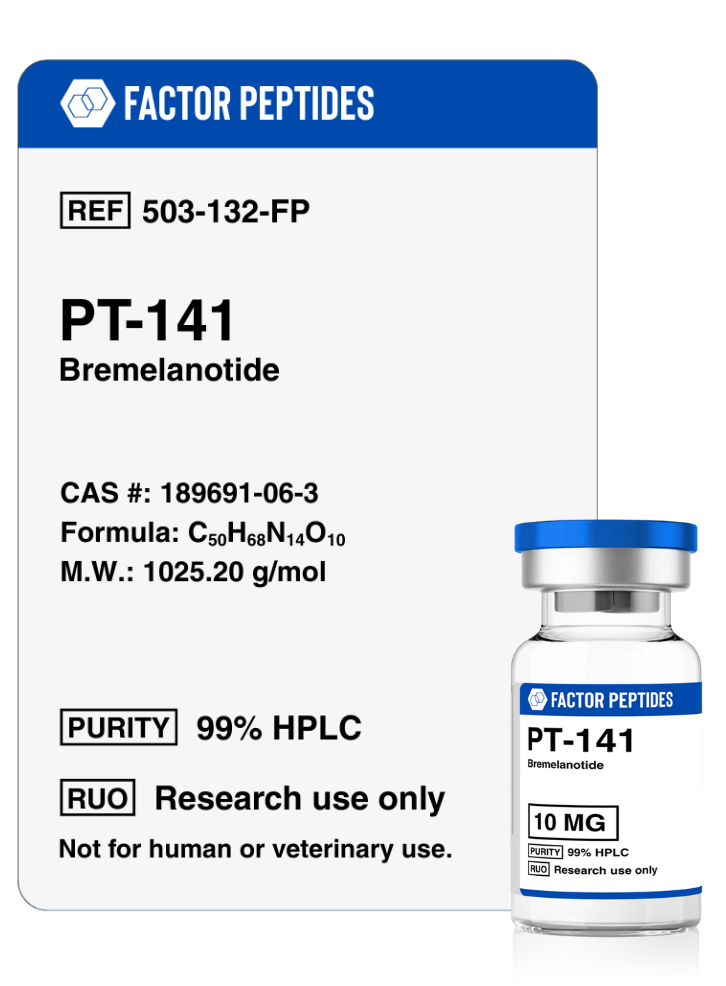
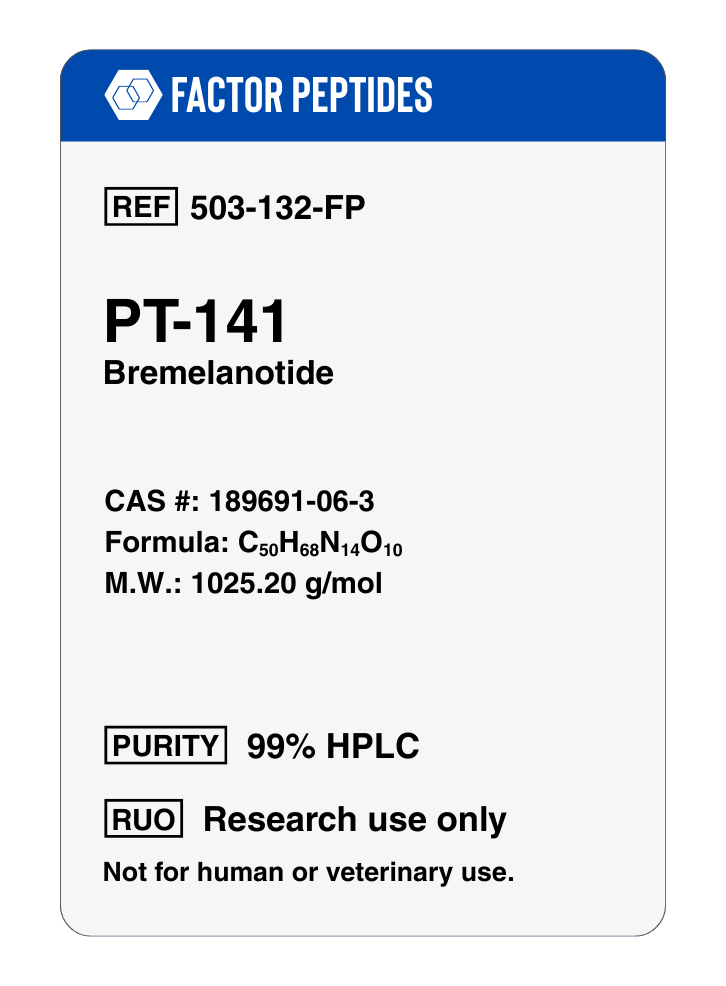
Molecular Formula: C50H68N14O10
Molecular Weight: 1025.182 g/mol
PT-141 Research
PT-141 and Sexual Arousal
PT-141 is notable because it acts directly on melanocortin 4 receptors in the central nervous system, a pathway closely linked to sexual arousal and behavior. In animal studies, activating this receptor increases sexual activity in both males and females. Unlike medications that work mainly by improving blood flow to the genital area, PT-141 targets central pathways, which means it may help address sexual desire problems that are not caused by circulatory issues alone.
In human research involving men with erectile dysfunction who did not respond to conventional blood-flow–based treatments, a significant portion achieved erections suitable for intercourse when given PT-141 as a nasal spray, with clear dose-dependent effects. These findings suggest that PT-141 can be helpful in cases where traditional therapies fail and may provide clues about how to address centrally driven sexual desire disorders.
Early trials in women with low sexual desire showed improvements in the number of satisfying sexual events and reductions in distress related to sexual function, without major safety concerns. Despite this, development was paused for a time, which many clinicians in the field of sexual medicine attributed to the lack of clear regulatory guidelines for measuring outcomes in female sexual dysfunction and to broader social attitudes around women’s sexual health. This led to a push for better-defined endpoints and more comprehensive treatment approaches that combine pharmacological tools like PT-141 with psychological and behavioral therapies.
Renewed interest later led to new studies using subcutaneous injections of PT-141 in women, with updated trial designs and outcome measures. A newer formulation has been developed in this context, and investigative work has focused on refining dosing, assessing long-term safety, and evaluating its role in broader sexual dysfunction treatment strategies for both men and women.
PT-141 and Hemorrhage
A modified form of PT-141 has also been tested as a possible treatment for hemorrhagic shock, a condition in which severe blood loss leads to critically low blood pressure and poor tissue perfusion. Because PT-141 engages both melanocortin 1 and melanocortin 4 receptors, it appears to help protect tissues from damage during periods of insufficient blood flow. In experimental models, intravenous administration of a related compound, often referred to by a different development code, improved outcomes without causing significant adverse reactions, supporting further exploration in this area.
PT-141 and Infection
Melanocortin 1 receptors have been shown in animal models to contribute to defenses against certain fungal infections by combining anti-inflammatory and direct antimicrobial actions. This is an appealing property because many current antifungal medications share similar mechanisms and can cause serious side effects. PT-141 and related melanocortin agonists may provide an alternative way to manage difficult fungal infections, especially in individuals with weakened immune systems, by modulating both immune response and local tissue protection.
PT-141 and Cancer
Activation of melanocortin 1 receptors is also involved in pathways that enhance DNA repair and limit damage from environmental stressors, including ultraviolet radiation. Variations in these receptors are associated with a higher risk of certain skin cancers, such as basal cell and squamous cell carcinoma. Modified PT-141–like molecules that can optimize melanocortin 1 signaling may help correct some of these vulnerabilities, offering a potential route to new preventive or therapeutic strategies in oncology.
Research Directions
While PT-141 has drawn the most attention for its role in treating sexual dysfunction, its range of possible applications is much broader. Defects in melanocortin 4 receptor signaling are implicated in a notable fraction of early-onset obesity cases, and PT-141 provides a valuable tool for probing this pathway and exploring targeted interventions. Melanocortin 1 receptors, meanwhile, are involved in inflammation, pain perception, kidney function, and host defense against infection. By acting on these receptors, PT-141 can help researchers better understand these systems and may point toward future therapies in multiple disease areas.
In preclinical work, PT-141 has generally shown a favorable safety profile, with limited side effects and low oral but strong subcutaneous bioavailability in animal models. However, dose levels used in small animals cannot be directly applied to humans. At present, PT-141 is intended strictly for controlled laboratory and educational research and is not approved for human consumption or clinical use.
Factor Peptides Storage Guidelines:
These peptides arrive in a dried, stabilized form produced by a process called lyophilization, or freeze drying. In this state, they are generally suitable for transport and short-term storage at typical room temperatures for several months.
Once the dry powder is mixed with bacteriostatic water and turned into a liquid solution, the storage requirements change. The reconstituted solution should be kept in a refrigerator to help maintain its properties, and is usually considered suitable for use for about 30 days under chilled conditions.
Lyophilization involves freezing the material and then exposing it to low pressure so that ice in the sample passes directly from solid to vapor, rather than melting. This leaves behind a light, porous, white solid that is more stable than the original liquid. In this form, the product can often be kept at room temperature until it is time to add diluent.
After delivery, it is good practice to protect the vials from heat and strong light. If the product will be used in the near future, storing the lyophilized powder or reconstituted solution in a refrigerator at temperatures below about 4°C (39°F) is typically appropriate. The dry form often remains intact at room temperature for a number of weeks, so this may also be acceptable when immediate refrigeration is not available and the intended use is relatively soon.
For storage over longer periods, such as many months or years, much colder conditions are preferred. Placing the vials in a deep freezer, around -80°C (-112°F), is commonly used to help preserve the structure and activity of peptides for extended time frames.