
Product Usage: This product is intended solely for use as a research chemical. It is designated exclusively for in vitro research and laboratory testing. All information provided on this site is for educational purposes only. It is strictly prohibited to administer this product to humans or animals. Only licensed and qualified professionals should handle it. This product is not classified as a drug, food, or cosmetic and must not be misrepresented or used as such. This product is for research use only. Not for human consumption.
VIP
VIP, studies indicate that this peptide can lessen inflammatory activity throughout the body, with particular interest in conditions such as degenerative brain disorders, scarring of lung tissue, chronic inflammation in the digestive tract, and fibrotic changes affecting the heart. It seems to act on several pathways related to tissue scarring, suggesting potential value in addressing the widespread fibrotic processes that contribute significantly to illness and early death.
Beyond its influence on fibrosis, thought to arise largely from its anti-inflammatory actions, this peptide also serves as a powerful regulator of immune responses and a broad-acting inflammation modulator. Experimental work further suggests that it can help shield the central nervous system from damage and may support the preservation of thinking and memory abilities in the context of progressive neurological conditions.
Price range: $55.00 through $75.00
All Products
- DESCRIPTION
- STORAGE
Vasoactive Intestinal Peptide (VIP)
Vasoactive intestinal peptide (VIP, also called vasoactive intestinal polypeptide or PHM27) is a short regulatory peptide produced primarily in the gut, pancreas, and brain of many vertebrate species, including humans. VIP signals through class II G protein-coupled receptors and has broad effects on metabolism, circulation, smooth muscle tone, and neuroimmune function.
Experimental work indicates that VIP can:
- promote glycogen breakdown in liver and skeletal muscle,
- lower systemic blood pressure via vasodilation,
- relax smooth muscle throughout the gastrointestinal tract,
- increase heart rate and enhance the force of cardiac contraction,
- stimulate fluid and electrolyte secretion in the GI tract,
- influence sexual function, including vaginal lubrication,
- modulate prolactin release,
- support cartilage integrity,
- protect neurons from ischemic and oxidative stress,
- affect autonomic nerve signaling, and
- help synchronize circadian rhythms by acting on neurons of the suprachiasmatic nucleus in response to light cues.
Because of this wide activity profile, VIP has been the focus of extensive basic and translational research. A major theme emerging from this work is that VIP and its analogues can reduce inflammation and limit fibrotic remodeling in multiple organ systems.
VIP Peptide Structure
Amino Acid Sequence: HSDAVFTDNYXRLRKQMAVKKYLNSXLN
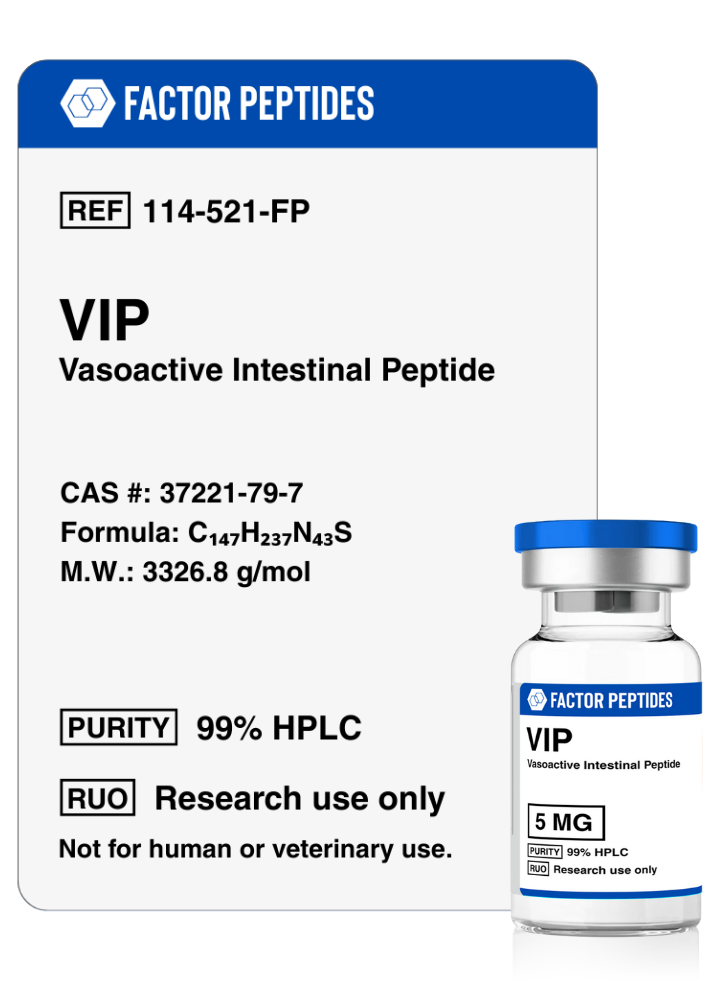
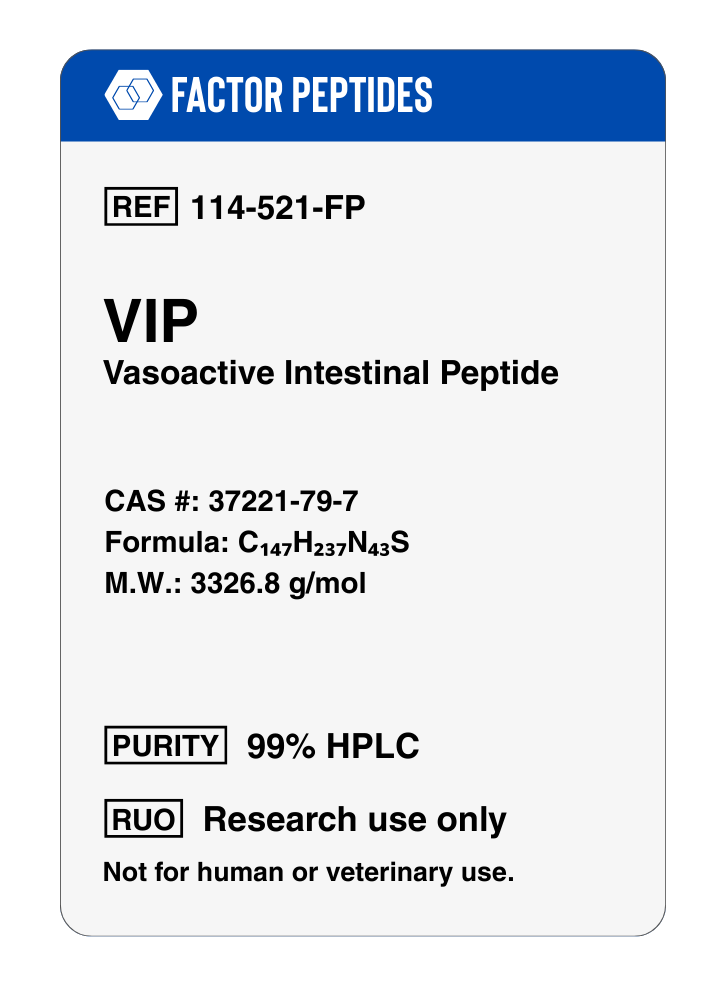
Molecular Formula: C147H237N43O43S
Human Gene: VIP; 6q25.2
PubChem CID: 44567960
CAS Number: 37221-79-7
Synonyms: VIP, PHM27, vasoactive intestinal polypeptide
VIP Research
Bowel Inflammation
VIP is produced not only by neurons in the central and peripheral nervous systems and the heart, but also by various immune cells. Within the immune system, VIP promotes a Th2-skewed response and supports the generation of regulatory pathways that can dampen excessive inflammation. For this reason, VIP and VIP-based analogues have been widely explored as immunomodulators in intestinal, cardiovascular, and neuroinflammatory disease models.
In experimental models of inflammatory bowel disease (IBD), including Crohn’s disease and ulcerative colitis, VIP has been shown to improve intestinal barrier function and reduce inflammation driven by Th1-type responses. VIP signaling can encourage the development of T cells that produce interleukin-10 (IL-10), a key anti-inflammatory cytokine, thereby helping to quiet mucosal immune overactivity.
Preserving or restoring epithelial barrier integrity is believed to be critical in IBD, where increased permeability allows greater passage of luminal antigens into the lamina propria. By supporting tight junction function and barrier homeostasis, VIP may reduce inappropriate antigen exposure to immune cells and blunt one of the early steps in the cascade that leads to chronic colitis and severe intestinal inflammation.
Vasoactive Intestinal Peptide in Lung Function
In the lung, VIP participates in several processes relevant to chronic respiratory disease. One key mechanism involves modulation of pulmonary vascular remodeling under inflammatory conditions. VIP has been shown to suppress the transcription factor NFAT, which drives T-cell activation and pro-inflammatory signaling. By limiting NFAT activity, VIP may help restrain the inflammatory responses that contribute to pulmonary fibrosis.
VIP also appears to inhibit smooth muscle proliferation in the airways. Over time, chronic inflammation in conditions such as poorly controlled asthma can thicken airway smooth muscle, narrow the bronchial lumen, and exacerbate airflow limitation. VIP’s ability to reduce smooth muscle hyperplasia is therefore of interest as a potential way to mitigate long-term structural changes in the airways.
Additionally, the vasodilatory actions of VIP extend to the pulmonary circulation. Early experimental work indicates that VIP can lower pulmonary arterial pressure, increase cardiac output, and improve venous oxygen saturation in models of pulmonary hypertension. These findings support further investigation of VIP-based compounds as potential tools for managing vascular components of lung disease.
VIP in Transplants
Organ transplantation is often limited by graft rejection driven by the host immune system. Even with good donor–recipient matching, long-term graft survival usually requires broad immunosuppression, which can increase infection risk and cause additional adverse effects.
VIP has been found to influence dendritic cells (DCs), the antigen-presenting cells that play a central role in orchestrating immune responses against both pathogens and transplanted tissues. VIP can reduce DC activation and proliferation, and preferentially promotes DC phenotypes that favor immune tolerance rather than autoimmunity or rejection.
By shifting DC function toward a more tolerogenic profile, VIP-based approaches may help reduce the intensity of anti-graft responses, potentially allowing for more targeted, less globally immunosuppressive transplant protocols in the future.
VIP as a Neuroprotectant
In the central nervous system, VIP serves several roles: it acts as a neuromodulatory peptide, a neurotrophic/neurogenic factor, and an anti-inflammatory/neuroprotective signal. One of its important functions is maintaining the integrity of the blood–brain barrier (BBB), a specialized interface between the circulation and neural tissue that tightly regulates molecular trafficking into the brain and spinal cord.
Dysfunction of the BBB has been implicated in disorders such as multiple sclerosis, autoimmune encephalomyelitis, and ischemic stroke. By helping stabilize barrier components and limiting inflammatory infiltration, VIP may contribute to preserving neural tissue under stress.
VIP has also been reported to influence the accumulation of beta-amyloid in experimental models of Alzheimer’s disease and to exert neuroprotective effects in models of Parkinson’s disease. In part, these actions are thought to arise from VIP’s capacity to shift immune balance away from Th1-mediated pro-inflammatory patterns toward Th2 and regulatory profiles, thereby reducing neuroinflammation.
Experimental evidence suggests that VIP signaling through VPAC1 and VPAC2 receptors increases production of neurotrophic factors such as ADNP (activity-dependent neuroprotective protein) and BDNF (brain-derived neurotrophic factor). These factors help support synaptic integrity, protect astrocytes and neurons, and may slow degenerative processes in the brain.
Cardiac Fibrosis
Cardiac fibrosis is a common end pathway in many heart diseases and is associated with stiffening of the myocardium, valvular dysfunction, impaired contractility and filling, and electrical conduction abnormalities. In advanced cases, fibrosis can lead to severe heart failure and may leave transplantation as the only definitive option.
While existing therapies can slow fibrotic remodeling to some extent, very few interventions have been shown to reverse established cardiac scarring. In rat models, VIP infusion has demonstrated the ability not only to limit further fibrosis but to partially reverse existing myocardial scar tissue. Mechanistically, this appears to involve a strong downregulation of angiotensinogen and angiotensin II type 1a receptor expression, aligning with the known antifibrotic benefits of ACE inhibitors and angiotensin receptor blockers.
Vasoactive Intestinal Peptide and COVID-19
More recently, a synthetic VIP analogue called aviptadil (RLF-100) has been investigated as a potential therapy for severe COVID-19–related respiratory failure. Aviptadil shares VIP’s anti-inflammatory and cytoprotective properties and has been studied for its ability to protect type II alveolar cells, which are critical for gas exchange and surfactant production in the lungs.
Early reports from compassionate-use and preliminary clinical studies suggest that aviptadil may reduce inflammatory cytokine production in the lungs, help maintain alveolar cell integrity, and possibly interfere with viral entry into these cells. Phase 2/3 clinical trials were initiated to more rigorously assess safety and efficacy in patients with severe COVID-19. While results continue to evolve, this line of research has highlighted VIP-based compounds as tools for probing lung protection and antiviral mechanisms in acute respiratory distress.
Summary and Future Directions
VIP belongs to a broader family of neuroendocrine peptides with overlapping roles in the nervous, endocrine, and immune systems. It influences function in the central nervous system, gastrointestinal tract, pulmonary tissue, heart, and vasculature, and plays recognized roles in embryonic growth and development.
Across multiple organ systems, VIP has shown the ability to modulate inflammatory responses, support barrier integrity, and limit or even reverse fibrotic remodeling. These properties make it particularly interesting in models of neurodegeneration, pulmonary fibrosis, inflammatory bowel disease, and cardiac fibrosis, where progressive inflammation and scarring are central features.
In addition to its antifibrotic and anti-inflammatory effects, VIP is being explored as a neuroprotective and immunoregulatory peptide, with active research into its impact on cognitive function and neurodegenerative disorders. Synthetic VIP analogues such as aviptadil have further expanded interest in VIP-based therapies by serving as test cases in high-profile indications like COVID-19–related lung injury.
Going forward, VIP and its analogues are expected to remain important tools in experimental studies of immune regulation, fibrosis, and neuroprotection. Insights from ongoing and future clinical trials may help clarify where VIP-targeted strategies are most beneficial and how they can be integrated with existing treatments.
Research Use Only: VIP exhibits minimal side effects and shows low oral and excellent subcutaneous bioavailability in mice. Doses used in animal experiments do not translate directly to human use. VIP supplied by Peptide Sciences is intended strictly for educational and scientific research purposes and is not approved for human or veterinary use. Only qualified, licensed researchers should purchase or handle VIP.
Factor Peptides Storage Guidelines:
These peptides arrive in a dried, stabilized form produced by a process called lyophilization, or freeze drying. In this state, they are generally suitable for transport and short-term storage at typical room temperatures for several months.
Once the dry powder is mixed with bacteriostatic water and turned into a liquid solution, the storage requirements change. The reconstituted solution should be kept in a refrigerator to help maintain its properties, and is usually considered suitable for use for about 30 days under chilled conditions.
Lyophilization involves freezing the material and then exposing it to low pressure so that ice in the sample passes directly from solid to vapor, rather than melting. This leaves behind a light, porous, white solid that is more stable than the original liquid. In this form, the product can often be kept at room temperature until it is time to add diluent.
After delivery, it is good practice to protect the vials from heat and strong light. If the product will be used in the near future, storing the lyophilized powder or reconstituted solution in a refrigerator at temperatures below about 4°C (39°F) is typically appropriate. The dry form often remains intact at room temperature for a number of weeks, so this may also be acceptable when immediate refrigeration is not available and the intended use is relatively soon.
For storage over longer periods, such as many months or years, much colder conditions are preferred. Placing the vials in a deep freezer, around -80°C (-112°F), is commonly used to help preserve the structure and activity of peptides for extended time frames.