
Peptide Purity
IMPORTANT NOTICE: All articles and product details shared here are for educational and informational purposes only. The products mentioned are intended strictly for in-vitro research use, meaning they are designed for experiments conducted outside of living organisms. These items are not drugs or medications and have not been reviewed or approved by the FDA for diagnosing, treating, curing, or preventing any disease or medical condition. Use of these products in or on humans or animals is strictly forbidden by law.
How Do We Ensure Peptide Purity?
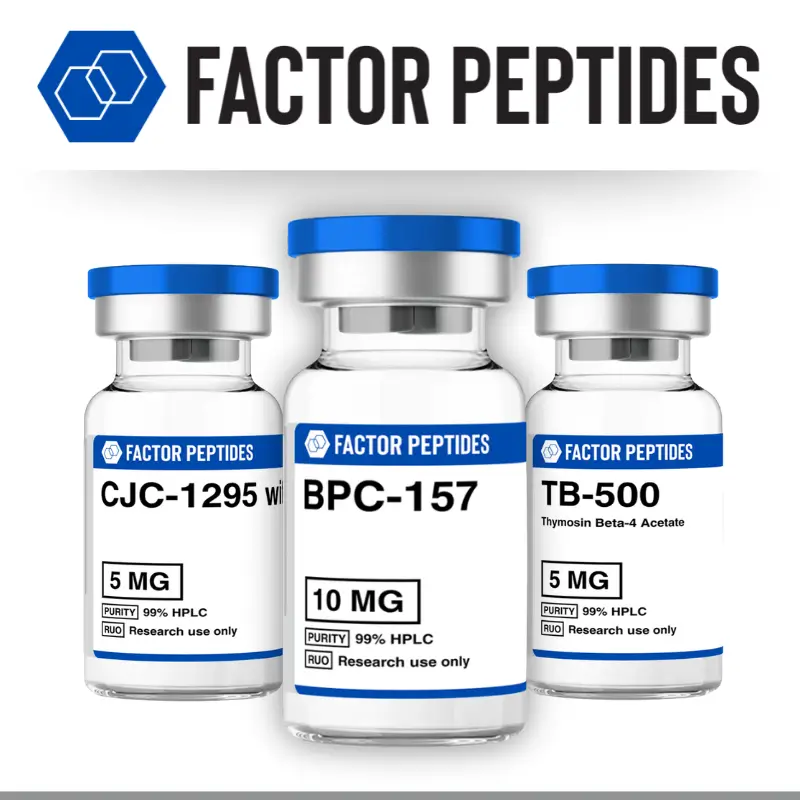
At Factor Peptides, we manufacture our peptides to exceed 99% purity. We use advanced techniques like solution and solid-phase peptide synthesis to produce peptides and proteins of exceptional quality, ideal for diverse research applications. This level of purity is consistently upheld through strict manufacturing protocols, comprehensive quality control, and detailed analytical testing at every key stage of production.
HPLC and Mass Spectrometry
High-performance liquid chromatography (HPLC) is a precise analytical technique used to separate, identify, and measure the individual components of a mixture. It plays a crucial role in accurately evaluating the purity and composition of peptides. Mass spectrometry (MS) is another essential tool that determines the molecular masses within a sample. It works by ionizing molecules and sorting the resulting ions based on their mass-to-charge ratio. The output is a spectrum that reflects ion intensity relative to mass, offering detailed molecular insights. When combined, HPLC and MS deliver complementary, highly dependable data that verify both the purity and identity of peptides provided by Factor Peptides.
At Factor Peptides, quality is prioritized throughout the entire production process. Testing is built into each stage of development and manufacturing. In the peptide synthesis lab, advanced analysis is used to confirm sequence accuracy and batch consistency, ensuring every peptide meets strict quality benchmarks.
How Pure Should Peptides Be?
Factor Peptides supplies only high-purity peptides (over 99%) for research and development. However, peptide purity can vary widely between suppliers, which often raises the question of what minimum purity is suitable for different research needs. Generally, higher purity is always recommended, particularly for sensitive or data-driven studies. Applications like in-vitro research or clinical investigations typically require very high purity (usually above 98%). For less critical experiments, a slightly lower purity level may still be acceptable. Ultimately, the ideal minimum purity depends on the nature of your study. Below are typical recommended purity levels based on common research applications.
High Peptide Purity (>95% Purity)
This level of purity is recommended for applications where accuracy, safety, and consistency are crucial, including:
• In vitro and in vivo studies
• Clinical trials
• Drug development studies where peptides are used as active pharmaceutical agents
• Cosmetic peptides used in cosmeceutical formulations
• Crystallography experiments
• Monoclonal antibody production
• Quantitative protease and enzyme studies
• Quantitative receptor–ligand interaction studies
• Quantitative blocking and competitive inhibition studies
• Quantitative ELISA and RIA standards
• Chromatography standards
Mid-range Peptide Purity (>85%)
Mid-range purity can be acceptable for many exploratory or semi-quantitative applications, such as:
• Peptide blocking studies (e.g., Western blot)
• Phosphorylation studies
• NMR (nuclear magnetic resonance) studies
• Cell attachment and adhesion studies
• Semi-quantitative analysis of enzyme–substrate interactions
• Epitope mapping experiments
• General biological activity testing
Low Peptide Purity (>70%)
Lower purity peptides may still be suitable for certain screening or supporting applications, including:
• Peptide arrays
• ELISA standards used to measure antibody titers
• Antigens for polyclonal antibody production or affinity purification
Peptides that meet higher purity standards can always be used in applications that require lower minimum purity, providing additional flexibility and confidence. Peptide Sciences focuses on supplying very high purity peptides that meet or exceed the requirements of all the categories listed above, helping support robust and reliable research outcomes.