
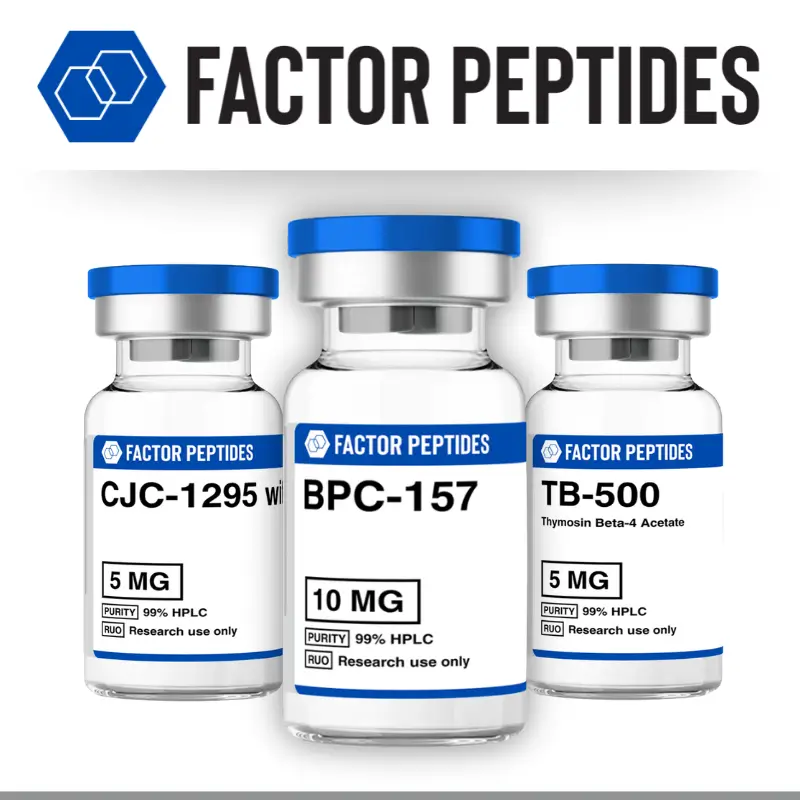
Peptide Storage
IMPORTANT NOTICE: All articles and product details shared here are for educational and informational purposes only. The products mentioned are intended strictly for in-vitro research use, meaning they are designed for experiments conducted outside of living organisms. These items are not drugs or medications and have not been reviewed or approved by the FDA for diagnosing, treating, curing, or preventing any disease or medical condition. Use of these products in or on humans or animals is strictly forbidden by law.
Proper Handling and Storage of Peptides
To ensure the reliability of your research, proper peptide storage is critical. Storing peptides correctly helps preserve their stability, minimize contamination, and prevent oxidation or degradation—factors that could negatively affect both the material and your results. While some peptides are naturally more stable, following proper storage practices can extend the lifespan of most sequences.
Upon receiving your peptide shipment, keep it cold and shielded from light. If the peptides will be used within days or a few months, refrigeration at temperatures below 4 °C (39 °F) is usually adequate. Lyophilized peptides are generally stable at room temperature for a few weeks, so short-term storage outside of refrigeration may be acceptable if they’re used quickly.
For long-term storage (spanning several months to years) keeping peptides in a –80 °C (–112 °F) freezer is ideal. These ultra-low temperatures help preserve structural integrity and reduce the risk of degradation.
Avoid repeated freeze–thaw cycles, as they can speed up peptide breakdown. Also, steer clear of frost-free freezers, as their automatic defrosting causes temperature changes that may damage sensitive peptide materials.
Protective Measures Against Peptide Contamination
Air and moisture are two major threats to peptide stability. Moisture exposure is especially problematic when cold vials are removed directly from the freezer and opened immediately. Condensation can form on the peptide or inside the container, leading to unwanted water uptake.
To reduce this risk, allow the peptide container to reach room temperature before opening it. This simple step helps prevent moisture from condensing on the cold surfaces.
Limiting air exposure is equally important. Keep peptide containers closed as much as possible and open them only briefly to remove the required amount. After sampling, resealing the vial under an atmosphere of dry, inert gas such as nitrogen or argon can greatly reduce oxidation of the remaining material. Sequences that contain cysteine (C), methionine (M), or tryptophan (W) are especially vulnerable to oxidative damage.
Because repeated thawing, refreezing, and exposure to air can rapidly erode long term stability, many researchers prefer to divide peptides into single-use or experiment-sized aliquots. Preparing separate vials for each planned use helps preserve the remaining stock and reduces the number of times any given portion is exposed to the environment.
Proper Storage of Peptide Solutions
Peptide solutions are far less stable than lyophilized powders. In solution, peptides are more susceptible to hydrolysis, oxidation, and bacterial growth. Sequences containing Cys, Met, Trp, Asp, Gln, or an N-terminal Glu are particularly prone to degradation when dissolved.
If storage in solution cannot be avoided, use sterile buffers at a pH of about 5–6 and divide the solution into aliquots to avoid repeated freeze–thaw cycles. Under refrigerated conditions (around 4 °C or 39 °F), many peptide solutions remain usable for up to 30 days, although inherently unstable sequences should be kept frozen when not actively in use.
Proper Storage Vials for Peptides
Appropriate containers are an important part of peptide storage strategy. Vials should be:
- Clean and free from visible defects
- Structurally sound and well sealed
- Chemically resistant to the solvents and buffers used
- Suitably sized for the volume of peptide or solution
Both glass and plastic vials are widely used. Plastic containers are typically made from polystyrene or polypropylene:
- Polystyrene vials are usually clear and easy to inspect visually but offer limited chemical resistance.
- Polypropylene vials tend to be translucent but are more resistant to many solvents and reagents.
High quality glass vials combine clarity and good chemical resistance, which makes them a preferred option in many laboratories. However, peptides are often shipped in plastic vials to reduce the risk of breakage during transport. If needed, peptides can be transferred from plastic to glass or vice versa once they arrive in the lab.
Peptide Storage Best Practices
When storing peptides, it can be helpful to keep a short checklist in mind:
- Keep peptides in a cool, dry, and dark location
- Reduce how often they go through freeze–thaw cycles
- Limit air exposure as much as possible
- Shield peptides from direct light
- Avoid storing peptides in solution for extended periods
- Divide peptides into smaller aliquots to match your experimental use