
r

Product Usage: This product is intended solely for use as a research chemical. It is designated exclusively for in vitro research and laboratory testing. All information provided on this site is for educational purposes only. It is strictly prohibited to administer this product to humans or animals. Only licensed and qualified professionals should handle it. This product is not classified as a drug, food, or cosmetic and must not be misrepresented or used as such. This product is for research use only. Not for human consumption.

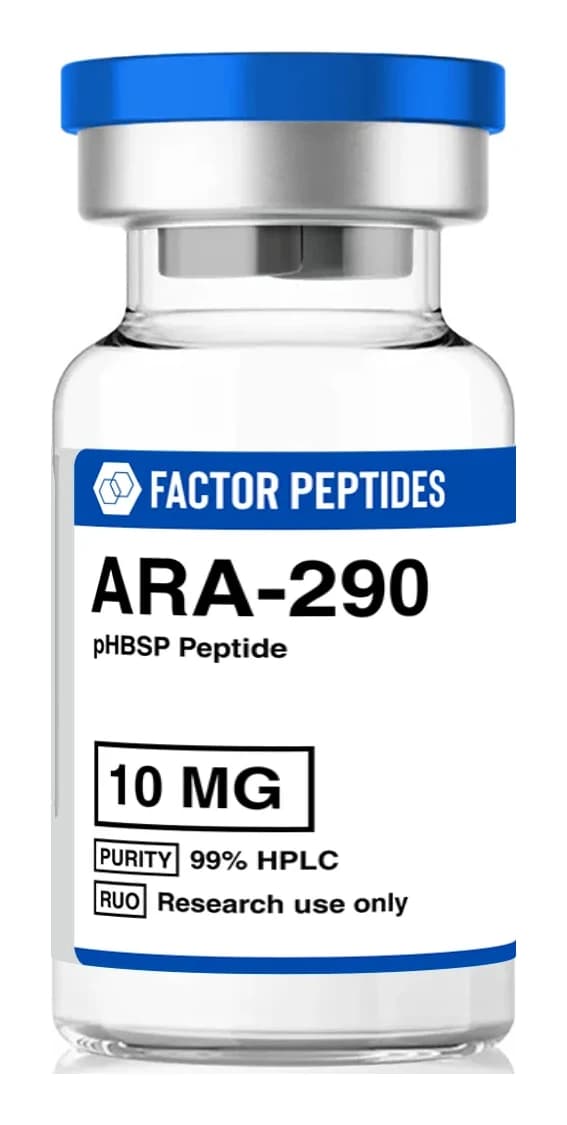
ARA-290 10 mg

ARA-290 is a specialized peptide related to certain hormone-based signaling molecules and is being studied for its ability to influence inflammatory processes through local cell-to-cell communication and specific repair receptors. Experimental findings suggest it may support healthier blood sugar levels as reflected by HbA1c, contribute to better cholesterol profiles, ease symptoms associated with nerve-related pain, and encourage the body’s natural tissue healing responses.

$55.00

  • DESCRIPTION
  • STORAGE

Overview of ARA-290

ARA-290 is a short peptide modeled on a specific portion of a kidney-produced signaling protein that is traditionally known for its role in red blood cell formation. The original protein also influences blood vessel development, cell survival, blood pressure regulation, and nerve protection, particularly in the setting of metabolic disease. ARA-290 was created to capture many of the nerve-protective and pain-relieving properties of the parent molecule while avoiding stimulation of red blood cell production. It has progressed through mid-stage human trials and is being further evaluated for use in metabolic and immune-related conditions. Current investigations focus on its ability to ease nerve-related pain, support wound recovery in long-standing metabolic disease, modulate immune activity, and potentially assist in managing certain chronic autoimmune disorders.

ARA-290 Structure

Sequence: ZEQLERALNSS
Molecular Formula: C51H84N16O21
Molecular Weight: 1257.3 g/mol
PubChem CID: 91810664
CAS No: 1208243-50-8
Synonyms: cibinetide, PH-BSP

ARA-290 Scientific Findings

Contribution to Vascular Repair

Many vision problems arise when blood flow to the light-sensitive tissues of the eye is reduced for prolonged periods. Protecting or restoring the cells that line blood vessels in these regions could help preserve sight. Experimental work in animal models suggests that ARA-290 can shield certain vessel-forming cells from inflammatory damage, allowing them to survive longer and better carry out their repair functions. In these studies, the peptide appears to support the ability of these progenitor cells to rebuild damaged blood vessels and maintain healthier circulation.

Additional research in similar models indicates that ARA-290 encourages these vascular progenitor cells to multiply, move toward damaged regions, and persist within the bloodstream and vessel walls. It also seems to improve their capacity to home in on areas where blood supply is compromised. This combination of enhanced survival, migration, and targeting suggests that ARA-290 could be used alongside cell-based therapies to improve the success of transplanted repair cells for restoring circulation and possibly supporting other functions such as hormone production or tissue regeneration.

Influence on Inflammatory Signals

Studies in animals show that ARA-290 can improve the survival of transplanted insulin-producing cells by dampening the activity of certain immune cells that drive inflammation. Long-term replacement of these cells has long been viewed as a promising approach for managing sugar control in metabolic disease, but their rapid destruction after transplantation has limited the practicality of this strategy. In research models, ARA-290 reduces the production of several key inflammatory messengers, which in turn helps transplanted cells live longer and function more effectively.

The protective effect of ARA-290 on tissues appears to be linked to its interaction with a specific receptor complex involved in limiting injury and regulating immune responses. By engaging this receptor, the peptide promotes cell survival pathways and tones down excessive inflammatory signaling. As a result, it can help decrease cell death, support tissue regeneration, and limit the extent of scarring and functional loss after injury. In various preclinical settings, these actions have been associated with faster recovery, less structural damage, and a reduced overall burden from chronic inflammatory complications.

Support for Tissue Integrity

In several experimental systems, ARA-290 has been shown to help protect vulnerable tissues from immune-mediated injury by lessening the activation of inflammatory cells. In models where insulin-producing cells are transplanted, the peptide increases the lifespan of these cells by reducing exposure to damaging inflammatory messengers. This leads to more stable sugar regulation and delays or prevents the failure of the transplanted tissue.

The same receptor pathways that underlie its anti-inflammatory activity also contribute to broader tissue-protective effects. By improving cell survival and moderating overly aggressive immune reactions, ARA-290 promotes more orderly healing, encourages healthier tissue remodeling, and limits the formation of dense scar tissue. Taken together, these qualities point to the peptide as a potential tool for preserving organ function and improving outcomes after injury or chronic inflammation.

Impact on Immune Function

The receptor system targeted by ARA-290 is present on many immune cell types, including several that play central roles in inflammation and long-term immune memory. Laboratory evidence indicates that when this receptor is activated on certain cells, the release of strong proinflammatory messengers is significantly reduced. While this can slightly slow the clearance of some threats in specific scenarios, it also prevents the immune response from overshooting and causing long-lasting tissue damage.

Activation of this receptor alters the pattern of chemical signals produced by immune cells, reducing the traffic of highly inflammatory cells into damaged tissues and encouraging a more balanced repair-oriented response. This shift appears to support better healing with fewer painful or destructive side effects. At the same time, ARA-290 may subtly adjust how other immune cells process and present foreign material, which can reshape long-term immune memory. Such fine-tuning has important implications for reducing rejection after organ or tissue transplantation and for controlling overactive immune responses in various chronic conditions.

Because of these immune-modulating properties, ARA-290 is being explored as a candidate for conditions in which inappropriate or exaggerated immune activity plays a central role. One area of particular interest is inflammatory disease of the digestive tract, where more selective immune control could help relieve symptoms and improve quality of life compared with broad immune-suppressive treatments.

The peptide is also being investigated in models of systemic autoimmune disorders. In these settings, administration of ARA-290 has been associated with reductions in disease-related immune markers and less damage to critical organs such as the kidneys. These findings raise the possibility that it could contribute to more targeted approaches for controlling autoimmune activity and limiting long-term complications.

Modulation of Pain Pathways

The immune system and pain perception are closely linked, especially in chronic nerve-related pain, which is often difficult to manage with current options. Research indicates that ARA-290 can act on receptor systems involved in tissue repair and immune signaling to reduce inflammatory drivers of nerve pain. Emerging data also suggest that it may influence specific ion channels responsible for detecting heat and burning sensations, which are commonly reported in conditions involving nerve injury.

Loss of small pain- and temperature-sensing nerve fibers is a frequent consequence of certain metabolic and immune disorders, leading to symptoms such as burning, tingling, or prickling sensations. Clinical studies in affected individuals have found that treatment with ARA-290 can increase the density of these small nerve fibers and substantially lessen pain. These outcomes point to a potential role for the peptide in supporting nerve repair and reducing discomfort in a broad range of conditions associated with small fiber damage.

Development Status in Rare Conditions

ARA-290 has been granted special regulatory consideration for the investigation of its effects in people with severe nerve pain linked to uncommon inflammatory disorders. Early human studies have reported meaningful improvements in pain scores and nerve fiber measures, supporting continued development of the compound in this setting.

Ongoing and planned clinical studies are designed to clarify how daily dosing may help individuals living with chronic nerve pain and other complications of long-standing inflammatory and metabolic diseases. Preclinical work also suggests that ARA-290 can speed the closure of persistent wounds in animal models with impaired healing, which may eventually have implications for managing chronic skin breakdown and reducing the risk of serious complications in high-risk populations.

Overall Summary

ARA-290 is being actively investigated for a broad range of potential uses, with particular emphasis on chronic nerve pain, immune regulation, and tissue repair. The most advanced work centers on its ability to reduce symptoms and improve nerve structure in people with long-standing nerve damage related to metabolic and inflammatory conditions. At the same time, studies are exploring its application in autoimmune disorders, chronic digestive inflammation, and pain syndromes associated with various systemic diseases.

In animal studies, ARA-290 has generally shown a favorable safety profile, with limited adverse effects and strong uptake when delivered by injection. Doses used in these experiments are tailored to the species being studied and cannot be directly applied to humans. At present, this compound is intended solely for controlled laboratory and clinical research and is not approved for routine human use or self-administration.

Factor Peptides Storage Guidelines:

These peptides arrive in a dried, stabilized form produced by a process called lyophilization, or freeze drying. In this state, they are generally suitable for transport and short-term storage at typical room temperatures for several months.

Once the dry powder is mixed with bacteriostatic water and turned into a liquid solution, the storage requirements change. The reconstituted solution should be kept in a refrigerator to help maintain its properties, and is usually considered suitable for use for about 30 days under chilled conditions.

Lyophilization involves freezing the material and then exposing it to low pressure so that ice in the sample passes directly from solid to vapor, rather than melting. This leaves behind a light, porous, white solid that is more stable than the original liquid. In this form, the product can often be kept at room temperature until it is time to add diluent.

After delivery, it is good practice to protect the vials from heat and strong light. If the product will be used in the near future, storing the lyophilized powder or reconstituted solution in a refrigerator at temperatures below about 4°C (39°F) is typically appropriate. The dry form often remains intact at room temperature for a number of weeks, so this may also be acceptable when immediate refrigeration is not available and the intended use is relatively soon.

For storage over longer periods, such as many months or years, much colder conditions are preferred. Placing the vials in a deep freezer, around -80°C (-112°F), is commonly used to help preserve the structure and activity of peptides for extended time frames.

Factor Peptides Logo

You must be 21 years of age or older to enter this site.

By accessing this website, you agree to our Terms and Conditions.

All products offered by Factor Peptides are intended strictly for research and laboratory use only. Accessories such as bacteriostatic water, syringes, or related equipment are not included. Most compounds are provided in lyophilized (powdered) form and must be properly reconstituted with an appropriate diluent before use in research settings.