r

Product Usage: This product is intended solely for use as a research chemical. It is designated exclusively for in vitro research and laboratory testing. All information provided on this site is for educational purposes only. It is strictly prohibited to administer this product to humans or animals. Only licensed and qualified professionals should handle it. This product is not classified as a drug, food, or cosmetic and must not be misrepresented or used as such. This product is for research use only. Not for human consumption.

BPC157

BPC-157 is a synthetic chain of 15 amino acids derived from a naturally occurring protective compound found in stomach fluid. In animal research, it has been observed to speed up the recovery of various injuries, including those affecting muscles, tendons, and ligaments, while also helping shield internal organs and reducing the likelihood of developing stomach ulcers. Studies suggest it supports overall digestive health by acting along the gastrointestinal tract, where it has been associated with improvements in conditions such as increased intestinal permeability, irritable bowel symptoms, abdominal cramping, and certain inflammatory bowel issues. This peptide has also been linked to pain-relieving effects and appears to promote faster healing of burns by enhancing circulation to injured areas. Experimental work indicates that it can boost the production of structural proteins like reticulin and collagen, encourage the growth of new blood vessels, and support the activity of key repair cells, making it a promising candidate for advanced wound care strategies.

Price range: $40.00 through $65.00

  • DESCRIPTION
  • STORAGE

Background on BPC-157

BPC-157 is a laboratory-synthesized peptide that was originally identified as a small portion of a naturally occurring protective factor in stomach fluids. The parent compound helps maintain the stability of the digestive lining, shields it from harsh digestive chemicals, and encourages the restoration of damaged tissue, in part by supporting healthy circulation in the surrounding area.

The isolated peptide segment known as BPC-157 consists of 15 amino acids and appears, in research settings, to preserve many of the restorative and protective actions of the larger molecule. Experimental work has linked BPC-157 to multiple biological processes, including:

  • Supporting closure and remodeling of injured tissue
  • Stimulating the sprouting of new blood vessels
  • Influencing clotting and related repair cascades
  • Interacting with pathways that use nitric oxide signaling
  • Shaping certain aspects of immune response
  • Affecting patterns of gene regulation in target cells
  • Modulating communication between the digestive tract and nervous system

BPC-157 Peptide Structure

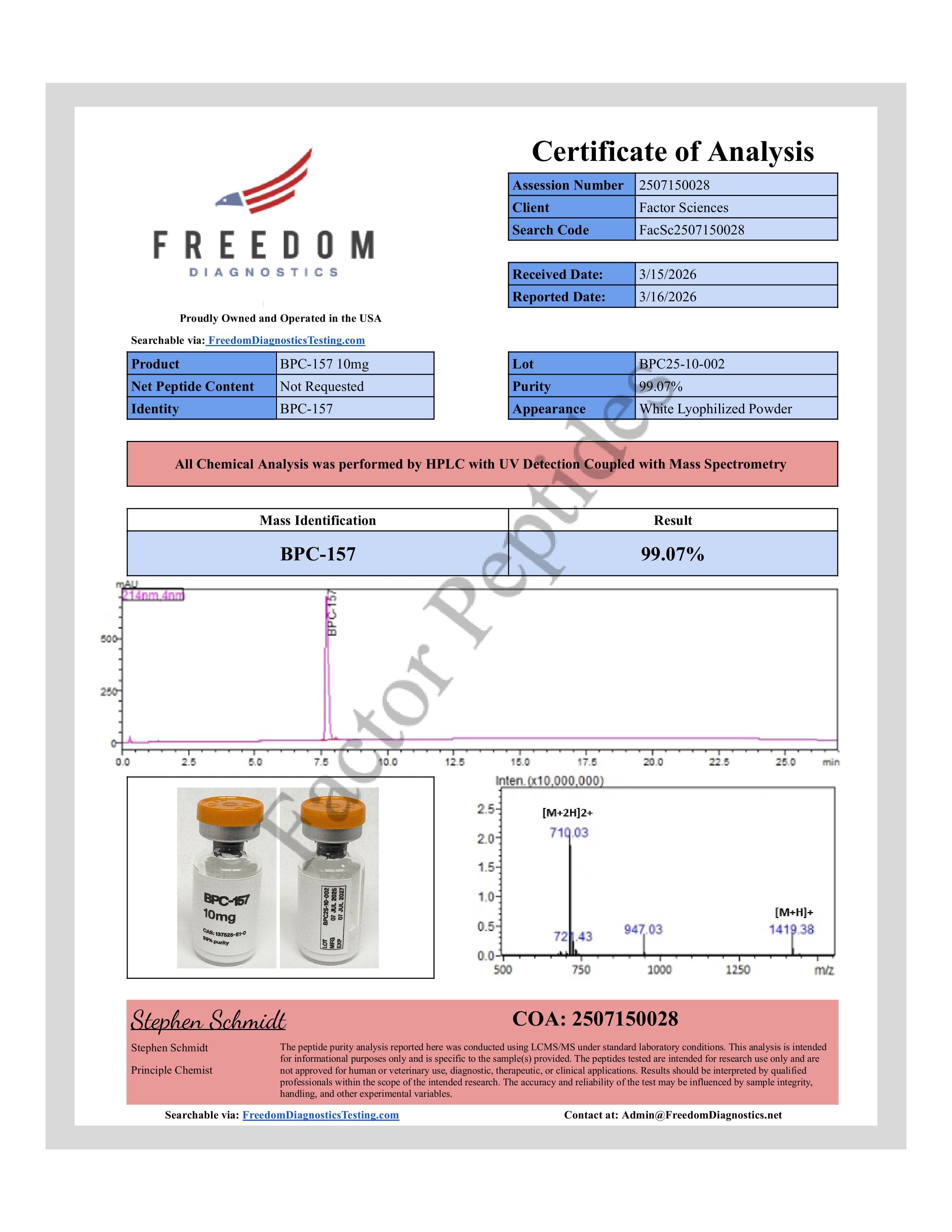
Sequence: Gly- Glu-Pro-Pro-Pro-Gly-Lys-Pro-Ala-Asp-Asp-Ala-Gly-Leu-Val
Molecular Formula: C62H98N16O22
Molecular Weight: 1419.556 g/mol
PubChem CID: 108101

Experimental Work with BPC-157

1. Repair Processes in Soft Tissue

Within the digestive system, the natural protective compound from which BPC-157 is derived helps preserve the surface barrier that separates stomach contents from deeper tissues. One of the ways it appears to do this is by drawing in fibroblasts, the structural cells responsible for producing collagen and other matrix components. Laboratory experiments show that BPC-157 can speed up both the multiplication and movement of fibroblasts, and that these effects become stronger as the concentration of the peptide increases. Because fibroblasts are central to rebuilding damaged areas, this activity is thought to contribute significantly to faster and more organized repair of wounds.

2. Blood Vessel Remodeling and Bypass Growth

Studies in animal and cell models indicate that BPC-157 strongly encourages endothelial cells, which line the interior of blood vessels, to grow and spread. In situations where blood flow is partially blocked, the peptide promotes the development of alternate vessel routes that divert circulation around the obstruction, helping supply oxygen and nutrients to tissue that would otherwise be at risk. Although this has been studied extensively in the digestive tract, similar patterns of improved collateral circulation have been seen in heart, brain, and muscle models, suggesting potential relevance to a wide range of ischemic conditions.

Work in embryonic and cell culture systems suggests that BPC-157 may act through receptor pathways associated with nitric oxide–mediated signaling, which are important for vessel formation and maintenance. By enhancing these pathways, the peptide appears to support the survival and expansion of microvessels, contributing to a richer and more adaptable vascular network in areas of stress or injury.

Other experiments have described a phenomenon often termed “vascular running,” in which vessels extend and reorganize toward injured or blocked regions after exposure to BPC-157. This natural rerouting of blood flow raises the possibility that, at some point in the future, related approaches might be explored as non-surgical strategies for managing slowly developing vessel blockages.

3. Support for Tendons and Other Connective Tissues

Tendons and ligaments are notorious for healing slowly because their limited blood supply restricts the arrival of repair cells. In preclinical models, BPC-157 has been shown to improve both the density of fibroblasts and the formation of small new vessels in damaged tendons, ligaments, and bone. These changes correspond with stronger and more complete healing in animal studies, and in some settings the peptide has outperformed several well-known growth factors commonly evaluated in connective tissue research.

Microscopic analyses reveal that BPC-157 stimulates the assembly of F-actin, a key component of the internal scaffolding that controls cell shape and movement. It also increases the activation of signaling proteins that coordinate cell migration, which helps repair cells move into injury sites and spread throughout them more effectively. This combination of enhanced structure and mobility is believed to be central to its supportive effects in tendon and ligament repair models.

4. Effects on Oxidative Stress and Cellular Protection

Research in rodents suggests that BPC-157 can reduce certain markers associated with oxidative stress, including those related to nitric oxide imbalance and lipid breakdown. These findings point to a broader protective role against chemical stress in tissues, particularly within the digestive system. In studies where beneficial bacteria were engineered to deliver BPC-157 directly, elevated local levels of the peptide were detected, further supporting the idea that it may be used to explore targeted antioxidant strategies in the gut.

5. Interaction with Medication-Related Side Effects

Many medicines are effective but limited by damage to the stomach lining, heart rhythm disturbances, or neurologic complications. In experimental systems, BPC-157 has been reported to lessen injury to the gastrointestinal tract induced by certain commonly used drugs, suggesting a potential role in protecting the gut from medication-related stress.

Beyond the digestive tract, BPC-157 has shown the ability to counteract some forms of drug-induced electrical disturbances in the heart that can predispose to irregular rhythms. It has also reduced several serious movement and sensory side effects in animal models receiving medications used for long-term psychiatric or metabolic conditions. These observations raise the possibility that, in theory, agents with similar properties could one day help patients tolerate essential therapies more easily, although this remains an area of early-stage investigation.

6. Applications in Invertebrate Health Research

Honey bees and other pollinators can suffer from gut infections that contribute to colony decline. In trials where BPC-157 was added to the diet of affected bee colonies, there was less visible injury to the digestive tract and improved survival in field conditions. While this work is still exploratory, it hints that BPC-157 may also serve as a tool for studying how gut-supportive peptides influence resilience in ecologically important species.

Ongoing and Future Study Areas

BPC-157 remains an active subject of research in many preclinical models, not only as a potential means to encourage wound closure and vessel growth, but also as a probe for unraveling the signaling pathways that govern these processes. Because new vessel formation is central to healing, development, and various disease states, insights gained from BPC-157 studies may extend into fields such as cancer biology, regenerative medicine, and developmental science.

In animal-based experiments, BPC-157 has generally shown a low incidence of adverse findings, with good uptake after subcutaneous administration and measurable effects after oral delivery in certain designs. The dosing regimens used in these studies are specific to those models and cannot be directly translated to human use. At this time, BPC-157 is restricted to controlled laboratory and experimental work and is not authorized for routine use in people or for unsupervised self-experimentation.

Factor Peptides Storage Guidelines:

These peptides arrive in a dried, stabilized form produced by a process called lyophilization, or freeze drying. In this state, they are generally suitable for transport and short-term storage at typical room temperatures for several months.

Once the dry powder is mixed with bacteriostatic water and turned into a liquid solution, the storage requirements change. The reconstituted solution should be kept in a refrigerator to help maintain its properties, and is usually considered suitable for use for about 30 days under chilled conditions.

Lyophilization involves freezing the material and then exposing it to low pressure so that ice in the sample passes directly from solid to vapor, rather than melting. This leaves behind a light, porous, white solid that is more stable than the original liquid. In this form, the product can often be kept at room temperature until it is time to add diluent.

After delivery, it is good practice to protect the vials from heat and strong light. If the product will be used in the near future, storing the lyophilized powder or reconstituted solution in a refrigerator at temperatures below about 4°C (39°F) is typically appropriate. The dry form often remains intact at room temperature for a number of weeks, so this may also be acceptable when immediate refrigeration is not available and the intended use is relatively soon.

For storage over longer periods, such as many months or years, much colder conditions are preferred. Placing the vials in a deep freezer, around -80°C (-112°F), is commonly used to help preserve the structure and activity of peptides for extended time frames.

Factor Peptides Logo

You must be 21 years of age or older to enter this site.

By accessing this website, you agree to our Terms and Conditions.

All products offered by Factor Peptides are intended strictly for research and laboratory use only. Accessories such as bacteriostatic water, syringes, or related equipment are not included. Most compounds are provided in lyophilized (powdered) form and must be properly reconstituted with an appropriate diluent before use in research settings.