
Product Usage: This product is intended solely for use as a research chemical. It is designated exclusively for in vitro research and laboratory testing. All information provided on this site is for educational purposes only. It is strictly prohibited to administer this product to humans or animals. Only licensed and qualified professionals should handle it. This product is not classified as a drug, food, or cosmetic and must not be misrepresented or used as such. This product is for research use only. Not for human consumption.
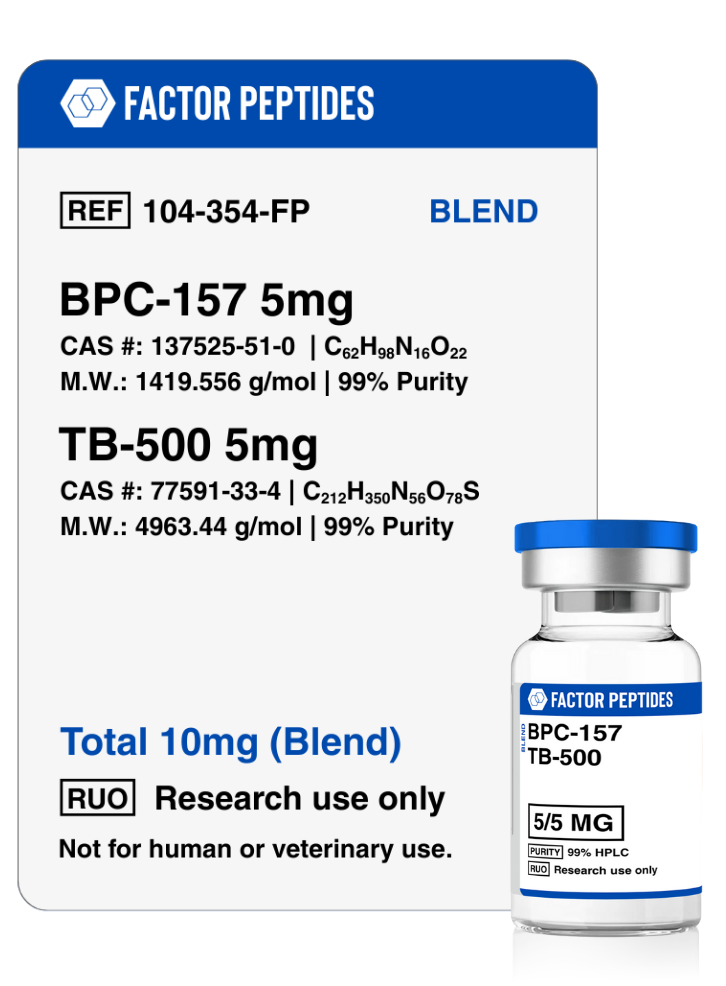
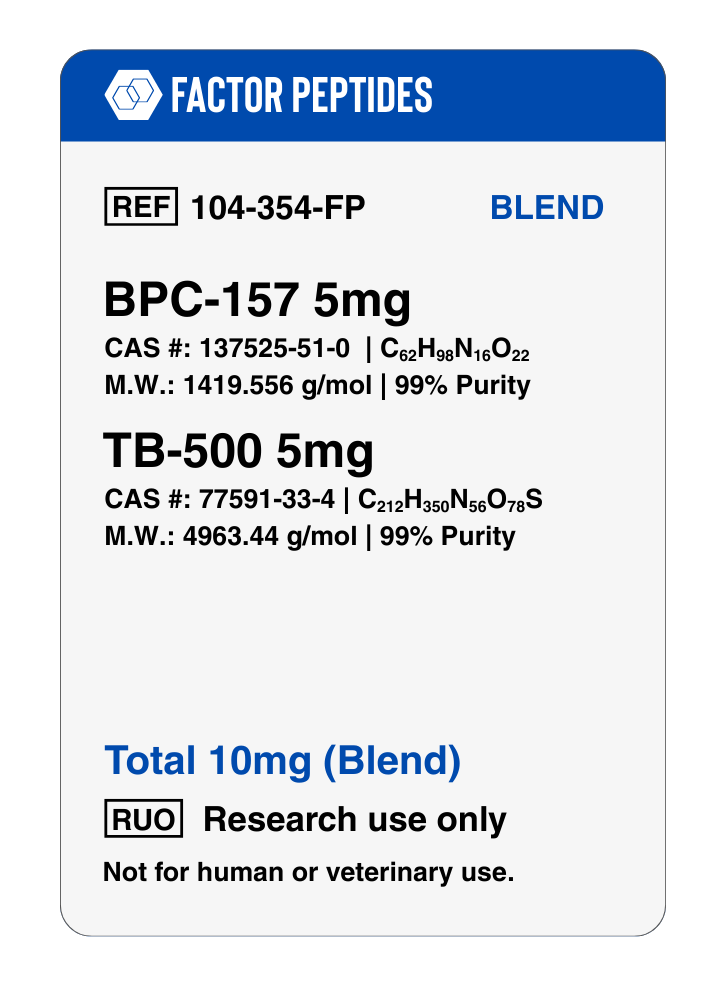
BPC157 + TB500
B7-33 is a peptide currently being studied for its powerful anti-fibrotic properties. It is under active investigation as a potential treatment for both acute and chronic conditions involving fibrosis, such as heart failure, lung inflammation, and kidney disease. In preclinical studies, B7-33 has demonstrated the ability to reduce fibrotic tissue by up to 50%, significantly improving survival rates following injury. It has also been shown to minimize scar formation after cardiac damage and has shown potential in addressing vascular disorders and pregnancy-related conditions like preeclampsia.
Price range: $80.00 through $110.00
All Products
- DESCRIPTION
- STORAGE
Potential BPC-157 and TB-500 Synergy in Wound Repair
Experimental work suggests that BPC-157 and TB-500 may complement one another in models of tissue repair. Both peptides have been studied for their roles in supporting wound healing, yet they appear to act through different biochemical pathways. When considered together, their combined influence on cell movement and growth-related signaling has led to growing interest in their potential synergy.
Cell Migration and Actin Dynamics
Effective wound healing relies on the timely arrival of key cell types at the site of injury. Fibroblasts, which help build and remodel the extracellular matrix, and immune cells, which clear debris and coordinate repair, must migrate into damaged tissue in a coordinated way. This migration process is highly dependent on the cytoskeletal protein actin.
BPC-157 has been reported to influence gene expression patterns associated with actin production, which may support the availability of actin needed for cell movement. TB-500, a peptide derived from an actin-binding protein, has been studied for its ability to regulate actin pools within cells and facilitate the formation of actin filaments that drive cell motility. Together, these effects suggest that BPC-157 and TB-500 could, in principle, enhance both the supply and organization of actin, thereby promoting more efficient migration of fibroblasts and immune cells into injured tissue in preclinical models.
Growth Hormone Signaling in the “Big Picture”
Growth hormone and its downstream pathways play an important role in tissue regeneration. Research indicates that BPC-157 can increase the number of growth hormone receptors on fibroblasts, potentially extending their functional lifespan and enhancing their capacity to participate in soft tissue repair.
TB-500’s influence on actin dynamics may complement this effect by ensuring that fibroblasts with increased growth hormone sensitivity also possess the cytoskeletal resources needed for movement, shape change, and matrix production. In this conceptual framework, BPC-157 supports receptor availability and signaling readiness, while TB-500 supports the structural machinery required for these cells to respond effectively during repair.
Future studies may continue to explore how these peptides interact with growth hormone pathways and other components of the wound-healing environment, with the goal of better understanding how combined modulation of signaling, migration, and matrix remodeling influences overall tissue recovery.
Research Use Only
The potential interactions described above are based on preclinical and experimental findings. BPC-157 and TB-500 remain research compounds and are not approved treatments for wound care or any medical condition. They should be used only in controlled laboratory and educational settings by qualified researchers, and not administered to humans or animals.
Factor Peptides Storage Guidelines:
These peptides arrive in a dried, stabilized form produced by a process called lyophilization, or freeze drying. In this state, they are generally suitable for transport and short-term storage at typical room temperatures for several months.
Once the dry powder is mixed with bacteriostatic water and turned into a liquid solution, the storage requirements change. The reconstituted solution should be kept in a refrigerator to help maintain its properties, and is usually considered suitable for use for about 30 days under chilled conditions.
Lyophilization involves freezing the material and then exposing it to low pressure so that ice in the sample passes directly from solid to vapor, rather than melting. This leaves behind a light, porous, white solid that is more stable than the original liquid. In this form, the product can often be kept at room temperature until it is time to add diluent.
After delivery, it is good practice to protect the vials from heat and strong light. If the product will be used in the near future, storing the lyophilized powder or reconstituted solution in a refrigerator at temperatures below about 4°C (39°F) is typically appropriate. The dry form often remains intact at room temperature for a number of weeks, so this may also be acceptable when immediate refrigeration is not available and the intended use is relatively soon.
For storage over longer periods, such as many months or years, much colder conditions are preferred. Placing the vials in a deep freezer, around -80°C (-112°F), is commonly used to help preserve the structure and activity of peptides for extended time frames.