
Product Usage: This product is intended solely for use as a research chemical. It is designated exclusively for in vitro research and laboratory testing. All information provided on this site is for educational purposes only. It is strictly prohibited to administer this product to humans or animals. Only licensed and qualified professionals should handle it. This product is not classified as a drug, food, or cosmetic and must not be misrepresented or used as such. This product is for research use only. Not for human consumption.
Cagrilintide
Cagrilintide is a long-acting synthetic analogue of amylin, a peptide hormone naturally secreted alongside insulin. In preclinical studies, cagrilintide has demonstrated potential in addressing obesity and type 2 diabetes, as well as offering benefits in liver health, including alcohol-related liver conditions, and cardiovascular disease.
There is growing scientific interest in its broader therapeutic applications, including neurodegenerative conditions like Alzheimer’s disease, though formal studies in that area have not yet been published. Notably, research involving the combination of cagrilintide and semaglutide shows enhanced outcomes in weight management and metabolic health, with the two peptides appearing to act synergistically.
While early data are encouraging, clinical research in humans remains limited. More studies are needed to confirm its safety, efficacy, and long-term impact across various health conditions.
Price range: $95.00 through $150.00
All Products
- DESCRIPTION
- STORAGE
Cagrilintide Overview
Cagrilintide is a long-acting research analogue of amylin, a peptide that is normally released alongside insulin from the pancreas. In preclinical and early clinical studies, it has been explored for its potential to support body-weight reduction and improve markers related to type 2 diabetes. Experimental work has also examined possible benefits in metabolic liver stress, obesity-related cardiovascular risk, and other metabolic complications. There is ongoing interest in how amylin-based analogues might relate to brain health and neurodegenerative processes, although this remains an emerging area of investigation.
Cagrilintide Structure
Peptide sequence: XKCNTATCATQRLAEFLRHSSNNFGPILPPTNVGSNTP
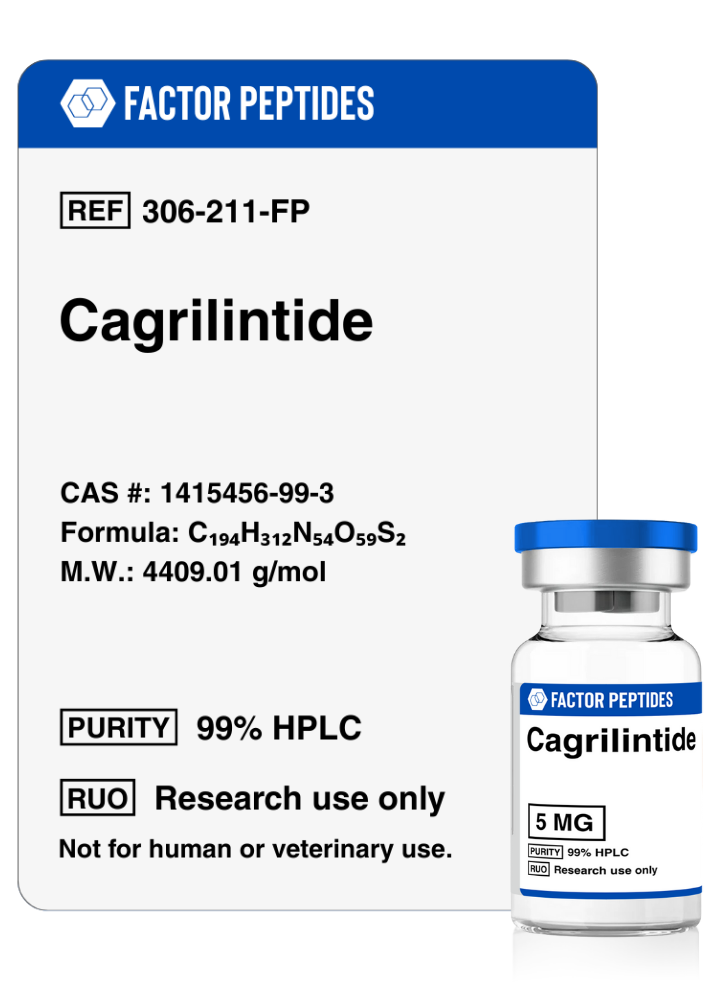
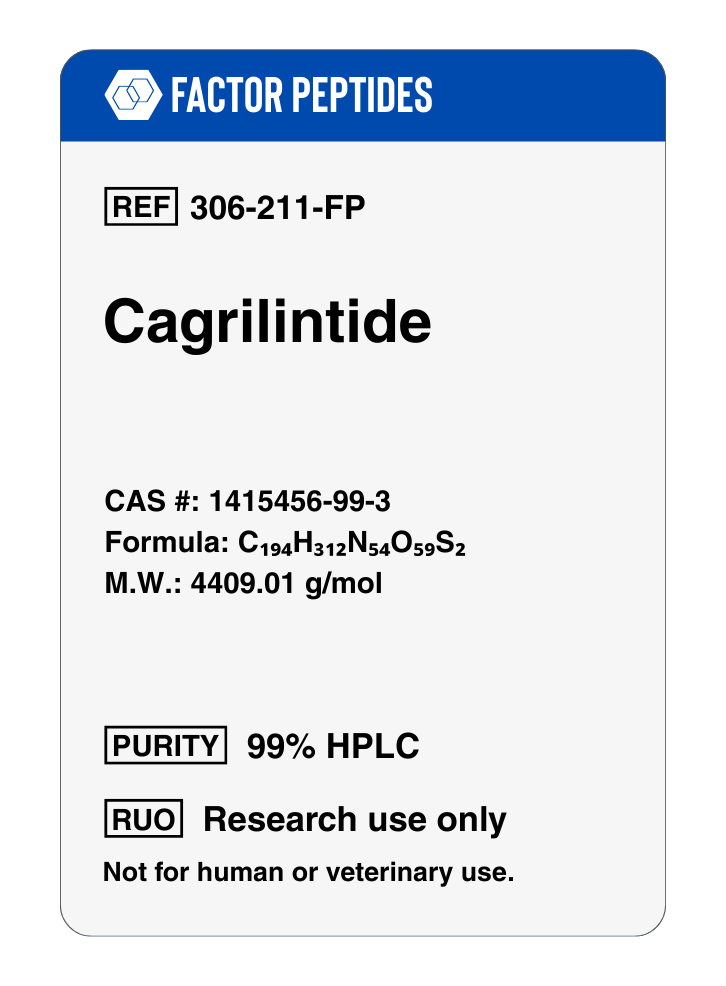
Molecular formula: C194H312N54O59S2 · xC2H4O2
Molecular weight: 4409.01 g/mol
Synonyms: AT42613, AM833
Cagrilintide is engineered to be more stable in circulation than native amylin, with modifications that reduce its tendency to aggregate and extend its half-life in the body.
Origin and Role of Amylin
Amylin, also known as islet amyloid polypeptide, is co-secreted with insulin from pancreatic beta cells. It helps coordinate the body’s response to food intake by:
- Slowing gastric emptying so nutrients enter the bloodstream more gradually
- Sending satiety signals to the brain to help limit meal size
- Blunting rapid spikes in post-meal blood glucose
Amylin is produced as a longer precursor peptide that is then processed into a 37–amino acid active form. Beyond its metabolic effects, amylin is structurally related to calcitonin-type peptides and may take part in bone mineral regulation and calcium handling.
Under conditions of sustained overnutrition and insulin resistance, native amylin can accumulate at very high concentrations. In such settings, it can form fibrils and deposits that are thought to contribute to stress on pancreatic beta cells. This has led to substantial interest in designing analogues that preserve the beneficial signaling functions of amylin while reducing its tendency to aggregate.
What Is Cagrilintide?
Cagrilintide is a synthetic amylin analogue developed to overcome key limitations of the native peptide. Earlier amylin analogues were used primarily as add-on therapy to insulin, helping to flatten post-meal glucose rises but requiring frequent injections and offering only modest weight effects.
Cagrilintide incorporates several design features:
- Sequence changes at the C-terminal region that reduce self-aggregation and enhance stability while maintaining
receptor activity. - Additional modifications that improve binding to amylin-related receptors and promote sustained engagement of
downstream signaling pathways. - A fatty acid moiety at the N-terminal portion to encourage reversible binding to albumin, extending
circulation time and enabling once-weekly dosing in trials.
These changes preserve the satiety and gastric-emptying effects of amylin while making the peptide more suitable for long-acting, systemic administration in controlled research settings.
How Cagrilintide May Work
Cagrilintide appears to act through several complementary mechanisms:
- Gastrointestinal transit: It slows the movement of food from the stomach into the intestine.
This can prolong feelings of fullness and reduce the rate at which glucose enters the bloodstream after meals. - Central satiety signaling: Amylin-sensitive receptors are present in brain regions involved in
appetite control. Activation of these receptors in animal models reduces food intake and increases subjective
fullness signals. - Glucagon modulation: Cagrilintide may help reduce inappropriate glucagon release from the
pancreas, which in turn can limit excess glucose output by the liver and reduce conversion of carbohydrate
energy into stored fat.
By acting both in the gut and the central nervous system, cagrilintide supports a coordinated response that favors smaller meals, slower nutrient absorption, and more stable post-prandial glucose profiles in experimental models.
Cagrilintide and Weight Management Research
Controlled trials have explored once-weekly cagrilintide as a potential tool for body-weight reduction. In these studies, participants receiving cagrilintide experienced greater average weight loss over several weeks than those receiving placebo, with results that were at least comparable to, and in some cases more pronounced than, established injectable weight-management peptides.
Additional research has examined cagrilintide in combination with GLP-1 receptor agonists. When paired with a GLP-1 analogue, cagrilintide produced weight-loss outcomes that exceeded what would be expected from either agent alone, suggesting a synergistic effect. Reported average weight reductions in these combination arms have reached well into the double-digit percentage range of starting body weight over a few months, under intensive lifestyle and medical supervision.
Cagrilintide and Glycemic Control
Cagrilintide and earlier amylin analogues have been investigated as adjuncts to insulin or other glucose-lowering therapies. Their main contribution appears to be:
- Smoothing post-meal blood sugar rises by delaying gastric emptying
- Lowering total daily energy intake through increased satiety
- Tempering inappropriate glucagon secretion
In clinical research, these combined effects have been associated with meaningful reductions in long-term glycemic markers such as HbA1c when used under specialist supervision. Cagrilintide’s extended duration of action offers the practical advantage of less frequent dosing while maintaining a relatively steady effect on appetite and glucose variability between injections.
Metabolic Health, Brain Function, and Open Questions
Elevated or unstable blood sugar levels are well recognized as risk factors for cognitive decline. Persistent hyperglycemia and insulin resistance are associated with increased oxidative stress, vascular injury, and alterations in brain energy use. These processes may contribute to higher rates of mild cognitive impairment and dementia in individuals with long-standing metabolic disease.
Amylin itself can cross the blood–brain barrier and shares several structural features with amyloid-forming peptides in the brain. Both very low and very high circulating amylin levels have been linked, in observational work, with changes in cognitive performance and with markers related to amyloid deposition.
Experimental studies in animal models have suggested that carefully calibrated amylin-like signaling might influence amyloid handling and plaque dynamics. However, research specifically evaluating cagrilintide in this context is still at an early stage, and no definitive conclusions can yet be drawn about its role in preventing or treating neurodegenerative disease. This remains a promising but largely unexplored research direction.
Cagrilintide Summary
Cagrilintide is a next-generation amylin analogue designed for extended activity, improved stability, and reduced aggregation compared with native amylin. In research settings it:
- Slows gastric emptying and enhances satiety signaling
- Helps flatten post-prandial glucose excursions
- Supports meaningful body-weight reductions in clinical trials
- Shows particularly strong effects when combined with GLP-1 receptor agonists
Beyond weight management and glycemic control, cagrilintide may have broader implications for cardiometabolic health and possibly cognitive function, although these areas require considerably more investigation. As a research tool, it offers a powerful way to study amylin-related pathways, energy balance, and the intersection between metabolic and neurological health.
Research Use Only
Cagrilintide is an experimental research peptide. It is not an approved drug and is not intended to diagnose, treat, cure, or prevent any disease. All information provided here relates exclusively to laboratory and clinical research contexts. Cagrilintide must not be administered to humans or animals and should be handled only by qualified professionals in appropriate research facilities.
Factor Peptides Storage Guidelines:
These peptides arrive in a dried, stabilized form produced by a process called lyophilization, or freeze drying. In this state, they are generally suitable for transport and short-term storage at typical room temperatures for several months.
Once the dry powder is mixed with bacteriostatic water and turned into a liquid solution, the storage requirements change. The reconstituted solution should be kept in a refrigerator to help maintain its properties, and is usually considered suitable for use for about 30 days under chilled conditions.
Lyophilization involves freezing the material and then exposing it to low pressure so that ice in the sample passes directly from solid to vapor, rather than melting. This leaves behind a light, porous, white solid that is more stable than the original liquid. In this form, the product can often be kept at room temperature until it is time to add diluent.
After delivery, it is good practice to protect the vials from heat and strong light. If the product will be used in the near future, storing the lyophilized powder or reconstituted solution in a refrigerator at temperatures below about 4°C (39°F) is typically appropriate. The dry form often remains intact at room temperature for a number of weeks, so this may also be acceptable when immediate refrigeration is not available and the intended use is relatively soon.
For storage over longer periods, such as many months or years, much colder conditions are preferred. Placing the vials in a deep freezer, around -80°C (-112°F), is commonly used to help preserve the structure and activity of peptides for extended time frames.