
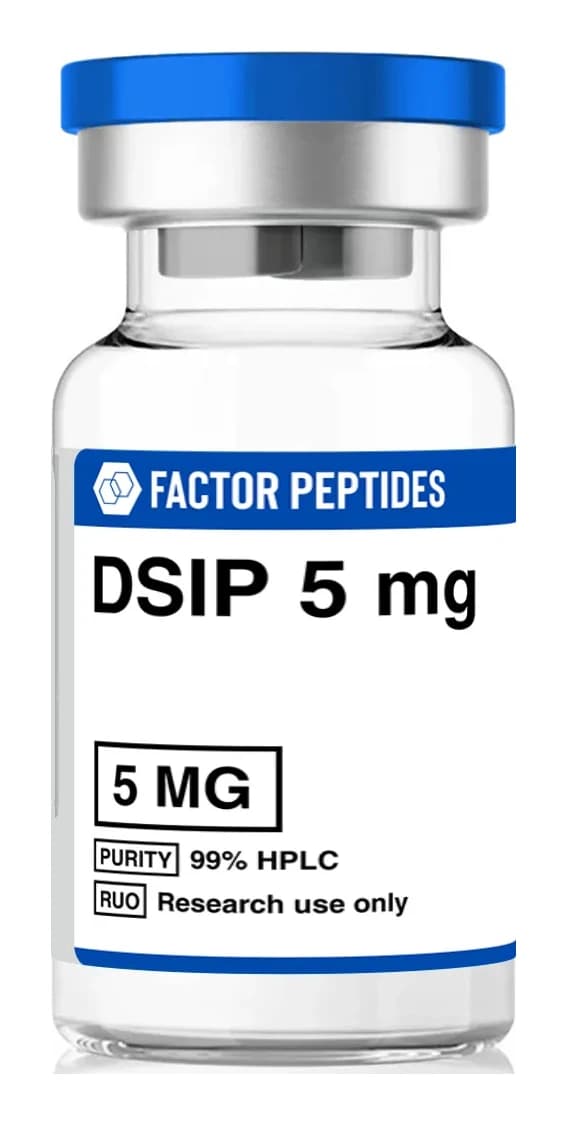
Product Usage: This product is intended solely for use as a research chemical. It is designated exclusively for in vitro research and laboratory testing. All information provided on this site is for educational purposes only. It is strictly prohibited to administer this product to humans or animals. Only licensed and qualified professionals should handle it. This product is not classified as a drug, food, or cosmetic and must not be misrepresented or used as such. This product is for research use only. Not for human consumption.
DSIP 5 mg
Delta sleep-inducing peptide is a small protein like molecule found in the brain that helps regulate several hormonerelated and bodily functions within the nervous system. Current research is focusing on how it may lower oxidative stress, support healthier and more stable heart muscle contractions, and whether it could be useful as a future treatment approach for conditions such as major depressive disorder.
$40.00
Cellular Age Support Peptides
Cellular Growth Research Peptides
Metabolic Activation Peptides
Metabolic Research Peptides
Popular Peptides
Reproductive System Research Peptides
Tissue Integrity Research Peptides
Uncategorized
- DESCRIPTION
- STORAGE
Overview of DSIP (Delta Sleep-Inducing Peptide)
Delta sleep-inducing peptide, often abbreviated as DSIP, is a naturally occurring peptide made up of a short chain of amino acids. It was originally detected in animal brain tissue during deep, slow-wave sleep and was later observed to trigger sleep in experimental models, which led to its name. Ongoing work suggests that DSIP is involved in a range of regulatory processes, including the control of certain pituitary hormones, modulation of stress responses, stabilization of blood pressure, adjustment of sleep–wake patterns, and changes in how pain is perceived. Early findings also point to possible roles in limiting oxidative damage and supporting investigations into mood disorders and cellular growth control.
DSIP Structure
Sequence: Trp-Ala-Gly-Gly-Asp-Ala-Ser-Gly-Glu
Molecular Formula: C35H48N10O15
Molecular Weight: 848.824 g/mol
PubChem CID: 68816
CAS Number: 62568-57-4
Synonyms: Emideltide, DSIP nonapeptide, Deltaran
Research on DSIP
DSIP and Sleep Regulation
Although DSIP was first associated with deep sleep, its exact influence on sleep architecture has proven complex. Studies in various species have produced mixed outcomes, with some reports showing an increase in slow-wave sleep and a reduction in dream-associated sleep, while others have found little or no measurable effect. Certain investigations have even described an initial phase of alertness followed by later drowsiness after DSIP administration. When looking at people who struggle with long-term insomnia, some trials have reported that DSIP can shorten the time it takes to fall asleep, improve sleep continuity, and bring overall sleep quality closer to that of individuals without insomnia, even though traditional brain-wave recordings do not always show strong sedative patterns. These contradictions suggest that DSIP may influence sleep in ways that are not fully captured by standard monitoring techniques and that it could offer a tool for refining how sleep states are assessed in the laboratory.
DSIP in Chronic Pain Studies
Managing persistent pain is challenging because many common pain relievers lose effectiveness over time or cause unwanted effects when used continuously. Preliminary clinical work with DSIP in people experiencing chronic, intense pain episodes has shown reductions in reported pain levels and improvements in general well-being. In these observations, DSIP also appeared to ease discomfort associated with tapering off long-term pain medication, helping to blunt withdrawal-related symptoms and rebound pain when other analgesics were reduced or discontinued.
Animal experiments indicate that DSIP can engage receptor systems in the brain that are also targeted by certain potent pain medications. The resulting antinociceptive effect is clearly dose dependent, yet current findings do not indicate the same pattern of dependence and tolerance typically seen with many drugs that act on these receptor pathways. This has led to interest in DSIP as a potential candidate for longer-term pain management strategies.
Metabolic and Mitochondrial Effects of DSIP
Under stress, cells often shift from efficient, oxygen-based energy production to less efficient pathways that generate more toxic byproducts. Research in rodents suggests that DSIP can help preserve normal mitochondrial respiration even when oxygen levels are reduced, limiting the switch to less efficient metabolism. This preservation of oxidative phosphorylation could have important implications in situations like reduced blood flow to the brain or heart, where maintaining energy production for as long as possible is critical to protecting tissue until circulation is restored.
By supporting healthier mitochondrial function in these conditions, DSIP may indirectly reduce the formation of reactive molecules associated with oxidative stress. This mechanism places DSIP among candidates being explored as potential protectors against cellular damage and age-related decline, although much more work is needed before its role in such applications can be clearly defined.
DSIP, Mood, and Neurochemical Balance
Because DSIP appears to stabilize mitochondrial activity during oxygen deprivation, researchers have examined how it might interact with key brain enzymes and signaling molecules. Experimental studies show that DSIP can influence the activity of monoamine-related pathways and help keep certain neurotransmitter systems from shifting excessively during stress. These findings, together with the tight relationship between sleep quality, energy metabolism, and mood, led to the idea that changes in DSIP levels could be associated with depressive states.
Analyses of fluid surrounding the brain and spinal cord in people diagnosed with major mood disorders have found altered DSIP concentrations compared with individuals without such diagnoses. While these observations do not prove cause and effect, they suggest that DSIP could be part of the wider network of regulators that connect sleep, stress, and emotional health. Research has also linked DSIP to broader hormonal stress pathways and to patterns observed in individuals with severe mood disturbances, indicating that it may one day contribute to a more nuanced understanding of how sleep-related peptides intersect with psychiatric conditions.
DSIP in Withdrawal and Dependence Research
Substance withdrawal, particularly from alcohol and opioids, can involve intense physical and psychological symptoms that complicate detoxification. Clinical observations in groups undergoing treatment for dependence have shown that courses of DSIP may substantially improve withdrawal experiences for a large proportion of participants, reducing both the severity and duration of symptoms. In these settings, alcohol-related withdrawal has tended to respond more quickly, while opioid-related withdrawal often requires longer DSIP administration for noticeable benefit. Because unmanaged withdrawal can be life threatening, especially with certain substances, any compound that eases this process while maintaining safety is of considerable interest for future therapeutic development.
DSIP and Cancer-Related Investigations
Cancer research often focuses on treatment after tumors develop, but another area of interest is reducing the likelihood of malignant changes in the first place. In long-term animal studies where DSIP-containing preparations were administered intermittently over a substantial portion of the lifespan, treated groups showed markedly fewer spontaneous tumors than untreated controls, along with fewer chromosomal abnormalities in bone marrow cells. These findings hint that DSIP might influence mechanisms related to genomic stability and the accumulation of DNA damage, which are central themes in cancer biology and aging research.
DSIP as a Supportive Agent in Cancer Therapy
Beyond potential effects on tumor development, DSIP has been evaluated as a supportive tool during aggressive treatments such as chemotherapy. Such treatments can impair brain function, leading to movement problems, cognitive changes, and mood alterations, particularly in younger patients. Early work suggests that DSIP or related formulations may help normalize certain aspects of central nervous system activity under these conditions. In animal models experiencing brain stress due to limited blood flow or exposure to toxic agents, DSIP-like compounds have been shown to improve survival and support better maintenance of brain blood flow, which may help preserve neural tissue and reduce long-term functional deficits.
Broader Physiologic and Muscle-Related Actions of DSIP
Although DSIP was first associated with sleep regulation, its presence in tissues throughout the body and the uncertainty about where it is produced suggest that its core functions may extend well beyond sleep alone. Some researchers have proposed that DSIP could act in a hormone-like fashion from the hypothalamic region, coordinating multiple systems in a manner similar to other regulatory peptides.
In experimental models, DSIP has been found to influence molecules that normally restrain muscle growth. By dampening these inhibitory signals, DSIP appears to support both increases in muscle fiber size and number, indicating that it may have direct relevance to skeletal muscle remodeling. Additionally, DSIP has been linked to changes in blood pressure, heart rhythm, body temperature regulation, and certain immune-related signaling pathways. Notably, some of these physiological shifts occur before clear signs of sleep, implying that DSIP might prepare the body for rest by gradually adjusting cardiovascular, metabolic, and immune functions.
Across preclinical work, DSIP has generally been associated with a low incidence of observed adverse effects, along with good uptake following subcutaneous administration and more limited impact when given orally in animal models. Experimental dosing schemes in these studies are tailored to the species and conditions being investigated and cannot be directly translated to humans. At present, DSIP is used strictly as a research compound in controlled scientific environments and is not approved for routine human use or unsupervised experimentation.
Factor Peptides Storage Guidelines:
These peptides arrive in a dried, stabilized form produced by a process called lyophilization, or freeze drying. In this state, they are generally suitable for transport and short-term storage at typical room temperatures for several months.
Once the dry powder is mixed with bacteriostatic water and turned into a liquid solution, the storage requirements change. The reconstituted solution should be kept in a refrigerator to help maintain its properties, and is usually considered suitable for use for about 30 days under chilled conditions.
Lyophilization involves freezing the material and then exposing it to low pressure so that ice in the sample passes directly from solid to vapor, rather than melting. This leaves behind a light, porous, white solid that is more stable than the original liquid. In this form, the product can often be kept at room temperature until it is time to add diluent.
After delivery, it is good practice to protect the vials from heat and strong light. If the product will be used in the near future, storing the lyophilized powder or reconstituted solution in a refrigerator at temperatures below about 4°C (39°F) is typically appropriate. The dry form often remains intact at room temperature for a number of weeks, so this may also be acceptable when immediate refrigeration is not available and the intended use is relatively soon.
For storage over longer periods, such as many months or years, much colder conditions are preferred. Placing the vials in a deep freezer, around -80°C (-112°F), is commonly used to help preserve the structure and activity of peptides for extended time frames.


