
r

Product Usage: This product is intended solely for use as a research chemical. It is designated exclusively for in vitro research and laboratory testing. All information provided on this site is for educational purposes only. It is strictly prohibited to administer this product to humans or animals. Only licensed and qualified professionals should handle it. This product is not classified as a drug, food, or cosmetic and must not be misrepresented or used as such. This product is for research use only. Not for human consumption.

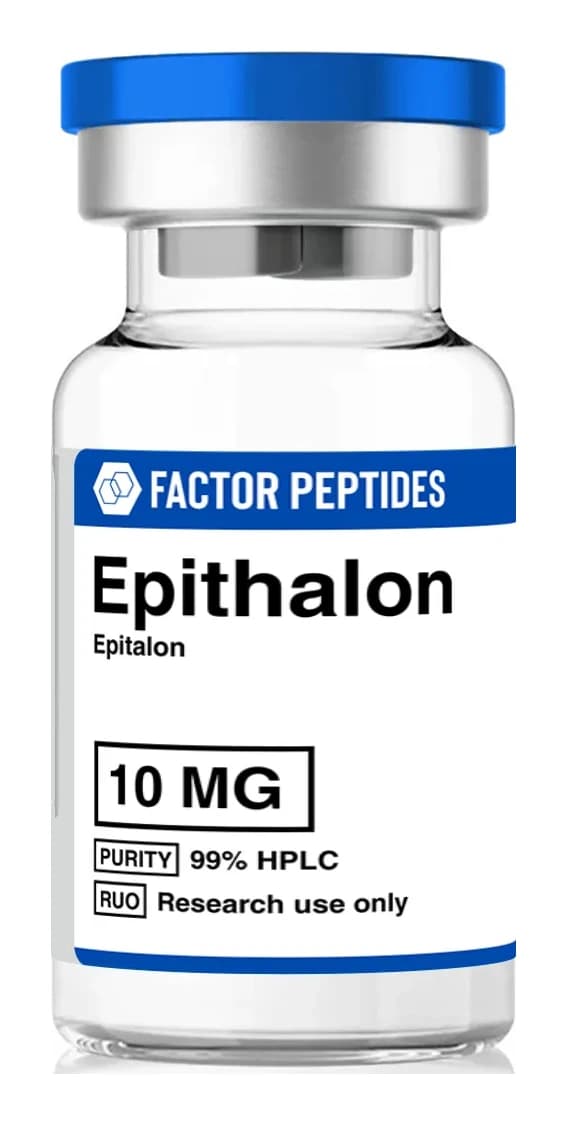
Epithalon 10 mg

Epithalon is a lab-created peptide related to a naturally occurring substance and is being investigated for its influence on telomerase, an enzyme that helps preserve the protective ends of chromosomes known as telomeres. Scientific studies indicate that this compound may support the lengthening of telomeres, which in turn is being examined for its possible role in slowing or counteracting certain cellular changes associated with aging.

$50.00

  • DESCRIPTION
  • STORAGE

What Is Epithalon?

Epithalon, sometimes written as epitalon or epithalamin, is a laboratory-made tetrapeptide that has been studied for its influence on cellular aging processes. It has been shown in animal and cell models to stimulate the enzyme that maintains chromosome ends and to support the natural rhythm of certain hormones related to the day–night cycle. Early experimental work suggests that Epithalon may delay age-related decline in various body systems, extend lifespan in some model organisms, and influence processes linked to immune balance, cell growth control, and responses to infection.

Epithalon Structure

Sequence: Ala-Glu-Asp-Gly
Molecular Formula: C14H22N4O9
Molecular Weight: 390.349 g/mol
PubChem CID: 219042
CAS Number: 307297-39-8

Epithalon Research

1. Telomerase Activation and Longevity

Work in insects and mammals has shown that Epithalon can significantly influence survival curves, with treated groups of certain species living longer on average than untreated controls. In some models, this has included animals that are genetically more likely to develop heart or malignant disease, where Epithalon still increased lifespan relative to comparison groups. Part of this effect appears to stem from its impact on cellular stress markers and the reduction of damage caused by unstable reactive molecules.

Laboratory studies on human cells grown in culture indicate that Epithalon can stimulate telomerase, the enzyme responsible for maintaining the protective caps at the ends of chromosomes. By supporting telomere maintenance, the peptide may help slow the rate at which DNA strands accumulate structural errors during cell division. Over time, fewer accumulated defects can translate into better preservation of normal cell function, slower functional decline, and a lower likelihood that cells will drift toward disorganized or malignant behavior.

2. Epithalon and Gene Activity

The influence of Epithalon is not limited to telomeres. Research suggests that the peptide can interact with specific regions of DNA that govern whether particular genes are switched on or off. In experimental systems, Epithalon has been observed to bind to promoter zones of several genes involved in immune responsiveness, tissue remodeling, and protein processing, leading to altered levels of those gene products.

For example, Epithalon has been linked to enhanced signaling in pathways that help immune cells communicate and coordinate responses, as well as to genes that regulate the structure of connective tissues such as skin and tendons. In aging immune cells, it has been shown to increase the output of certain messenger molecules that are important for antiviral defense, indicating a potential role in supporting immune vigilance as organisms grow older.

The following are reported DNA interaction targets influenced by Epithalon:

  1. CD5 – Supports differentiation and maturation of certain immune cell subsets.
  2. IL-2 – Promotes production of a key regulator of white blood cell growth and activity.
  3. MMP2 – Modulates enzymes that remodel extracellular matrix and may help temper inflammatory reactions.
  4. Tram1 – Assists in the handling and processing of newly synthesized proteins.
  5. Arylalkylamine-N-acetyltransferase – Participates in the biochemical pathway that produces melatonin.
  6. pCREB – Contributes to circadian rhythm control and has been linked to protective effects against abnormal cell growth.
  7. Telomerase – Enhances the enzyme that maintains telomere length and supports cellular longevity.

3. Effects on Skin Structure and Repair

Because Epithalon can influence genes involved in matrix remodeling, its impact on skin and other connective tissues has been a focus of several studies. In experimental models, the peptide increases the activity of fibroblasts, the cells responsible for producing collagen, elastin, and related structural components. Exposed fibroblast populations have shown noticeably higher levels of activity compared with untreated controls, suggesting improved capacity for maintenance and regeneration of the extracellular framework that supports skin firmness and elasticity.

Epithalon has also been associated with reduced activity of enzymes that drive programmed cell death in skin cells. By moderating these pathways, the peptide appears to help maintain fibroblast viability for longer periods, which may contribute to better preservation of skin thickness, resilience, and overall structural integrity as tissues age.

4. Influence on Tumor Development

In animal models where tumors arise spontaneously, repeated courses of Epithalon have been reported to slow tumor growth and, in some cases, reduce the likelihood that malignant cells spread to distant organs. Experiments in strains predisposed to specific types of tumors, including mammary and reproductive system malignancies, suggest that Epithalon may alter the local environment in ways that are less favorable to rapid cancer expansion.

One proposed mechanism involves the peptide’s impact on circadian clock genes in brain regions that regulate daily rhythms. Certain components of the internal clock are often expressed at lower levels in tumor cells, and restoring more normal patterns of expression appears to influence how these cells respond to stressors such as radiation. By improving the sensitivity of abnormal cells to conventional treatments, Epithalon could theoretically allow for lower doses of such therapies while maintaining or enhancing their effectiveness, although this concept remains under active study.

5. Melatonin Rhythm and Epithalon

Melatonin, a hormone closely tied to sleep timing and age-related changes in physiology, is produced mainly in a small gland deep in the brain. Studies in animal models have shown that Epithalon and related short peptides can affect the gene machinery that controls melatonin synthesis and release. By adjusting the expression of specific enzymes and transcription factors in this pathway, Epithalon appears to help normalize daily melatonin cycles that have become flattened or irregular with age.

In work with non-human primates and older subjects, Epithalon exposure has been associated with a more regular day–night melatonin pattern, suggesting potential benefits for restoring healthier circadian rhythms. This normalization of hormonal timing may in turn support better sleep quality, metabolic regulation, and overall physiological balance.

6. Visual Function and Retinal Health

Experimental studies in models of degenerative eye conditions have reported that Epithalon can help preserve retinal structure and function. Treated subjects showed a higher proportion of improved visual outcomes compared with untreated groups, with evidence of better-maintained retinal layers and enhanced electrical responses from the light-sensing cells that enable vision.

These findings imply that Epithalon may support protective processes in neural tissues of the eye, possibly through its combined effects on gene expression, antioxidant defenses, and local blood flow regulation.

Across preclinical investigations, Epithalon has generally demonstrated a low incidence of observed adverse reactions and favorable absorption when delivered by subcutaneous routes in animal models, with more limited activity noted after oral administration. Dosing regimens used in these experiments are specific to the species and study design and cannot be directly extrapolated to people. At this time, Epithalon is intended solely for controlled laboratory and experimental research and is not authorized for routine human use or unsupervised self-administration.

Factor Peptides Storage Guidelines:

These peptides arrive in a dried, stabilized form produced by a process called lyophilization, or freeze drying. In this state, they are generally suitable for transport and short-term storage at typical room temperatures for several months.

Once the dry powder is mixed with bacteriostatic water and turned into a liquid solution, the storage requirements change. The reconstituted solution should be kept in a refrigerator to help maintain its properties, and is usually considered suitable for use for about 30 days under chilled conditions.

Lyophilization involves freezing the material and then exposing it to low pressure so that ice in the sample passes directly from solid to vapor, rather than melting. This leaves behind a light, porous, white solid that is more stable than the original liquid. In this form, the product can often be kept at room temperature until it is time to add diluent.

After delivery, it is good practice to protect the vials from heat and strong light. If the product will be used in the near future, storing the lyophilized powder or reconstituted solution in a refrigerator at temperatures below about 4°C (39°F) is typically appropriate. The dry form often remains intact at room temperature for a number of weeks, so this may also be acceptable when immediate refrigeration is not available and the intended use is relatively soon.

For storage over longer periods, such as many months or years, much colder conditions are preferred. Placing the vials in a deep freezer, around -80°C (-112°F), is commonly used to help preserve the structure and activity of peptides for extended time frames.

Factor Peptides Logo

You must be 21 years of age or older to enter this site.

By accessing this website, you agree to our Terms and Conditions.

All products offered by Factor Peptides are intended strictly for research and laboratory use only. Accessories such as bacteriostatic water, syringes, or related equipment are not included. Most compounds are provided in lyophilized (powdered) form and must be properly reconstituted with an appropriate diluent before use in research settings.