
Product Usage: This product is intended solely for use as a research chemical. It is designated exclusively for in vitro research and laboratory testing. All information provided on this site is for educational purposes only. It is strictly prohibited to administer this product to humans or animals. Only licensed and qualified professionals should handle it. This product is not classified as a drug, food, or cosmetic and must not be misrepresented or used as such. This product is for research use only. Not for human consumption.
GHK-Cu
GHK-Cu is a naturally occurring copper peptide found in human plasma, urine, and saliva. It plays a critical role in tissue repair and regeneration. Research in animal models shows that GHK-Cu:
- Promotes wound healing by stimulating collagen synthesis and fibroblast proliferation
- Enhances immune function and supports the body’s natural defense systems
- Improves skin health through angiogenesis (blood vessel formation) and structural protein support
- Acts as a biological feedback signal following tissue injury, helping to initiate repair processes
- Functions as a potent antioxidant, reducing free radical damage and oxidative stress
These properties make GHK-Cu a valuable peptide for research in dermatology, regenerative medicine, and age-related tissue degeneration.
Price range: $55.00 through $75.00
All Products
- DESCRIPTION
- STORAGE
GHK-Cu
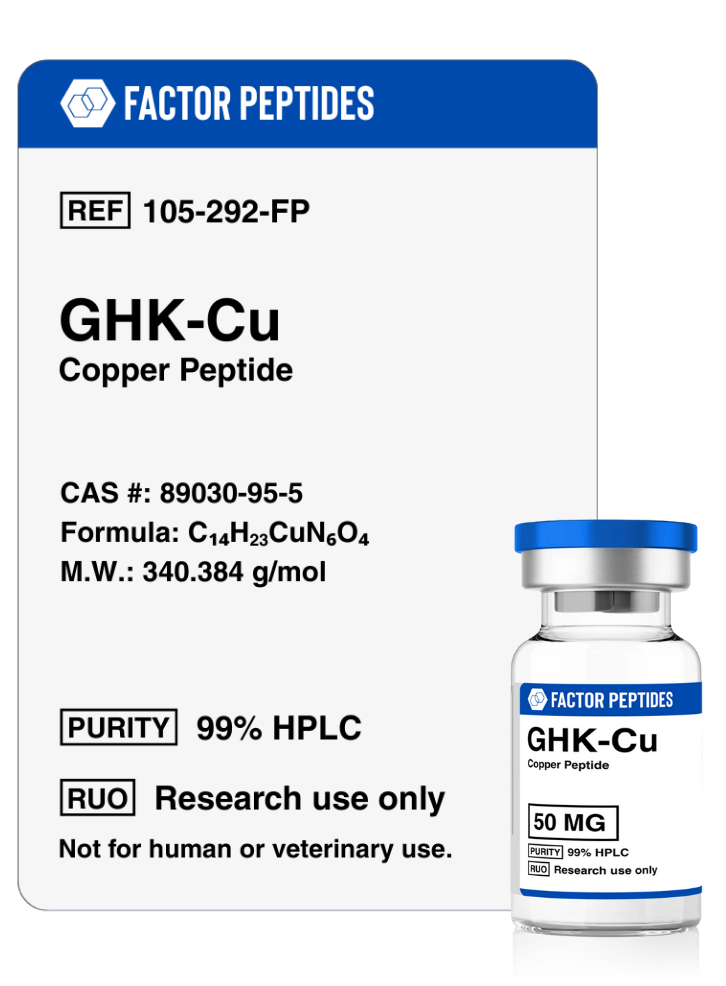
GHK-Cu is a naturally occurring peptide complex that was first isolated from human blood plasma and was later identified in urine and saliva. It consists of the tripeptide GHK (glycyl histidyl lysine) bound to a copper ion.
Research has shown that GHK-Cu has substantial benefits in wound healing and immune modulation. It is of particular interest in anti aging research because it has been found to:
- Support tissue repair and regeneration
- Suppress free radical damage
- Increase protein synthesis
- Promote healthier skin and fibroblast function
- Exert antibacterial and antifungal activity in certain formulations
GHK-Cu Structure
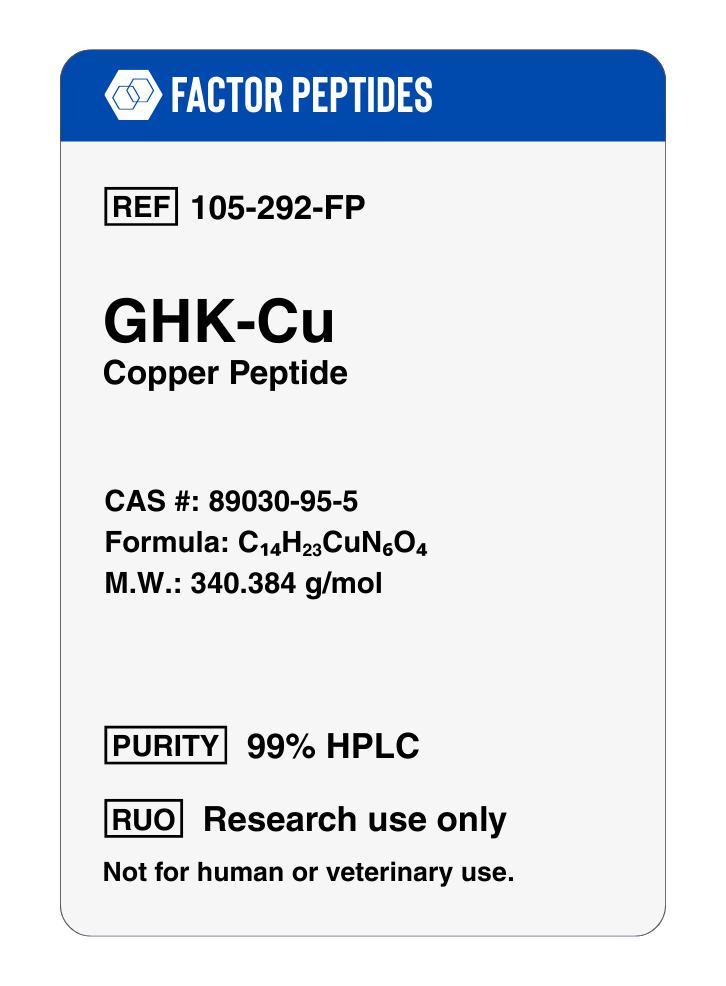
Sequence: Gly His Lys·Cu·xHAc
Molecular Formula: C14H23CuN6O4
Molecular Weight: 401.91 g/mol
PubChem CID: 73587
CAS Number: 89030 95 5
GHK-Cu Research
1. GHK-Cu and Skin Healing
As a natural component of human blood, GHK-Cu plays an important role in skin regeneration pathways. In skin cell cultures, GHK-Cu has been shown to stimulate both the synthesis and controlled breakdown of:
- Collagen
- Glycosaminoglycans
- Proteoglycans
- Chondroitin sulfate and other extracellular matrix components
At least part of this effect is mediated by the peptide’s ability to recruit fibroblasts, immune cells, and endothelial cells to sites of injury, where it appears to coordinate their activity in tissue repair.
GHK-Cu is a common ingredient in skin care and cosmetic formulations. In research and cosmetic settings, it has been associated with:
- Improved skin firmness and elasticity
- Reduction in the appearance of fine lines and wrinkles
- Diminished sun damage and hyperpigmentation
- Smoother skin texture and reduced appearance of scars
The ability of GHK-Cu to modulate collagen synthesis and remodeling is central to these effects and is linked, in part, to increased levels of transforming growth factor β (TGF β). The peptide likely acts through several biochemical pathways, including regulation at the level of gene transcription.
In mouse models of burn injury, GHK-Cu increased the rate of healing by up to 33%. In addition to recruiting repair cells, GHK-Cu also promotes angiogenesis at the wound site, which is particularly important in burns where blood vessels have been damaged or cauterized.
2. GHK-Cu and Antimicrobial Activity
Infection is a major barrier to wound healing, especially in burns and in individuals with compromised immune systems such as those with diabetes or HIV. When combined with certain fatty acids, GHK-Cu forms a potent antimicrobial complex with activity against a range of bacteria and fungi that commonly complicate wound healing.
In clinical research on diabetic ulcers, GHK-Cu plus standard care produced better outcomes than standard care alone. Treated patients showed:
- Approximately 40% greater wound closure
- About 27% lower infection rates
Similar improvements have been observed in patients with ischemic open wounds.
3. GHK-Cu, Cognition, and Nervous System Function
GHK-Cu has been investigated for potential neuroprotective and neuroregenerative effects. Experimental evidence suggests that it can:
- Enhance angiogenesis within the nervous system
- Promote nerve outgrowth and neurite extension
- Reduce inflammatory signaling in the central nervous system
- Help reset pathological gene expression toward a healthier profile
GHK-Cu is found at relatively high concentrations in the brain, but levels decline with age. Some researchers propose that this decline may contribute to age related neurodegeneration and that loss of GHK-Cu, rather than the emergence of entirely new disease processes, may underlie certain aspects of cognitive decline.
In rat models of brain injury, GHK-Cu appears to protect neurons by limiting apoptosis through the miR 339 5p / VEGFA pathway, which is active after intracerebral hemorrhage and stroke. In these models, GHK-Cu improved neurological function, reduced swelling, and inhibited neuron death associated with overexpression of miR 339 5p.
4. GHK-Cu and Chemotherapy-Related Fibrosis
In mouse models, GHK-Cu protects lung tissue from fibrosis caused by the chemotherapeutic drug bleomycin. This suggests that GHK-Cu could potentially serve as an adjuvant to chemotherapy, allowing for effective dosing while limiting fibrotic side effects.
Mechanistic studies indicate that GHK-Cu modulates levels of TNF alpha and IL 6, two pro inflammatory cytokines associated with extracellular matrix changes and smooth muscle remodeling in the lung. By dampening inflammatory signaling, GHK-Cu reduces fibrotic remodeling and supports more normal collagen deposition.
Similar protective effects have been observed in models of acute respiratory distress syndrome (ARDS), an inflammatory lung condition that can arise rapidly and is often fatal. In ARDS models, GHK-Cu again appears to act through downregulation of TNF alpha and IL 6 expression.
5. GHK-Cu and Pain Modulation
In rat models, GHK-Cu administration produces a dose dependent reduction in pain related behaviors. This analgesic effect is associated with increased levels of the amino acid L lysine. Additional research indicates that GHK-Cu can also raise levels of L arginine, another amino acid with analgesic properties.
These findings point toward the possibility of novel pain control strategies that do not rely on opiate medications or NSAIDs, both of which are associated with significant side effects, especially during long term use.
GHK-Cu Summary
GHK-Cu is a naturally occurring copper peptide complex with wide ranging effects on tissue repair, inflammation, and cellular signaling. Experimental research indicates that GHK-Cu:
- Supports wound healing and skin regeneration
- Modulates collagen and extracellular matrix remodeling
- Provides antimicrobial support when formulated with certain fatty acids
- Exerts neuroprotective and potentially cognitive benefits in animal models
- Helps protect lung tissue against fibrosis in chemotherapy and ARDS models
- Shows dose dependent analgesic effects in preclinical studies
FOR RESEARCH USE ONLY
All information presented above is for informational and educational purposes only.
GHK-Cu is supplied strictly for in vitro and other approved laboratory research applications. It is not a medicine or drug, has not been evaluated or approved by the FDA or any other regulatory authority to diagnose, treat, cure, or prevent any disease, and must not be introduced into the bodies of humans or animals.
Only licensed and qualified researchers should purchase and handle GHK-Cu for scientific research.
Factor Peptides Storage Guidelines:
These peptides arrive in a dried, stabilized form produced by a process called lyophilization, or freeze drying. In this state, they are generally suitable for transport and short-term storage at typical room temperatures for several months.
Once the dry powder is mixed with bacteriostatic water and turned into a liquid solution, the storage requirements change. The reconstituted solution should be kept in a refrigerator to help maintain its properties, and is usually considered suitable for use for about 30 days under chilled conditions.
Lyophilization involves freezing the material and then exposing it to low pressure so that ice in the sample passes directly from solid to vapor, rather than melting. This leaves behind a light, porous, white solid that is more stable than the original liquid. In this form, the product can often be kept at room temperature until it is time to add diluent.
After delivery, it is good practice to protect the vials from heat and strong light. If the product will be used in the near future, storing the lyophilized powder or reconstituted solution in a refrigerator at temperatures below about 4°C (39°F) is typically appropriate. The dry form often remains intact at room temperature for a number of weeks, so this may also be acceptable when immediate refrigeration is not available and the intended use is relatively soon.
For storage over longer periods, such as many months or years, much colder conditions are preferred. Placing the vials in a deep freezer, around -80°C (-112°F), is commonly used to help preserve the structure and activity of peptides for extended time frames.