
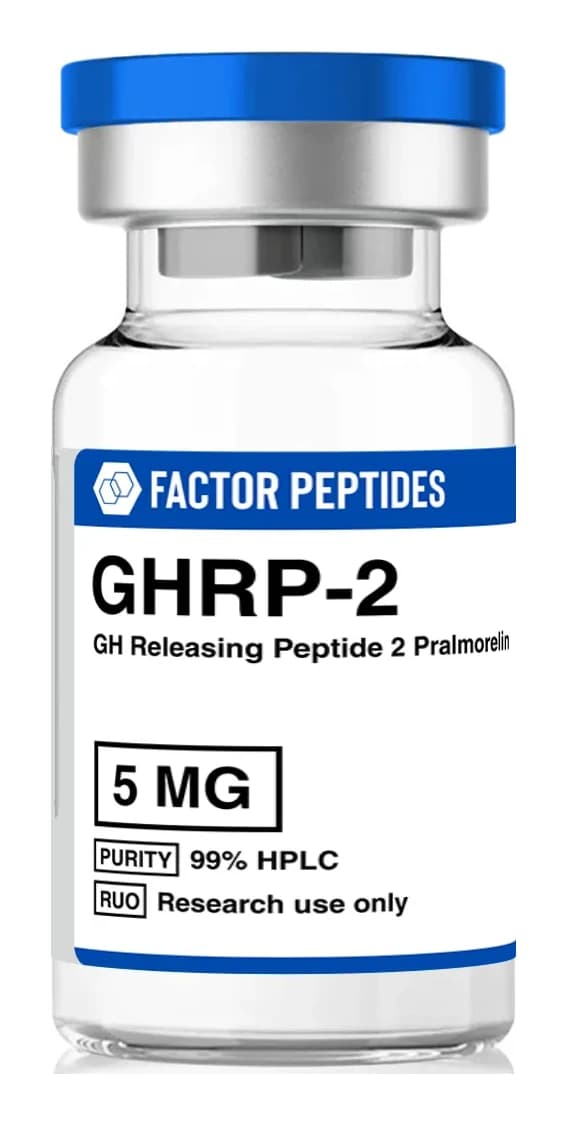
Product Usage: This product is intended solely for use as a research chemical. It is designated exclusively for in vitro research and laboratory testing. All information provided on this site is for educational purposes only. It is strictly prohibited to administer this product to humans or animals. Only licensed and qualified professionals should handle it. This product is not classified as a drug, food, or cosmetic and must not be misrepresented or used as such. This product is for research use only. Not for human consumption.
GHRP2 5 mg
GHRP-2 is a synthetic peptide classified as a growth hormone secretagogue, meaning it stimulates the natural release of growth hormone by binding to the ghrelin/growth hormone secretagogue receptor (GHS-R).
Research findings highlight several potential benefits:
- Promotes muscle growth and recovery through elevated growth hormone levels
- Modulates immune function, potentially aiding in immune regulation
- Improves sleep patterns, contributing to better overall recovery and well-being
- Demonstrates oral bioavailability, making it a unique candidate among similar peptides for non-injectable administration
These properties position GHRP-2 as an important peptide in the study of metabolic function, regenerative processes, and endocrine regulation.
$40.00
Cellular Age Support Peptides
Cellular Growth Research Peptides
Metabolic Activation Peptides
Metabolic Research Peptides
Popular Peptides
Reproductive System Research Peptides
Tissue Integrity Research Peptides
Uncategorized
- DESCRIPTION
- STORAGE
What Is GHRP-2?
GHRP 2 (also known as pralmorelin) is a synthetic growth hormone secretagogue that binds to the ghrelin/growth hormone secretagogue receptor. It was the first peptide in this class to be developed.
GHRP 2 is currently used as a diagnostic test peptide in clinical settings to assess growth hormone deficiency and secondary adrenal failure. It has undergone phase II clinical trials for the evaluation of short stature and remains an active focus in preclinical research for its effects on:
- Appetite regulation
- Muscle growth and preservation
- Immune system support
- Cardiovascular protection
- Sleep architecture
- Pain perception
Unlike many peptide hormones, GHRP 2 is both orally and sublingually active, so it does not require injection in research models to exert its effects.
GHRP-2 Structure
GHRP-2 Structure
Sequence: D Ala D 2Nal Ala Trp D Phe Lys
Molecular Formula: C45H55N9O6
Molecular Weight: 817.97 g/mol
PubChem CID: 6918245
CAS Number: 158861 67 7
Code Names: KP 102, GPA 748, WAY GPA 748
GHRP-2 Effects
1. Muscle Protection and Growth
Research in yaks indicates that GHRP 2 can enhance muscle mass through two complementary mechanisms:
- Increasing protein deposition in muscle
- Reducing protein degradation by inactivating atrogin 1 and MuRF1, key regulators of muscle catabolism
In this model, GHRP 2 helped animals overcome natural growth plateaus caused by food restriction, disease, and harsh environmental conditions, supporting the development of lean body mass even under stres. These findings suggest potential relevance in research on muscle wasting seen in chronic illness.
2. Appetite Stimulation
GHRP 2 has been shown to increase food intake in animal models and human volunteers. In controlled studies in healthy adult men, GHRP 2 significantly increased caloric intake compared to placebo.
Appetite stimulation is of particular interest in research on chronic disease, cancer cachexia, and other conditions where inadequate nutritional intake contributes to poor outcomes.
3. Cardioprotective Potential
Experiments in fetal heart cell lines demonstrate that GHRP 2 and related peptides (GHRP 1 and GHRP 6) can reduce apoptosis in cardiomyocytes, supporting cell survival under stress. This effect is especially relevant in ischemic settings such as heart attack, where nutrient and oxygen supply are compromised.
Work with the related analogue Hexarelin suggests that these peptides may act through a specific cardiac receptor, opening a research pathway for novel cardioprotective agents.
4. Immune System Support
GHRP 2 has been shown to stimulate and partially rejuvenate the thymus, the central organ responsible for T cell maturation. With age, thymic output declines, which contributes to reduced immune competence and impaired tissue repair.
In research models, GHRP 2 increases both the number and diversity of T cells produced by the thymus, leading to enhanced immune function and potentially improved responses to infections and tissue damage.
5. Sleep Architecture and Quality
Polysomnographic studies indicate that GHRP 2 can alter sleep structure by:
- Increasing the duration of stage 3 and 4 sleep by approximately 50 percent each
- Increasing REM sleep duration by about 20 percent
- Reducing deviation from “normal” sleep patterns by up to one third
These changes have been associated with improvements in cognitive performance, blood pressure regulation, healing, and subjective energy levels. Such findings are of particular interest in older research subjects, where age related changes in sleep are common.
6. Modulation of Pain Perception
In osteoarthritis models, GHRP 2 reduced pain behaviors before tissue healing could reasonably account for the effect, suggesting a direct action on pain pathways rather than a purely structural effect.
Subsequent work showed that GHRP 2 interacts with opioid receptors. Unlike many traditional opioids, which act on several receptor subtypes, GHRP 2 shows selective agonism, primarily targeting receptors associated with analgesia and sedation. This selectivity has made GHRP 2 a valuable tool in research aimed at designing next generation analgesics with reduced risks of respiratory depression and addiction.
GHRP-2 Summary
GHRP 2 is a synthetic growth hormone secretagogue that activates the ghrelin/growth hormone secretagogue receptor and is orally and sublingually active. Research indicates that it can:
- Support muscle mass by increasing protein synthesis and reducing catabolism
- Stimulate appetite in underfed or catabolic states
- Protect cardiomyocytes from apoptosis in ischemic conditions
- Enhance thymic function and T cell output
- Improve sleep architecture and overall sleep quality
- Modulate pain perception through selective opioid receptor activity
GHRP 2 exhibits minimal to moderate side effects, with low oral and excellent subcutaneous bioavailability in mice. Per kg dosing in mice does not scale to humans.
FOR RESEARCH USE ONLY
All articles and product information provided on this website are for informational and educational purposes only.
The products offered on this website are furnished for in vitro studies only. In vitro studies (Latin: “in glass”) are carried out outside of living organisms. These products are not medicines or drugs and have not been approved by the FDA to prevent, treat, or cure any medical condition, ailment, or disease. Bodily introduction of any kind into humans or animals is strictly forbidden by law.
GHRP 2 for sale at Peptide Sciences is limited to educational and scientific research only, not for human consumption. Only purchase GHRP 2 if you are a properly licensed and qualified researcher.
Factor Peptides Storage Guidelines:
These peptides arrive in a dried, stabilized form produced by a process called lyophilization, or freeze drying. In this state, they are generally suitable for transport and short-term storage at typical room temperatures for several months.
Once the dry powder is mixed with bacteriostatic water and turned into a liquid solution, the storage requirements change. The reconstituted solution should be kept in a refrigerator to help maintain its properties, and is usually considered suitable for use for about 30 days under chilled conditions.
Lyophilization involves freezing the material and then exposing it to low pressure so that ice in the sample passes directly from solid to vapor, rather than melting. This leaves behind a light, porous, white solid that is more stable than the original liquid. In this form, the product can often be kept at room temperature until it is time to add diluent.
After delivery, it is good practice to protect the vials from heat and strong light. If the product will be used in the near future, storing the lyophilized powder or reconstituted solution in a refrigerator at temperatures below about 4°C (39°F) is typically appropriate. The dry form often remains intact at room temperature for a number of weeks, so this may also be acceptable when immediate refrigeration is not available and the intended use is relatively soon.
For storage over longer periods, such as many months or years, much colder conditions are preferred. Placing the vials in a deep freezer, around -80°C (-112°F), is commonly used to help preserve the structure and activity of peptides for extended time frames.


