
Product Usage: This product is intended solely for use as a research chemical. It is designated exclusively for in vitro research and laboratory testing. All information provided on this site is for educational purposes only. It is strictly prohibited to administer this product to humans or animals. Only licensed and qualified professionals should handle it. This product is not classified as a drug, food, or cosmetic and must not be misrepresented or used as such. This product is for research use only. Not for human consumption.
Hexarelin
Hexarelin is a synthetic analogue of the natural hormone ghrelin, designed to stimulate growth hormone release. Research has highlighted its potential in cardiovascular health, particularly in protecting heart tissue after cardiac ischemia or heart attacks. In addition to its cardioprotective effects, Hexarelin has been shown to counteract skeletal muscle wasting and to improve lipid profiles by reducing cholesterol and triglyceride levels, making it a promising candidate in metabolic and muscle-related research.
Price range: $40.00 through $55.00
Cellular Age Support Peptides
Cellular Growth Research Peptides
Metabolic Activation Peptides
Metabolic Research Peptides
Popular Peptides
Reproductive System Research Peptides
Tissue Integrity Research Peptides
Uncategorized
- DESCRIPTION
- STORAGE
What Is Hexarelin?
Hexarelin, also known as Examorelin, is a lab-created peptide that mimics the effects of ghrelin and is very similar in structure to GHRP-6, differing only by a small methyl modification. Like other ghrelin analogues, it can be active when taken orally or under the tongue and shows high selectivity for its targets. Experimental work has focused heavily on its ability to support heart cells under stress, particularly in situations involving reduced blood flow or limited nutrients.
Hexarelin Structure
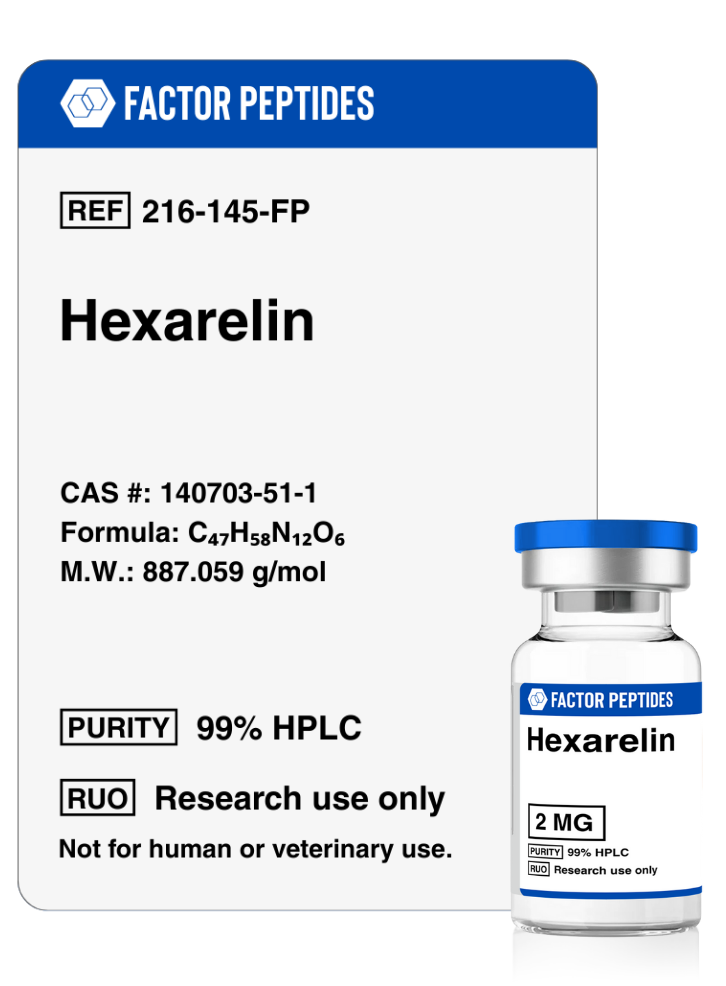
Sequence: His-D-Trp(2-Me)-Ala-Trp-D-Phe-Lys
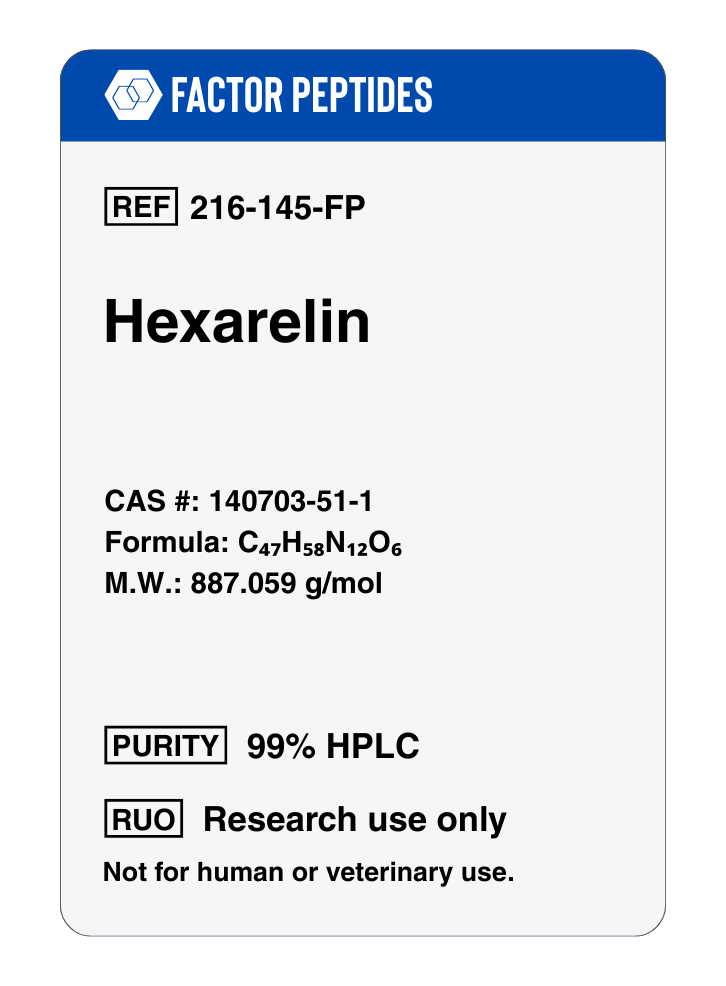
Molecular Formula: C47H58N12O6
Molecular Weight: 887.059 g/mol
PubChem CID: 6918297
CAS Number: 140703-51-1
Hexarelin Effects
1. Protects the Heart
Hexarelin interacts with specific receptors in heart tissue, including CD36 and the growth hormone secretagogue receptor (GHSR). In animal models of heart attack, activation of these receptors has been linked to better survival of heart muscle cells and reduced programmed cell death. Treated animals tend to show better heart performance, more viable heart cells, and lower levels of biochemical markers associated with cell damage and oxidative stress.
Related studies with similar peptides have shown that this class of compounds can reduce harmful remodeling of the heart that often follows injury or long-standing heart failure. By easing oxidative stress, influencing signaling pathways such as PTEN and protein kinase B, and shifting the nervous system balance away from chronic “fight or flight” activation, these peptides help preserve heart structure and function. There is also evidence that hexarelin can improve cardiac performance in models of diabetes by modulating the way heart muscle cells handle calcium and potassium, which are key ions in electrical activity and contraction.
2. Improves Fat Measures
“Dyslipidemia” describes unhealthy levels or patterns of fats in the bloodstream and is a major contributor to metabolic disorders, including diabetes, even in people who are not visibly overweight. Experimental work in animals suggests that peptides in the same family as hexarelin can help normalize blood lipid profiles in the setting of insulin resistance, while also improving blood sugar control and sensitivity to insulin. These findings raise the possibility that ghrelin-like peptides could one day inspire new approaches to managing severe lipid abnormalities alongside or instead of current cholesterol-lowering medications.
3. Protects Muscle
The protective actions of hexarelin are not limited to the heart. In models of cachexia, where severe weight and muscle loss occur as a result of chronic illness or chemotherapy, related peptides have been shown to help preserve muscle tissue. They appear to do this by stabilizing calcium handling inside muscle cells and helping to maintain mitochondrial function. Since mitochondria are responsible for generating cellular energy, supporting their function may help cells better withstand toxic or stressful conditions. By counteracting disruptions in calcium regulation commonly seen during cancer treatment, these peptides may reduce the loss of lean body mass and support overall physical resilience.
Hexarelin Research Summary
Heart disease and metabolic disorders remain leading health challenges worldwide, and hexarelin has become a valuable tool for exploring how the heart and muscles respond to injury, stress, and altered metabolism. Research with this peptide has highlighted new pathways involved in heart protection, cardiac remodeling, lipid balance, and muscle preservation. These insights may eventually contribute to the design of novel therapies for conditions that are currently difficult to manage, such as chronic heart failure or treatment-related muscle wasting.
Hexarelin Safety and Research Use Only
In animal studies, hexarelin has been reported to have moderate side effects, with low oral and strong subcutaneous bioavailability in mice. Doses used in these models cannot be directly converted to appropriate amounts for humans. Hexarelin is an experimental compound intended only for controlled laboratory and preclinical research. It is not a medicine, is not approved to diagnose, treat, cure, or prevent any disease, and is not for use in humans or animals.
Factor Peptides Storage Guidelines:
These peptides arrive in a dried, stabilized form produced by a process called lyophilization, or freeze drying. In this state, they are generally suitable for transport and short-term storage at typical room temperatures for several months.
Once the dry powder is mixed with bacteriostatic water and turned into a liquid solution, the storage requirements change. The reconstituted solution should be kept in a refrigerator to help maintain its properties, and is usually considered suitable for use for about 30 days under chilled conditions.
Lyophilization involves freezing the material and then exposing it to low pressure so that ice in the sample passes directly from solid to vapor, rather than melting. This leaves behind a light, porous, white solid that is more stable than the original liquid. In this form, the product can often be kept at room temperature until it is time to add diluent.
After delivery, it is good practice to protect the vials from heat and strong light. If the product will be used in the near future, storing the lyophilized powder or reconstituted solution in a refrigerator at temperatures below about 4°C (39°F) is typically appropriate. The dry form often remains intact at room temperature for a number of weeks, so this may also be acceptable when immediate refrigeration is not available and the intended use is relatively soon.
For storage over longer periods, such as many months or years, much colder conditions are preferred. Placing the vials in a deep freezer, around -80°C (-112°F), is commonly used to help preserve the structure and activity of peptides for extended time frames.