
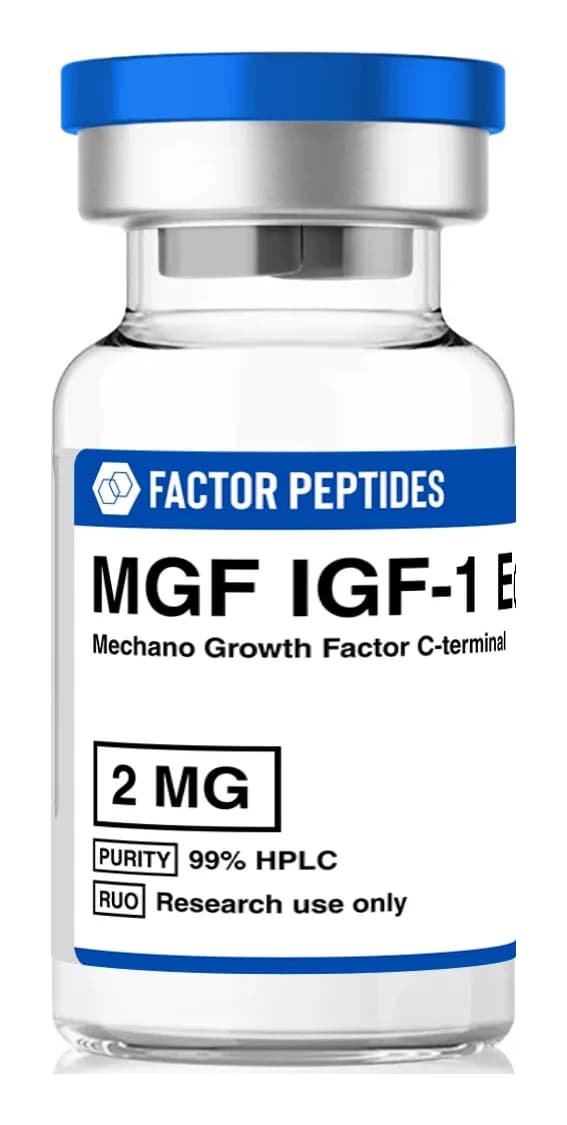
Product Usage: This product is intended solely for use as a research chemical. It is designated exclusively for in vitro research and laboratory testing. All information provided on this site is for educational purposes only. It is strictly prohibited to administer this product to humans or animals. Only licensed and qualified professionals should handle it. This product is not classified as a drug, food, or cosmetic and must not be misrepresented or used as such. This product is for research use only. Not for human consumption.
MGF 2 mg
MGF (Mechano Growth Factor) is a naturally occurring splice variant of IGF-1 (insulin-like growth factor-1) that plays a crucial role in tissue regeneration and adaptation. Produced in response to mechanical stress or injury, MGF has been shown in research to stimulate tissue repair, promote cellular growth, and support regeneration processes in various body systems.
MGF is particularly influential in skeletal muscle, where it enhances the activation and proliferation of satellite cells—key players in muscle repair and growth. It accelerates recovery following injury or intense physical activity and has shown potential in protecting tissues like cartilage from damage associated with repetitive stress, weight-bearing activity, or trauma. Beyond musculoskeletal benefits, studies suggest MGF may contribute to heart tissue repair after injury and aid in wound healing. These findings position MGF as a promising target for therapies aimed at enhancing recovery and protecting tissues in both athletic and clinical settings.
$65.00
Cellular Age Support Peptides
Cellular Growth Research Peptides
Metabolic Activation Peptides
Metabolic Research Peptides
Popular Peptides
Reproductive System Research Peptides
Tissue Integrity Research Peptides
Uncategorized
- DESCRIPTION
- STORAGE
MGF Structure
Primary sequence of MGF
Source: ResearchGate
-
Sequence:
Tyr Gln Pro Pro Ser Thr Asn Lys Asn Thr Lys Ser Gln Arg Arg Lys Gly Ser Thr Phe Glu Glu Arg Lys Cys - Molecular Formula: C124H204N42O41S1
- Molecular Weight: 2971.99 g/mol
- Synonyms: Mechano growth factor, IGF 1Eb
IGF 1 Alternative Splicing Creates MGF
Insulin like growth factor 1 (IGF 1) is subject to extensive alternative splicing, a process that allows a single gene to give rise to multiple peptide products. With six exons and several transcription start sites, IGF 1 can be spliced into two main classes that contain three major isoforms each (IGF 1Ea, IGF 1Eb, IGF 1Ec), for at least six distinct peptide variants.
These isoforms can then undergo additional processing and modification, generating an even broader range of functionally distinct IGF 1 derived peptides.
Mechano growth factor (MGF) corresponds to the IGF 1Eb isoform and has unique expression patterns and biological roles compared to other IGF 1 variants.
What Is MGF?
Mechano growth factor (MGF) is an alternative splice isoform of IGF 1, specifically the IGF 1Eb variant. It has been implicated in:
- Muscle remodeling and adaptation to mechanical load
- Cellular proliferation and survival
- Activation of satellite cells in skeletal muscle
- Neuroprotection
- Countering age related muscle loss
MGF is upregulated in response to mechanical stress and acute muscle damage. In rodent models, levels of MGF rise sharply following muscle injury, and this increase correlates with enhanced growth and differentiation of skeletal muscle cells. Its expression profile suggests a primary role in acute muscle repair after exercise or trauma.
MGF Research
1. MGF Levels Affected by Age
The pattern of IGF 1 splicing and isoform expression is influenced by a number of factors, including age, steroid hormones, growth hormone, and developmental cues. Age has a particularly strong impact on the relative abundance of IGF 1 isoforms.
Studies indicate that younger men show no strong preference between class 1 and class 2 isoforms. In contrast, older men exhibit a statistically and physiologically significant shift toward the IGF 1Ea class. The full implications of this shift for visible and functional aspects of aging are still under investigation, but the findings have prompted interest in MGF as a candidate for offsetting age related declines in muscle mass and repair capacity.
2. Mechano Growth Factor and Inflammation
Muscle regeneration depends heavily on inflammatory cells and the signaling molecules they release. Macrophages are especially important in this process and appear to be key producers of MGF during muscle inflammation.
IGF 1Ea (MGF) has been reported to:
- Exert anti inflammatory effects in muscle tissue
- Prolong macrophage survival in the regenerative environment
While the full significance of this macrophage survival effect is still being defined, it is speculated that exogenous MGF could enhance muscle healing by modulating the inflammatory phase and supporting efficient resolution and repair.
3. Muscle Growth and Optimized Physical Training
MGF has been shown to stimulate muscle hypertrophy and repair chiefly through activation of satellite cells, the resident stem cells of skeletal muscle. In mouse models, intramuscular MGF administration has produced:
- Approximately 25 percent increase in mean muscle fiber cross sectional area
- Enhanced repair after injury and mechanical overload
These findings highlight MGF as a potential candidate for research on:
- Muscle wasting diseases and sarcopenia
- Support of muscle recovery after injury or surgery
- Synergy with exercise interventions to improve lean mass and basal metabolic rate
In conditions such as Duchenne muscular dystrophy (DMD), transplantation of myogenic precursor cells can improve dystrophin expression but is limited by poor survival of the transplanted cells. In mouse models, MGF has been shown to improve survival of myogenic precursor cells potentially increasing the therapeutic value of such transplants.
4. Mechano Growth Factor and Cartilage
Cartilage is notoriously slow to heal due to limited blood supply and scarcity of resident stem cells. Research suggests that MGF can help address some of these barriers.
MGF appears to support chondrocyte survival under mechanical stress, the very cells responsible for producing and maintaining cartilage matrix. In preclinical models, MGF:
- Improves chondrocyte survival in response to mechanical overload
- Engages pathways such as YAP signaling to enhance chondrocyte migration into damaged cartilage
Importantly, MGF may have both therapeutic and preventative roles. Intervertebral disc degeneration is often driven by mechanical overload that induces chondrocyte apoptosis. Rodent studies indicate that MGF can inhibit apoptosis in these cells and reduce disc degeneration, making it a candidate for research on spinal joint preservation under mechanical stress.
5. MGF in Brain Development and Neuron Health
MGF expression has been detected in the developing brains of mice, where it appears to have neuroprotective effects. Subsequent work in rodent models shows:
- High MGF expression in regions experiencing hypoxia or ischemic stress
- Overexpression in brain areas undergoing active neuronal regeneration
In a mouse model of amyotrophic lateral sclerosis (ALS), treatment with MGF:
- Improved progressive muscle weakness
- Slowed loss of motor neurons, the primary driver of ALS symptoms
Comparative studies suggest that MGF is more effective at protecting neurons in the ALS setting than other IGF 1 isoforms and that it is present in regenerating regions of adult brains following global ischemia. These findings have prompted interest in MGF as an experimental tool for:
- Supporting motor neuron survival
- Improving neuromuscular function in degenerative conditions
6. Mechano Growth Factor and Heart Cells
Research in sheep models of acute myocardial infarction (MI) indicates that MGF can protect heart muscle from ischemic injury. In these studies:
- Injection of MGF reduced cardiomyocyte compromise by about 35 percent
- Overall cardiac function showed considerable improvement after MI
This is especially notable because few interventions directly reduce the extent of tissue damage during an acute heart attack. Apart from revascularization procedures and clot dissolving drugs, most current therapies focus on post event care and long term remodeling.
MGF opens a potential avenue for acute phase intervention in MI, with the possibility of giving first responders or emergency teams a peptide based tool to limit myocardial injury at the time of the event.
7. MGF Research Direction
Current research on MGF spans multiple tissue systems, with a strong central theme of muscle and tissue protection. Key areas of ongoing and future exploration include:
- Preservation and regeneration of skeletal muscle in aging and disease
- Support of cardiac tissue during and after ischemic events
- Enhancement of cartilage resilience and joint health
- Neuroprotection and motor neuron preservation in degenerative conditions
- Optimization of cell based therapies via improved survival of transplanted precursor cells
As new functions of MGF are uncovered, the peptide continues to attract interest as a candidate scaffold for the development of novel therapeutics targeting muscle, nerve, cartilage, and cardiovascular health.
MGF Summary and Research Use Only
Mechano growth factor (MGF) is an IGF 1 splice variant with distinctive expression patterns and biological actions. It is closely associated with mechanical load sensing, acute muscle repair, satellite cell activation, and broad cytoprotective effects in muscle, cartilage, neural tissue, and heart.
In preclinical models, MGF:
- Supports muscle hypertrophy and regeneration after injury
- Helps chondrocytes withstand mechanical stress and reduces disc degeneration
- Provides neuroprotection and preserves motor neuron function
- Reduces cardiomyocyte damage in acute myocardial infarction
MGF exhibits minimal side effects and low oral yet excellent subcutaneous bioavailability in mice. Per kilogram dosages used in rodent studies do not scale to humans and must not be applied to non research contexts.
FOR RESEARCH USE ONLY
All articles and product information provided are for informational and educational purposes only. The products described are supplied for in vitro experiments and approved preclinical animal research only.
These materials are not medicines or drugs and have not been evaluated or approved by the FDA to diagnose, treat, cure, or prevent any disease or medical condition. Any form of administration to humans or non research animals is strictly prohibited by law.
MGF for sale at Peptide Sciences is limited to educational and scientific research only, not for human consumption. Only purchase MGF if you are a properly licensed and qualified researcher.
Factor Peptides Storage Guidelines:
These peptides arrive in a dried, stabilized form produced by a process called lyophilization, or freeze drying. In this state, they are generally suitable for transport and short-term storage at typical room temperatures for several months.
Once the dry powder is mixed with bacteriostatic water and turned into a liquid solution, the storage requirements change. The reconstituted solution should be kept in a refrigerator to help maintain its properties, and is usually considered suitable for use for about 30 days under chilled conditions.
Lyophilization involves freezing the material and then exposing it to low pressure so that ice in the sample passes directly from solid to vapor, rather than melting. This leaves behind a light, porous, white solid that is more stable than the original liquid. In this form, the product can often be kept at room temperature until it is time to add diluent.
After delivery, it is good practice to protect the vials from heat and strong light. If the product will be used in the near future, storing the lyophilized powder or reconstituted solution in a refrigerator at temperatures below about 4°C (39°F) is typically appropriate. The dry form often remains intact at room temperature for a number of weeks, so this may also be acceptable when immediate refrigeration is not available and the intended use is relatively soon.
For storage over longer periods, such as many months or years, much colder conditions are preferred. Placing the vials in a deep freezer, around -80°C (-112°F), is commonly used to help preserve the structure and activity of peptides for extended time frames.


