
Product Usage: This product is intended solely for use as a research chemical. It is designated exclusively for in vitro research and laboratory testing. All information provided on this site is for educational purposes only. It is strictly prohibited to administer this product to humans or animals. Only licensed and qualified professionals should handle it. This product is not classified as a drug, food, or cosmetic and must not be misrepresented or used as such. This product is for research use only. Not for human consumption.
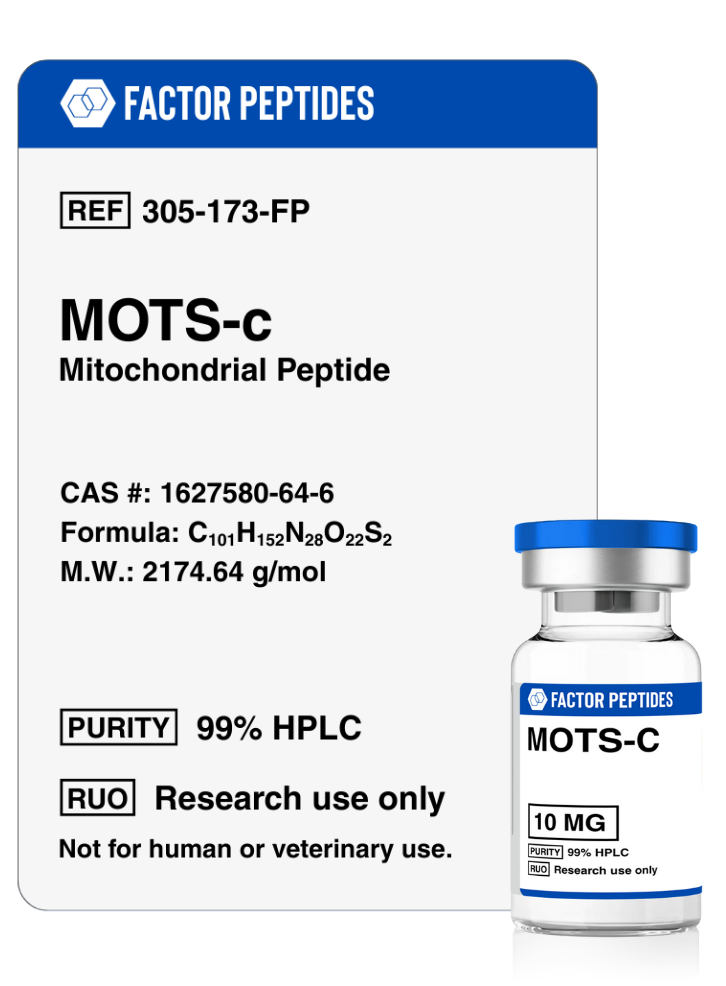
MOTS-C
MOTS-c is a 16-amino acid peptide originating from the mitochondria, classified as a mitochondrial-derived peptide (MDP). It plays a vital role in regulating cellular metabolism, especially in response to metabolic stress. MOTS-c influences glucose utilization, enhances insulin sensitivity, and supports cellular stress responses by interacting with key metabolic pathways. It enters the cell nucleus to help regulate gene expression linked to mitochondrial function and energy regulation. Studies suggest MOTS-c can enhance physical performance, reduce fat accumulation, improve insulin resistance, and offer protective effects against conditions like osteoporosis, metabolic disorders, and age-related diseases.
Price range: $80.00 through $165.00
Cellular Age Support Peptides
Cellular Growth Research Peptides
Metabolic Activation Peptides
Metabolic Research Peptides
Popular Peptides
Reproductive System Research Peptides
Tissue Integrity Research Peptides
Uncategorized
- DESCRIPTION
- STORAGE
MOTS-c Background
MOTS-c is a small peptide that comes from genetic instructions found inside mitochondria, the cell’s energy-producing structures. It belongs to a group of signaling molecules known as mitochondrial-derived peptides, which are now recognized as active hormones involved in how cells manage energy and respond to stress.
Although this family of peptides was first associated mainly with local mitochondrial activity, newer findings show that many of them also act in the cell nucleus and can circulate throughout the body. MOTS-c is one of these circulating peptides. It has been linked in research settings to influences on metabolism, body weight balance, physical performance, healthy aging, and conditions related to bone strength.
Because MOTS-c has been detected both inside cells and in the bloodstream, it is considered a naturally occurring hormone-like messenger. Its broad impact on energy handling and cellular resilience has led to a surge of scientific interest, with intensive investigations over recent years into its possible therapeutic applications.
MOTS-c Structure
Sequence: Met-Arg-Trp-Gln-Glu-Met-Gly-Tyr-Ile-Phe-Tyr-Pro-Arg-Lys-Leu-Arg
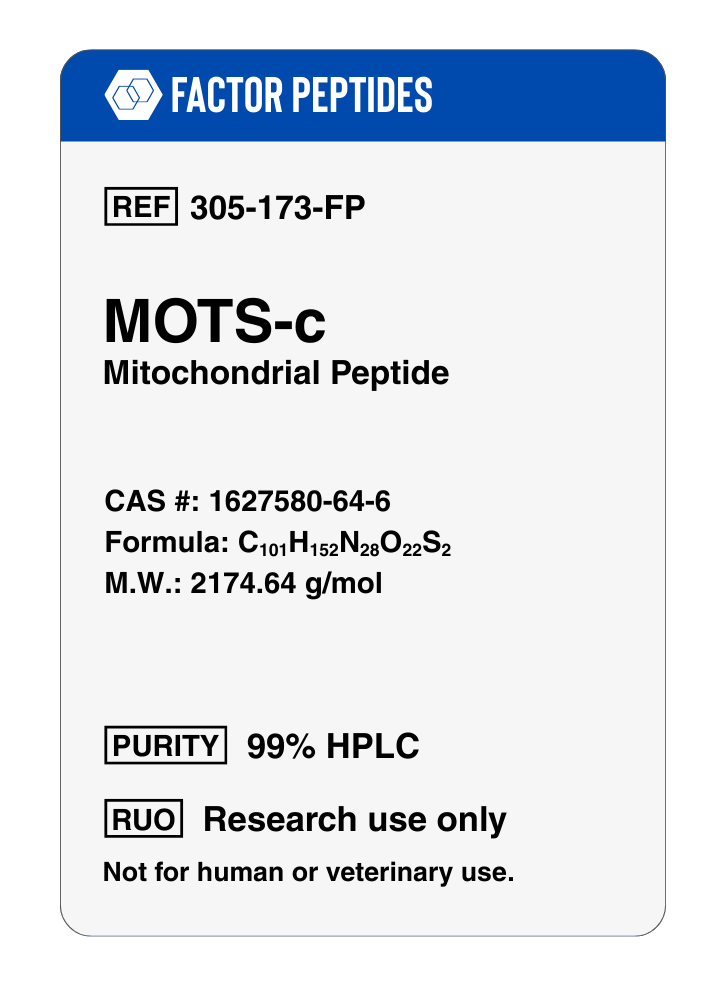
Molecular Formula: C101H152N28O22S2
Molecular Weight: 2174.64 g/mol
PubChem SID: 255386757
CAS Number: 1627580-64-6
Synonyms: Mitochondrial open reading frame of the 12S rRNA-c, MT-RNR1
MOTS-c Research Overview
Muscle Energy Use and Glucose Handling
Experimental work in rodents suggests that MOTS-c can improve how aging muscle tissue responds to glucose. In these studies, older animals given MOTS-c showed better uptake of sugar into skeletal muscle, even when normal insulin signaling was impaired. This effect appears to be linked to enhanced activation of cellular energy–sensing pathways and increased production of glucose transporters in muscle cells. As a result, muscles function more efficiently, grow and recover more easily, and display fewer signs of insulin resistance in these models.
Influence on Fat Metabolism and Adipose Tissue
Changes in hormone balance, such as lower estrogen levels, can promote excess fat storage and disturb the normal function of adipose tissue. In animal research, MOTS-c administration has been associated with improved activity in brown adipose tissue, reduced fat accumulation, and less inflammation in white fat. These changes may help protect against the sequence of events that often leads from adipose dysfunction to insulin resistance and, eventually, disturbances in blood sugar control.
Part of this effect is thought to arise from MOTS-c acting on the cell’s energy sensor pathways. When energy is low, these pathways encourage cells to draw in and burn both glucose and fatty acids. MOTS-c has been shown to interact with the methionine–folate cycle, elevate levels of certain intermediate molecules, and activate these energy-regulating signals. Newer findings indicate that MOTS-c can move from mitochondria to the cell nucleus, where it influences the activity of genes involved in responses to metabolic stress and antioxidant defense.
In obesity models, MOTS-c appears to reshape patterns of lipid handling, including pathways related to complex fats and intermediate metabolites. By dialing down these routes and enhancing fat oxidation, the peptide seems to reduce fat build-up in tissues. This has led to a broader hypothesis: when mitochondrial fat oxidation falters, circulating lipids rise, insulin levels climb to compensate, and the body gradually adapts to a state of chronically high insulin and increased fat storage. MOTS-c is being explored as a tool to better understand and potentially intervene in this process.
Insulin Sensitivity and Early Metabolic Changes
Studies measuring MOTS-c in people with different metabolic profiles suggest a link between circulating levels of this peptide and insulin sensitivity, particularly in lean individuals. The association appears to weaken once full insulin resistance has taken hold. This pattern has led researchers to propose that MOTS-c may be more relevant to the early stages of metabolic imbalance than to the maintenance of long-standing insulin resistance.
There is interest in the idea that shifts in MOTS-c levels could eventually serve as a signal of emerging metabolic stress, especially in individuals who do not yet show obvious signs of diabetes. In animal models, supplemental MOTS-c has shown promise in supporting insulin sensitivity, but more work is needed to define its role in human metabolism.
Bone Health and Osteoporosis
Bone-forming cells, known as osteoblasts, appear to be another important target of MOTS-c. Cell culture studies indicate that this peptide can activate signaling routes that protect osteoblasts from stress and support their survival. In doing so, MOTS-c helps maintain the production of type I collagen, a key structural protein needed for strong, resilient bone.
MOTS-c has also been shown to promote the maturation of bone marrow stem cells into osteoblasts through the same signaling pathways. This dual role in both preserving existing bone-forming cells and encouraging their development from precursors suggests a potential influence on overall bone density and the body’s ability to repair or regenerate bone tissue.
Longevity and Genetic Variants
Genetic studies have identified a specific variation in the MOTS-c sequence that appears more frequently in certain long-lived human populations of Northeast Asian origin. This variant involves a single amino acid substitution at a particular position in the peptide chain. Because the substituted amino acids have very different chemical properties, the change is likely to affect how MOTS-c is shaped and how it functions.
Although the exact consequences of this variant remain unclear, its association with groups known for longer average lifespan has attracted attention. It supports a growing view that mitochondrial signaling, including peptides like MOTS-c, may be an important factor in both lifespan and healthspan, complementing lifestyle factors such as diet and physical activity.
Cardiovascular Function
Research in humans undergoing evaluation for coronary artery problems has found that lower blood levels of MOTS-c are linked with poorer function of the cells lining blood vessels. These endothelial cells help regulate blood flow, clotting, and the formation of arterial plaque. Animal studies add to this picture, showing that MOTS-c can make these cells more responsive to normal signaling molecules that promote vessel relaxation and healthy circulation.
MOTS-c is one of several mitochondrial-derived peptides being investigated for their potential protective role in the heart and blood vessels. Disturbances in this peptide network may contribute to cardiovascular stress, inflammation, and injury, while adequate signaling could help buffer tissues against damage, particularly during episodes of reduced blood flow and subsequent reperfusion.
Experimental Status and Safety in Research
In rodent models, MOTS-c has generally shown favorable tolerance, with limited observable adverse effects and good uptake when administered by injection under the skin. Oral absorption, by contrast, appears to be low in these studies. It is important to emphasize that the amounts and conditions used in laboratory animals cannot be directly translated to safe or appropriate doses in humans.
MOTS-c remains an experimental research compound. Its long-term safety, effectiveness, and appropriate use in people have not been established, and it is not approved as a medicinal product. Any work with MOTS-c should be carried out within controlled research settings and in accordance with relevant scientific and regulatory standards.
Factor Peptides Storage Guidelines:
These peptides arrive in a dried, stabilized form produced by a process called lyophilization, or freeze drying. In this state, they are generally suitable for transport and short-term storage at typical room temperatures for several months.
Once the dry powder is mixed with bacteriostatic water and turned into a liquid solution, the storage requirements change. The reconstituted solution should be kept in a refrigerator to help maintain its properties, and is usually considered suitable for use for about 30 days under chilled conditions.
Lyophilization involves freezing the material and then exposing it to low pressure so that ice in the sample passes directly from solid to vapor, rather than melting. This leaves behind a light, porous, white solid that is more stable than the original liquid. In this form, the product can often be kept at room temperature until it is time to add diluent.
After delivery, it is good practice to protect the vials from heat and strong light. If the product will be used in the near future, storing the lyophilized powder or reconstituted solution in a refrigerator at temperatures below about 4°C (39°F) is typically appropriate. The dry form often remains intact at room temperature for a number of weeks, so this may also be acceptable when immediate refrigeration is not available and the intended use is relatively soon.
For storage over longer periods, such as many months or years, much colder conditions are preferred. Placing the vials in a deep freezer, around -80°C (-112°F), is commonly used to help preserve the structure and activity of peptides for extended time frames.