
r

Product Usage: This product is intended solely for use as a research chemical. It is designated exclusively for in vitro research and laboratory testing. All information provided on this site is for educational purposes only. It is strictly prohibited to administer this product to humans or animals. Only licensed and qualified professionals should handle it. This product is not classified as a drug, food, or cosmetic and must not be misrepresented or used as such. This product is for research use only. Not for human consumption.

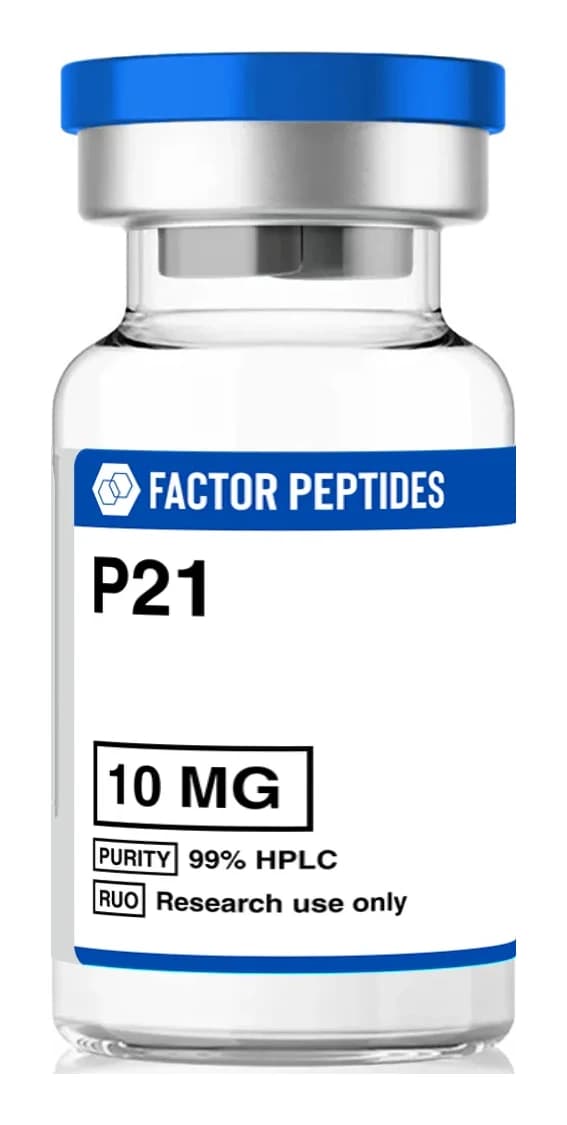
P21 10 mg

P21 is a peptide studied for its potential to support brain health and cognitive performance by encouraging the growth of new nerve cells. In experimental models, it has been found to increase levels of brain-derived neurotrophic factor (BDNF), a protein associated with the development and survival of neurons, while also helping to limit the buildup of amyloid deposits and tau-related changes that are characteristic of certain degenerative brain conditions. Because BDNF is connected to both enhanced neurogenesis and the regulation of enzymes involved in these harmful protein accumulations, the boost in BDNF seen with P21 may help protect brain structure and function. Research in animals has reported improvements in learning and memory when this peptide is used.

$145.00

  • DESCRIPTION
  • STORAGE

What Is P21?

P21 is a laboratory-designed peptide based on a small, active region of ciliary neurotrophic factor (CNTF), a natural protein that supports the growth and survival of nerve cells. CNTF has been studied mainly in the nervous system, but its receptors are also present in other tissues such as bone. It helps drive the production of neurotransmitters, encourages the growth of nerve extensions, and shields neurons and supporting cells from inflammatory damage. Beyond these nerve-supporting actions, CNTF also increases feelings of fullness and can reduce overall food intake.

P21 is distinct from cerebrolysin, and CNTF itself is also different from cerebrolysin. These compounds are often discussed together because they influence similar pathways, but they are not interchangeable and have different compositions and properties.

A modified form of CNTF was once developed as a drug candidate for neurodegenerative conditions, but the body quickly produced antibodies against it. This tendency to trigger immune responses has led to interest in using smaller mimetic peptides like P21, which may allow CNTF activity to be supported while limiting antibody formation.

P21 Peptide Structure

Sequence: DGGL-adamantane-G
Molecular Formula: C30H54N6O5
Molecular Weight: 578.3 g/mol
Synonyms: P021, Peptide 021

P21 Research

How Was P21 Developed?

P21 was created as a compact derivative of CNTF designed to reproduce key biological effects without the drawbacks of the full-size protein. Researchers used an approach called epitope mapping, which relies on antibodies to locate the most important binding regions on a target molecule. By identifying which small synthetic fragments could compete with CNTF for receptor-related antibody binding, they narrowed down the sequence to a four–amino acid core taken from the most active portion of CNTF. This core was then extended with an adamantane-containing glycine at one end to improve stability, protect against enzymatic breakdown, and enhance crossing of the blood–brain barrier and other biological barriers.

Full-length CNTF is too large and fragile for convenient systemic use. It does not readily enter the brain, has poor stability in circulation, and tends to provoke the formation of antibodies when given repeatedly. Direct delivery into the fluid surrounding the brain is possible, but invasive and associated with discomfort and risk. In contrast, P21 shows high stability in simulated stomach conditions, remains intact long enough in the intestine to be absorbed, and persists in blood plasma for several hours. These features make it a much more practical tool for experimental work aimed at enhancing neurotrophic signaling.

How Does P21 Work?

P21 acts mainly within the dentate gyrus, a region of the hippocampus that plays a central role in forming new memories, exploring new situations, and telling similar experiences apart. This area is one of the few parts of the adult brain where new neurons are continuously generated. P21 increases both the birth and maturation of new neurons in this region, particularly in the granular cell layer and subgranular zone, thereby strengthening the brain’s capacity for learning and memory.

Animal studies indicate that P21 does not directly activate the classic CNTF receptor in the way the full protein does. Instead, it seems to interfere with molecules such as antibodies that would normally neutralize CNTF, indirectly raising the effective levels and actions of the natural factor. In this sense, P21 does not simply copy CNTF, but instead preserves and amplifies the body’s own neurotrophic signaling, which in turn promotes neurogenesis.

In experimental models, treatment with P21 increases the number of actively dividing cells in the dentate gyrus, as shown by higher levels of proliferation markers. When markers of mature neurons are examined, they are also elevated in the same region, indicating that many of the dividing cells are differentiating into fully functional neurons. This supports the conclusion that P21 drives true neurogenesis rather than just general cell growth.

Another key aspect of P21’s activity involves the LIF–STAT pathway. Leukemia inhibitory factor (LIF) is a signaling molecule that, among other roles, limits cell proliferation and encourages differentiation at critical stages of development. By dampening LIF-related signaling, P21 removes a natural brake on the production of new neurons and shifts the local environment toward a more growth-permissive, development-like state in which neurogenesis is favored.

In models of Alzheimer’s disease, the brain responds to neuron and synapse loss by increasing activity in the dentate gyrus, but this compensatory response often fails in older brains because neurogenesis is impaired. P21 supports this natural attempt at repair by enhancing neurotrophic signaling and tipping the balance toward the generation of new neurons. Studies show that P21 increases levels of brain-derived neurotrophic factor (BDNF) and neurotrophin-4 while reducing the proliferative influence of fibroblast growth factor 2. When P21 is given before severe pathology develops in animal models, it can prevent the decline in learning and memory that would normally occur, suggesting strong potential as a preventive or early-intervention approach.

BDNF is not only linked to increased neurogenesis but also to reduced activity of enzymes that drive the formation of amyloid plaques and abnormal tau in Alzheimer-type pathology. By increasing BDNF, P21 indirectly diminishes the activity of a kinase involved in forming amyloid beta and phosphorylated tau, which are associated with inflammation and progressive neurodegeneration.

The kinase targeted through this pathway has been implicated in a variety of conditions, including metabolic disorders, several forms of cancer, and mood-related illnesses. Because P21 can reduce its activity, there is interest in exploring whether P21-like compounds might eventually be useful in areas such as stroke recovery, oncology, or mood stabilization, although this remains hypothetical at present.

P21 also helps restore the expression of structural and synaptic proteins that are reduced in disease models. These include MAP2, which reflects dendritic growth, as well as synapsin I, GluR1, and NR1, all of which are key to efficient synaptic communication and plasticity. Interestingly, P21 can raise the levels of these markers beyond normal values in both diseased and healthy brains, indicating a strong drive toward synapse formation and circuit strengthening.

Because P21 can increase neurogenesis and synaptogenesis to above-normal levels even in healthy animals, researchers suspect it may have nootropic potential, enhancing learning and memory in the absence of disease. In animal tests, P21 improves performance in tasks involving object recognition and spatial navigation, supporting its role as both a restorative and a performance-enhancing agent for cognitive function.

What Does P21 Do?

In broad terms, P21 enhances cognitive performance and helps protect the central nervous system from damage. It supports the transformation of precursor cells into mature neurons and strengthens the network of connections between neurons, processes that are fundamental to learning, memory consolidation, and adaptive brain function.

More specifically, research in rodent models shows that P21 improves object discrimination, spatial reasoning, and other measures of learning and memory. These behavioral benefits are accompanied by increases in BDNF, neurotrophin-4, synapsin I, GluR1, and NR1, all of which are associated with neurogenesis and synapse formation. Because these changes occur in both disease models and healthy animals, P21 is viewed as a candidate for boosting cognitive capacity in general, not only for repairing damage.

Food Intake

Although P21 has not been directly evaluated in controlled studies of appetite, there are plausible reasons to suspect that it could influence satiety. By reducing factors that neutralize CNTF, P21 effectively strengthens CNTF signaling and downstream pathways that increase alpha-melanocyte-stimulating hormone. Both enhanced neurogenesis and higher levels of this hormone have been associated with reduced food intake in experimental systems, so it would not be surprising if future work finds that P21 contributes to appetite suppression or weight regulation.

Does P21 Have Adverse Effects?

In rodent models of Alzheimer’s disease, P21 and the related peptide P22 have not produced obvious toxic effects at the doses tested. This does not guarantee safety in humans, but it suggests a favorable early profile. One consistent observation is a reduction in anxiety-like behavior in P21-treated animals compared with controls, which is generally viewed as a positive side effect rather than a harmful one.

Many compounds that promote neurogenesis can cause fatigue or other systemic symptoms in some settings. While such effects have not been clearly documented for P21, mild tiredness or related symptoms could still emerge under certain conditions and would need to be assessed in future studies.

What Is Cerebrolysin?

Cerebrolysin and P21 are often mentioned together but are quite different. P21 is a single, well-defined peptide with targeted effects on specific pathways, while cerebrolysin is a mixture of many peptides with a broad range of actions, including support for neurogenesis. In comparative animal studies, P21 has generally shown stronger and more consistent effects than cerebrolysin.

How Does Cerebrolysin Work?

Cerebrolysin appears to act on the same hippocampal regions where P21 has its strongest influence, particularly the dentate gyrus. In animal models of Alzheimer’s disease, cerebrolysin improves synaptic plasticity and performance on memory tasks and seems to protect neural progenitor cells from toxic insults such as amyloid buildup. By helping these precursor cells survive and mature, cerebrolysin may increase overall neurogenesis.

Analyses suggest that one component of cerebrolysin is able to neutralize antibodies against CNTF, similar to how P21 supports CNTF activity. Researchers have isolated a short peptide sequence within cerebrolysin that can be trimmed down to a four–amino acid core, which enhances hippocampal learning and memory through neurogenesis. This core corresponds to the main active sequence in P21. The adamantane-containing tail added to P21 is not the primary signal component but serves to stabilize the peptide and improve its ability to cross into the brain. In this way, cerebrolysin contains a natural precursor of P21, while P21 itself represents a refined, synthetic version of that active fragment.

Clarifying Cerebrolysin Versus P21

Although P21 is sometimes loosely described as a derivative of cerebrolysin, a more accurate description is that it is a synthetic analogue of a small portion of CNTF, which is only one element of the broader cerebrolysin mixture. P21 consists of four amino acids from CNTF plus an adamantane moiety, and it does not naturally occur within cerebrolysin. Rather, cerebrolysin contains fragments that inspired the design and isolation of P21.

In animal work, P21 has outperformed cerebrolysin in several measures of neuroprotection and cognitive support. Cerebrolysin’s usefulness appears limited by its tendency to stimulate the formation of antibodies against CNTF, which can eventually reduce native CNTF activity and worsen long-term outcomes. This immunogenicity is likely related to its origin as a purified animal-derived product, which also raises concerns about potential contamination. P21, being fully synthetic and smaller, has not shown the same antigenic behavior in current models and has not demonstrated a loss of effectiveness with continued administration.

Cerebrolysin was once considered a leading candidate for promoting neurogenesis and protecting brain function, probably because it contains fragments similar to those that form the basis of P21. However, the development of autoantibodies against CNTF over time, combined with practical concerns about using animal-derived mixtures, has shifted attention toward cleaner, more targeted molecules like P21 that can modulate neurotrophic pathways without the same risks.

Summary

P21 is a nootropic peptide that attracts interest primarily for its ability to enhance neurogenesis and synaptic connectivity in both healthy and diseased brains. So far, it has been studied mainly in rodent models, where it has shown robust benefits. The peptide includes an adamantane component that improves stability and brain penetration, and it supports neurotrophic signaling pathways that increase BDNF, promote neuron growth, and reduce key features of Alzheimer-type pathology such as plaques and abnormal tau tangles. It may also have effects on appetite and body weight, but this has not yet been directly explored.

In preclinical work, P21 has shown minimal side effects and favorable absorption when delivered by certain routes in animals. Doses used in these studies cannot be directly translated to humans, and at present P21 is intended only for controlled scientific and educational research. It is not approved for human use or consumption.

Factor Peptides Storage Guidelines:

These peptides arrive in a dried, stabilized form produced by a process called lyophilization, or freeze drying. In this state, they are generally suitable for transport and short-term storage at typical room temperatures for several months.

Once the dry powder is mixed with bacteriostatic water and turned into a liquid solution, the storage requirements change. The reconstituted solution should be kept in a refrigerator to help maintain its properties, and is usually considered suitable for use for about 30 days under chilled conditions.

Lyophilization involves freezing the material and then exposing it to low pressure so that ice in the sample passes directly from solid to vapor, rather than melting. This leaves behind a light, porous, white solid that is more stable than the original liquid. In this form, the product can often be kept at room temperature until it is time to add diluent.

After delivery, it is good practice to protect the vials from heat and strong light. If the product will be used in the near future, storing the lyophilized powder or reconstituted solution in a refrigerator at temperatures below about 4°C (39°F) is typically appropriate. The dry form often remains intact at room temperature for a number of weeks, so this may also be acceptable when immediate refrigeration is not available and the intended use is relatively soon.

For storage over longer periods, such as many months or years, much colder conditions are preferred. Placing the vials in a deep freezer, around -80°C (-112°F), is commonly used to help preserve the structure and activity of peptides for extended time frames.

Factor Peptides Logo

You must be 21 years of age or older to enter this site.

By accessing this website, you agree to our Terms and Conditions.

All products offered by Factor Peptides are intended strictly for research and laboratory use only. Accessories such as bacteriostatic water, syringes, or related equipment are not included. Most compounds are provided in lyophilized (powdered) form and must be properly reconstituted with an appropriate diluent before use in research settings.