
r

Product Usage: This product is intended solely for use as a research chemical. It is designated exclusively for in vitro research and laboratory testing. All information provided on this site is for educational purposes only. It is strictly prohibited to administer this product to humans or animals. Only licensed and qualified professionals should handle it. This product is not classified as a drug, food, or cosmetic and must not be misrepresented or used as such. This product is for research use only. Not for human consumption.

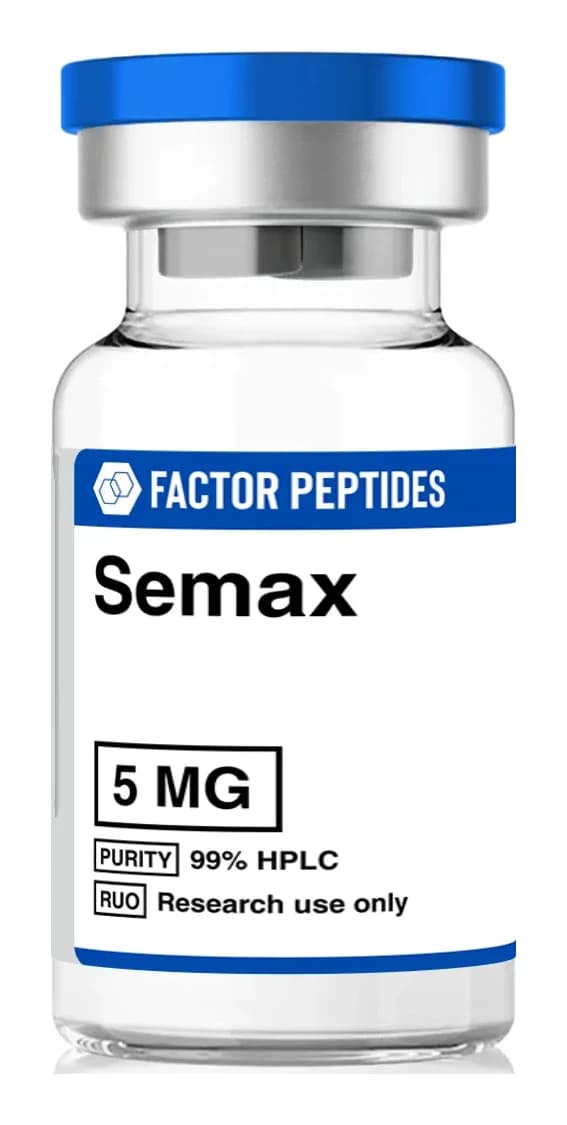
Semax

Semax is a lab-designed fragment based on a portion of adrenocorticotropic hormone and has been explored in research for its influence on brain and body function. Experimental work suggests it can raise levels of brain-derived neurotrophic factor (BDNF) and may support immune activity, help shield nerve cells, and contribute to healthy heart and circulation function, with additional studies looking at its possible roles in pain regulation and blood clotting processes.

Price range: $40.00 through $65.00

  • DESCRIPTION
  • STORAGE

Semax Overview

Semax is a peptide drug originally developed in Russia and has been studied in conditions such as stroke, cognitive decline, dementia, and inflammation of the optic nerve. Experiments also suggest that it may support immune function and display both antidepressant and anti-anxiety effects. Findings indicate that Semax can raise levels of brain-derived neurotrophic factor (BDNF) in the central nervous system, as well as increase key neurotransmitters like serotonin and dopamine.

Semax Structure

Sequence: Met-Glu-His-Phe-Pro-Gly-Pro
Molecular Formula: C37H51N9O10S
Molecular Weight: 813.92 g/mol
CAS Number: 80714-61-0
Synonyms: Pro-Gly-Pro-ACTH

What Is Semax?

Semax is a synthetic fragment of adrenocorticotropic hormone (ACTH), consisting of amino acids 4 through 10 of the original hormone sequence, designed to retain specific neuroactive properties while minimizing hormonal effects.

Semax Research

Semax and Resting Brain Activity

Brain imaging studies show that Semax enhances activity in the brain’s default mode network, a collection of regions that are more active during resting states than during focused tasks. This network is thought to participate in social awareness, self-referential thinking, and ongoing monitoring of the environment. By increasing activity within this system, Semax appears to heighten baseline alertness and responsiveness, making it easier for the brain to shift from rest to focused attention, especially in social contexts.

Greater activation of the default mode network is often associated with stronger connectivity between different brain areas. Higher interconnectivity has been linked to better memory, flexible thinking, and problem-solving. While direct confirmation is still needed, Semax may support more efficient communication across neural networks, potentially improving overall cognitive functioning.

Semax in Stroke and Brain Injury

In some countries, Semax is used as part of the treatment strategy for acute cerebral oxygen deprivation, including stroke and traumatic brain injury. Animal research indicates that Semax influences multiple molecular pathways involved in gene expression within the central nervous system. It alters the activity of numerous genes related to blood vessel dynamics, such as those involved in smooth muscle movement, blood cell production, and new vessel growth, which may explain its protective effects in ischemic conditions.

Clinical observations from rehabilitation programs after stroke suggest that Semax can accelerate recovery of lost functions and improve overall neurological outcomes. In these contexts, Semax appears to support neuronal survival, stabilize mitochondrial energy production, and enhance blood supply and nutrient delivery to damaged brain areas. Its ability to increase BDNF may also promote neuroplasticity, helping intact regions of the brain take over tasks previously handled by injured tissue.

Semax and Gene Expression in the Brain

The gene-modulating actions of Semax are not limited to injury states. In studies on healthy animals, a single intranasal dose of Semax altered the expression of multiple genes in the hippocampus and frontal cortex within minutes. These areas are crucial for memory formation, learning, concentration, planning, and organization of information. Among the most strongly affected genes are those related to nerve growth factor (NGF) and brain-derived neurotrophic factor (BDNF), both of which support neuron survival and synaptic adaptability.

Because Semax can rapidly influence gene expression in brain regions central to executive function and learning, researchers view it as a useful tool for exploring how the brain encodes information and adapts to new demands. There is ongoing interest in whether this peptide could help refine strategies for enhancing cognitive performance or stabilizing function in neurological disorders.

Semax and Cognitive Performance

Experimental and clinical data indicate that Semax may help preserve or improve learning and memory, especially when these functions are impaired by neurological disease. Related work with ACTH, the parent hormone from which Semax is derived, has shown that ACTH helps maintain cognitive abilities in animal models of epilepsy and has long been used to address developmental and seizure-related issues.

Because Semax is a tailored fragment of ACTH, it may offer many of the same protective benefits with a more focused profile. Research suggests that ACTH-based peptides can prevent learning and memory deficits when seizures or other insults occur, raising the possibility that Semax may have nootropic properties. This has led to speculation that controlled, low-dose use in appropriate models could not only counter existing deficits but also enhance cognitive performance under certain conditions.

Semax and Depression

Studies in animal models of depression have linked higher BDNF levels to improved mood regulation and more resilient brain function. Traditional antidepressants such as selective serotonin reuptake inhibitors (SSRIs) change serotonin signaling almost immediately, yet their clinical benefits often take weeks to appear. One explanation is that their true therapeutic impact depends on gradual increases in BDNF and the resulting boost in neurogenesis and synaptic remodeling.

By directly stimulating BDNF production and related pathways, Semax offers a different angle on mood regulation. Early findings suggest that combining BDNF-enhancing peptides with conventional antidepressants could potentially shorten response times and improve overall effectiveness, although much more work is needed to confirm this in human studies. This line of research supports a broader view of depression as a disorder of neuroplasticity, not just neurotransmitter imbalance.

Semax has shown minimal side effects and low oral but strong subcutaneous bioavailability in animal models. Doses used in these studies cannot be directly converted to human dosing. At present, Semax is supplied for laboratory and educational research only and is not intended for human consumption.

Factor Peptides Storage Guidelines:

These peptides arrive in a dried, stabilized form produced by a process called lyophilization, or freeze drying. In this state, they are generally suitable for transport and short-term storage at typical room temperatures for several months.

Once the dry powder is mixed with bacteriostatic water and turned into a liquid solution, the storage requirements change. The reconstituted solution should be kept in a refrigerator to help maintain its properties, and is usually considered suitable for use for about 30 days under chilled conditions.

Lyophilization involves freezing the material and then exposing it to low pressure so that ice in the sample passes directly from solid to vapor, rather than melting. This leaves behind a light, porous, white solid that is more stable than the original liquid. In this form, the product can often be kept at room temperature until it is time to add diluent.

After delivery, it is good practice to protect the vials from heat and strong light. If the product will be used in the near future, storing the lyophilized powder or reconstituted solution in a refrigerator at temperatures below about 4°C (39°F) is typically appropriate. The dry form often remains intact at room temperature for a number of weeks, so this may also be acceptable when immediate refrigeration is not available and the intended use is relatively soon.

For storage over longer periods, such as many months or years, much colder conditions are preferred. Placing the vials in a deep freezer, around -80°C (-112°F), is commonly used to help preserve the structure and activity of peptides for extended time frames.

Factor Peptides Logo

You must be 21 years of age or older to enter this site.

By accessing this website, you agree to our Terms and Conditions.

All products offered by Factor Peptides are intended strictly for research and laboratory use only. Accessories such as bacteriostatic water, syringes, or related equipment are not included. Most compounds are provided in lyophilized (powdered) form and must be properly reconstituted with an appropriate diluent before use in research settings.