
Product Usage: This product is intended solely for use as a research chemical. It is designated exclusively for in vitro research and laboratory testing. All information provided on this site is for educational purposes only. It is strictly prohibited to administer this product to humans or animals. Only licensed and qualified professionals should handle it. This product is not classified as a drug, food, or cosmetic and must not be misrepresented or used as such. This product is for research use only. Not for human consumption.
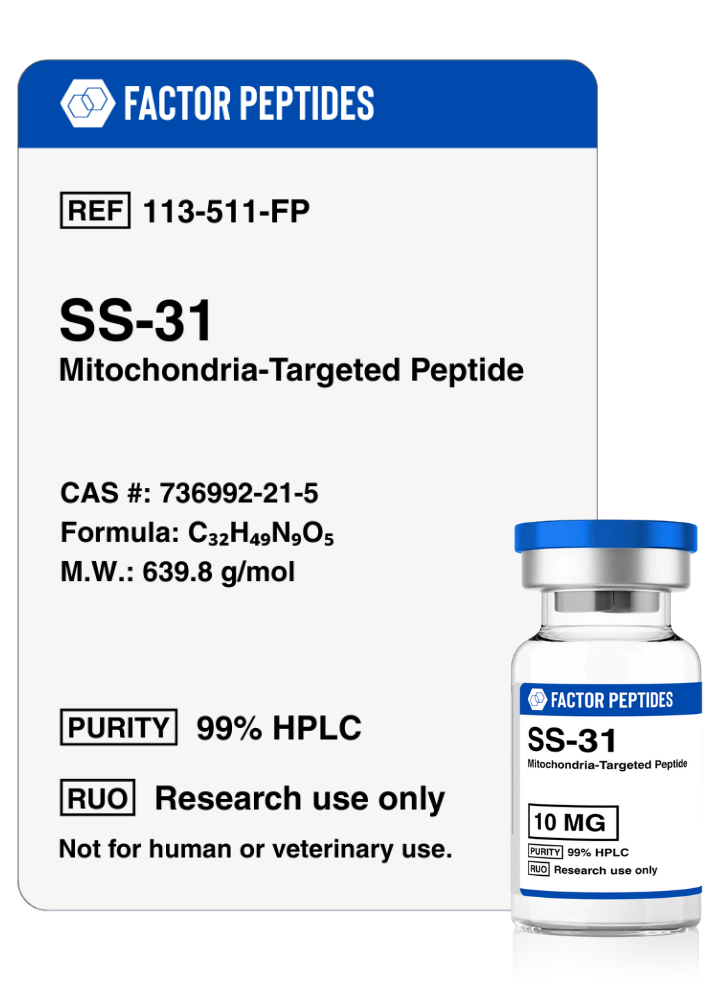
SS-31
SS-31 is a peptide designed to act directly within mitochondria, where it helps support the machinery that produces ATP, the main energy source for cells. By promoting more stable mitochondrial function, it contributes to better energy output and overall cellular resilience. Research suggests that SS-31 can lower the levels of inflammatory signaling molecules, which may ease oxidative stress and inflammation-related damage. Because of these effects, it is being studied in connection with conditions such as degenerative brain disorders, heart and blood vessel problems, metabolic issues like diabetes, kidney dysfunction, and a range of other long-term inflammatory diseases.
Price range: $95.00 through $265.00
All Products
- DESCRIPTION
- STORAGE
What Is SS-31?
SS-31, also known as elamipretide, is a small aromatic tetrapeptide that can penetrate both cell membranes and mitochondrial membranes. In laboratory models it associates with cardiolipin in the inner mitochondrial membrane, helping to stabilize this phospholipid, support electron transport chain function, and sustain ATP production. By reducing excessive reactive oxygen species and supporting mitochondrial energy balance, SS-31 is being explored as a research tool in conditions characterized by impaired mitochondrial activity and disordered cellular energetics, including various mitochondrial myopathies.
SS-31 Peptide Structure
Sequence: D-Arg-Tyr(2,6-diMe)-Lys-Phe
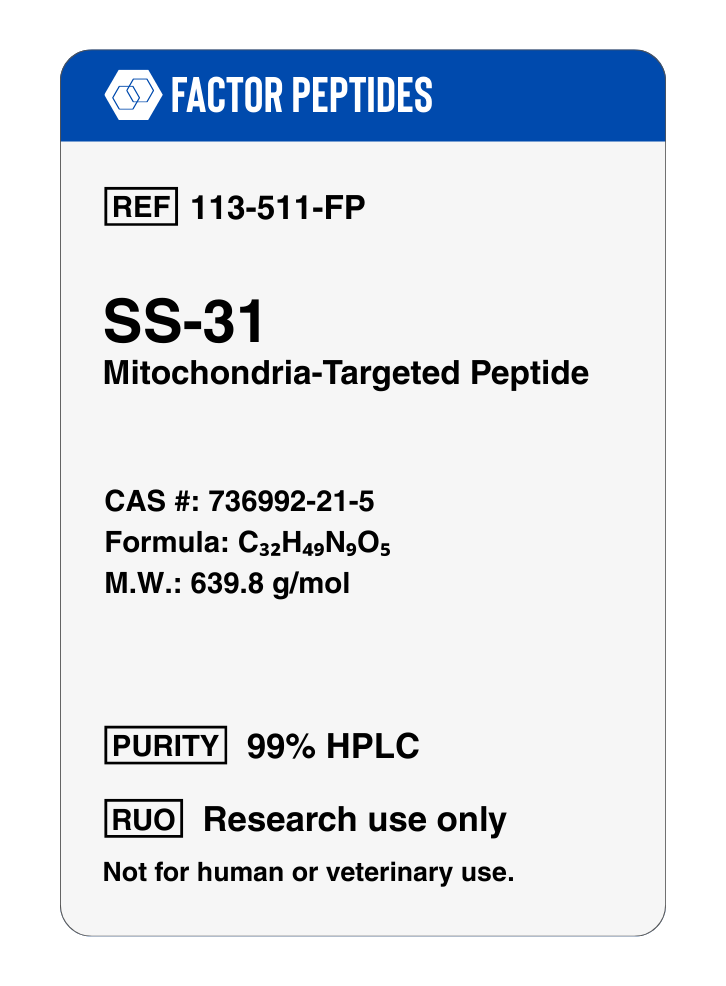
Molecular Formula: C32H49N9O5
Molecular Weight: 639.8 g/mol
PubChem CID: 11764719
CAS Number: 736992-21-5
Synonyms: elamipretide, MTP-131, Bendavia
SS-31 Research
Mitochondrial Function
SS-31 has been widely examined for its ability to support mitochondrial structure and bioenergetics. In animal models of primary mitochondrial defects and ischemia–reperfusion injury, the peptide has been observed to preserve inner mitochondrial membrane integrity, speed the recovery of ATP synthesis, and lessen cell loss in energy-demanding organs such as skeletal muscle and kidney. These effects are attributed in part to SS-31 binding cardiolipin, thereby stabilizing electron transport and improving overall respiratory chain efficiency.
Early clinical investigations in people with mitochondrial disorders have reported short-term gains in exercise capacity and a generally acceptable safety profile. Although larger trials have not consistently met all primary outcomes, the data generated so far have established SS-31 as a valuable probe for testing therapeutic strategies that target mitochondrial energy production.
Ischemia and Heart Function
In experimental models of myocardial infarction and chronic heart failure, SS-31 has been linked to enhanced mitochondrial respiration and improved ATP generation in cardiac tissue. Reported findings include reductions in cardiomyocyte apoptosis after ischemic episodes, better left ventricular performance and hemodynamic parameters, and attenuation of adverse remodeling and fibrosis in the heart.
In acute ischemia settings, administration of SS-31 has been associated with lower levels of biochemical markers of heart muscle injury, suggesting that the peptide may help protect cardiomyocytes by stabilizing mitochondrial function during and after reduced blood flow.
Diabetes and Metabolic Stress
SS-31 has also been evaluated under conditions of metabolic stress, particularly in studies of type 2 diabetes. Research in human tissues and animal models indicates that the peptide can lower mitochondrial reactive oxygen species, which are thought to contribute to microvascular damage and other complications of diabetes. These changes are accompanied by shifts in molecular markers such as SIRT1, a regulator linked to improved insulin signaling, enhanced mitochondrial biogenesis, and dampened inflammatory responses in metabolic organs.
Inflammation and Oxidative Stress
A common theme across SS-31 studies is the modulation of inflammatory and oxidative pathways. In cell culture and animal experiments, SS-31 has been observed to decrease expression of the mitochondrial fission protein FIS1, reduce activation of pro-inflammatory and pro-oxidant mediators such as CD36 and NADPH oxidase, and limit signaling through NF-κB pathways that are associated with chronic inflammation.
By helping mitochondria remain in an ATP-generating, low–ROS state rather than shifting toward a fragmented, highly oxidative phenotype, SS-31 provides a platform for examining how mitochondrial stabilization can influence inflammasome activity and downstream inflammatory cascades in diverse disease models.
Summary
Overall, SS-31 serves as a versatile research compound for probing mitochondrial bioenergetics, oxidative damage, and inflammation in models of mitochondrial disease, cardiovascular injury, metabolic disorders, and neurodegeneration. Ongoing investigations continue to define where the peptide offers the greatest experimental value, while reinforcing the importance of cardiolipin integrity and mitochondrial health in many pathological processes.
Research Use Only
SS-31 is an investigational peptide that is not approved for human or veterinary therapy and is supplied exclusively for controlled laboratory, in vitro, and in vivo animal studies performed by qualified personnel.
Factor Peptides Storage Guidelines:
These peptides arrive in a dried, stabilized form produced by a process called lyophilization, or freeze drying. In this state, they are generally suitable for transport and short-term storage at typical room temperatures for several months.
Once the dry powder is mixed with bacteriostatic water and turned into a liquid solution, the storage requirements change. The reconstituted solution should be kept in a refrigerator to help maintain its properties, and is usually considered suitable for use for about 30 days under chilled conditions.
Lyophilization involves freezing the material and then exposing it to low pressure so that ice in the sample passes directly from solid to vapor, rather than melting. This leaves behind a light, porous, white solid that is more stable than the original liquid. In this form, the product can often be kept at room temperature until it is time to add diluent.
After delivery, it is good practice to protect the vials from heat and strong light. If the product will be used in the near future, storing the lyophilized powder or reconstituted solution in a refrigerator at temperatures below about 4°C (39°F) is typically appropriate. The dry form often remains intact at room temperature for a number of weeks, so this may also be acceptable when immediate refrigeration is not available and the intended use is relatively soon.
For storage over longer periods, such as many months or years, much colder conditions are preferred. Placing the vials in a deep freezer, around -80°C (-112°F), is commonly used to help preserve the structure and activity of peptides for extended time frames.